A strategic guide to mastering and understanding the exam & percentile.
The CAT (Common Admission Test) is a competitive entrance exam in India used mainly for admission to MBA programs, especially at the IIMs and many other top business schools.
B-schools are testing your ability to read dense material, reason with incomplete information, and solve problems efficiently — not your MBA knowledge or advanced engineering math.
Most first-time aspirants walk in expecting trick formulas, GK, or case-interview prep. None of that is on the paper.
B-schools are testing your ability to read dense material, reason with incomplete information, and solve problems efficiently.
The competition is severe before profile filters even begin. Understanding the funnel is the first step to engineering your way through it.
The competition is severe before profile filters even begin. This is why strategy and profile awareness beat hard work.
120 minutes. Three sections. 40 minutes each. You cannot move between sections while a section is live.
The IIMs publish no chapter-wise syllabus. Master these recurring structural clusters — not memorised formulas.
How a raw tally becomes the number that decides your shortlist. Understanding each step tells you where small improvements compound.
A 99 percentile means you performed better than 99% of test-takers — not that you scored 99% of the marks. Two aspirants with different raw scores can land on the same percentile depending on their slot's difficulty.
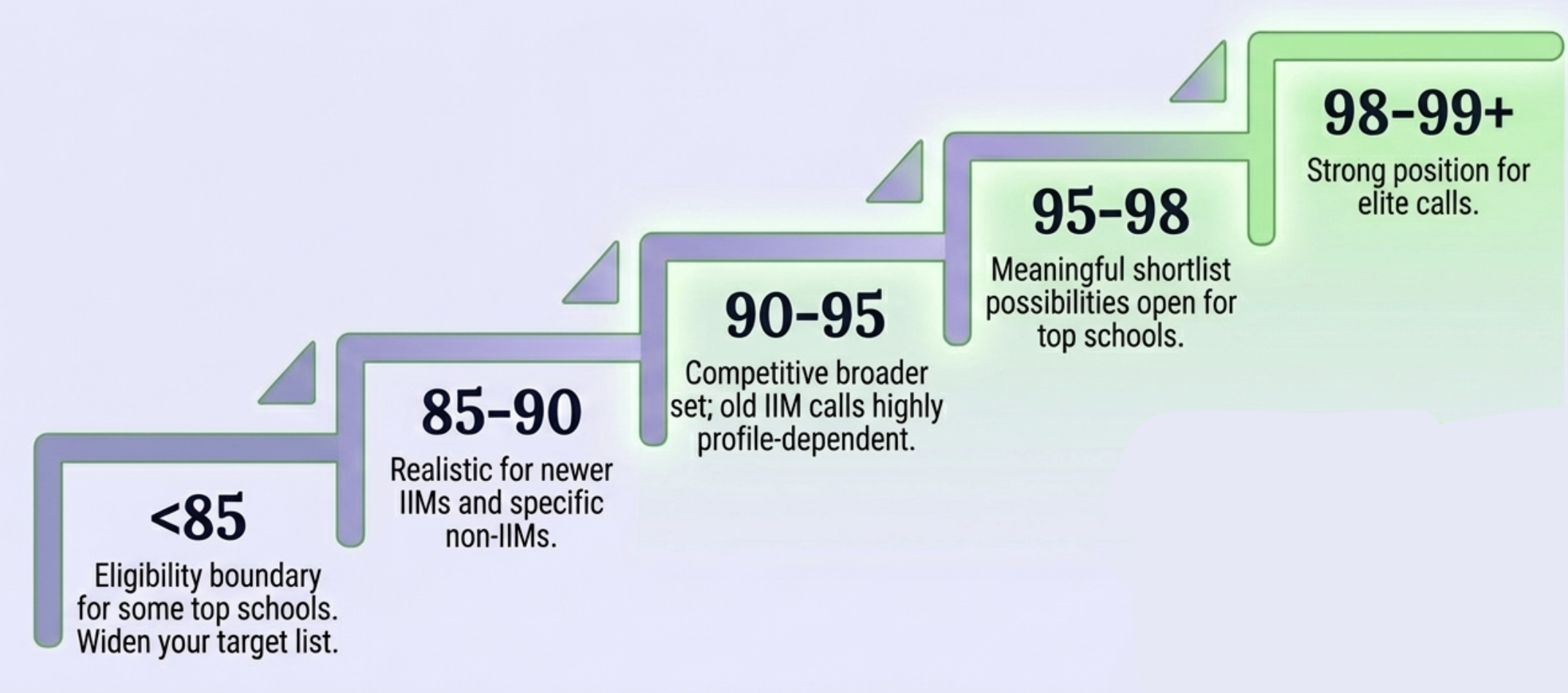
Where you land on this staircase decides which colleges open up. Use it as a planning tool, not a verdict.
Academics, work experience, gender, and academic diversity directly impact the actual cutoff. Two aspirants with the same CAT percentile can get opposite shortlist outcomes based on profile.
Quick answers to what new aspirants ask before they start preparing. Each answer reflects how the exam actually works — not what marketing says.
The Common Admission Test (CAT) is the entrance exam for India's 21 IIMs and 86+ non-IIM B-schools. It is a 120-minute computer-based test with three sections: Verbal Ability & Reading Comprehension (VARC), Data Interpretation & Logical Reasoning (DILR), and Quantitative Ability (QA). Scoring is +3 for correct, -1 for incorrect MCQs, and 0 for TITA (type-in-the-answer) questions.
Your raw score on CAT is normalized across exam slots (to neutralize difficulty differences), converted to a scaled score, then mapped to a percentile based on your rank relative to all test-takers. Percentile is sectional and overall — every IIM uses both, and a weak sectional percentile can block your shortlist even if your overall score is strong.
The shortlist staircase is approximate: 99+ percentile for the older IIMs (A, B, C, L, K, I), 95-99 for newer IIMs and FMS/MDI/SPJIMR, 90-95 for top non-IIMs, and 85-90 for a wider B-school net. Sectional cutoffs apply: most top IIMs expect 80-85 percentile in every section, not just the overall.
No. CAT is a test of clarity under pressure, problem decomposition, and reading comprehension — not MBA-domain knowledge. It uses Class 8-10 mathematics, English comprehension, and basic logic. The hard part is the timed accuracy demanded, not the syllabus.
The IIMs publish no chapter-wise syllabus. In practice, CAT repeatedly tests structural clusters: in VARC — inference, parajumbles, para-summary, RC depth; in DILR — caselets, arrangements, games, scheduling logic; in QA — arithmetic, algebra, geometry, modern math (set theory, P&C). Mastering these recurring clusters beats memorizing formulas.
Roughly 2.58 lakh aspirants compete for ~5,500 IIM seats — a ~2.1% conversion rate. Shortlists, however, factor in academic profile (10th, 12th, graduation), gender diversity, work experience, and academic discipline alongside CAT percentile, so the playing field is wider than the raw number suggests.
Yes — many top scorers self-prepare. The crucial pieces are a sharp diagnostic of your current weak spots, consistent mock testing with honest post-mortem, and access to someone who has cleared the exam to sanity-check your strategy. Structured platforms compress this; coaching is one form, mentor-led self-prep is another.
Get a free readiness report to see exactly where you stand, or book a 30-minute call with a recent IIM alum.