Topic Guide
Arithmetic for CAT: the 6-week foundation
Arithmetic is not a low-stakes warm-up. It is the QA block where small base errors damage percentages, ratios, profit-loss, and DI. A 6-week plan works because it builds the shared rate and ratio engine before mixed sets. The goal is accuracy first, speed second.
The 8 arithmetic sub-topics
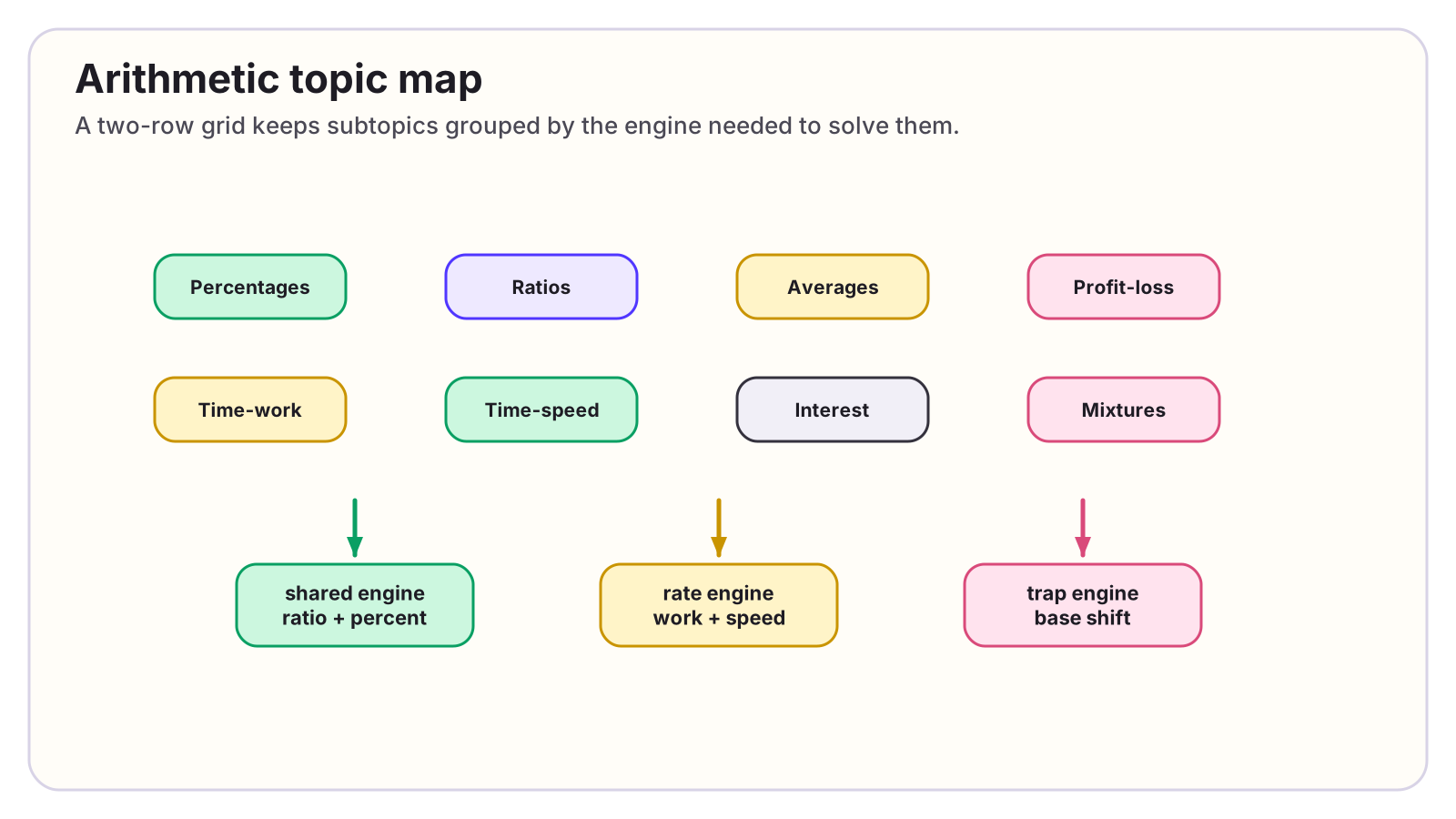
MBAUniverse’s 2021-2025 analysis estimates arithmetic at about 38 percent of QA questions, with algebra close behind at about 34 percent 3. IMS also notes arithmetic and algebra as the dominant recent QA areas 5. Treat arithmetic as 8 sub-topics: percentages, ratios, profit-loss, simple and compound interest, time-work, time-speed-distance, averages, and mixtures.
Aspirants often call arithmetic basic. That is misleading. It is foundational because errors compound across DI and QA.
The 6-week arithmetic plan
Week 1: percentages, 25 questions. Week 2: ratios, 30. Week 3: profit-loss and interest, 35. Week 4: time and work, 40. Week 5: time-speed-distance, 50. Week 6: mixed arithmetic, 60. Use NCERT textbooks as a fundamentals reference for algebraic manipulation and school-level arithmetic when a concept is rusty 6.
Do not mix all topics on day 1. Build one rate model, then reuse it.
Percentages and ratios - the shared engine
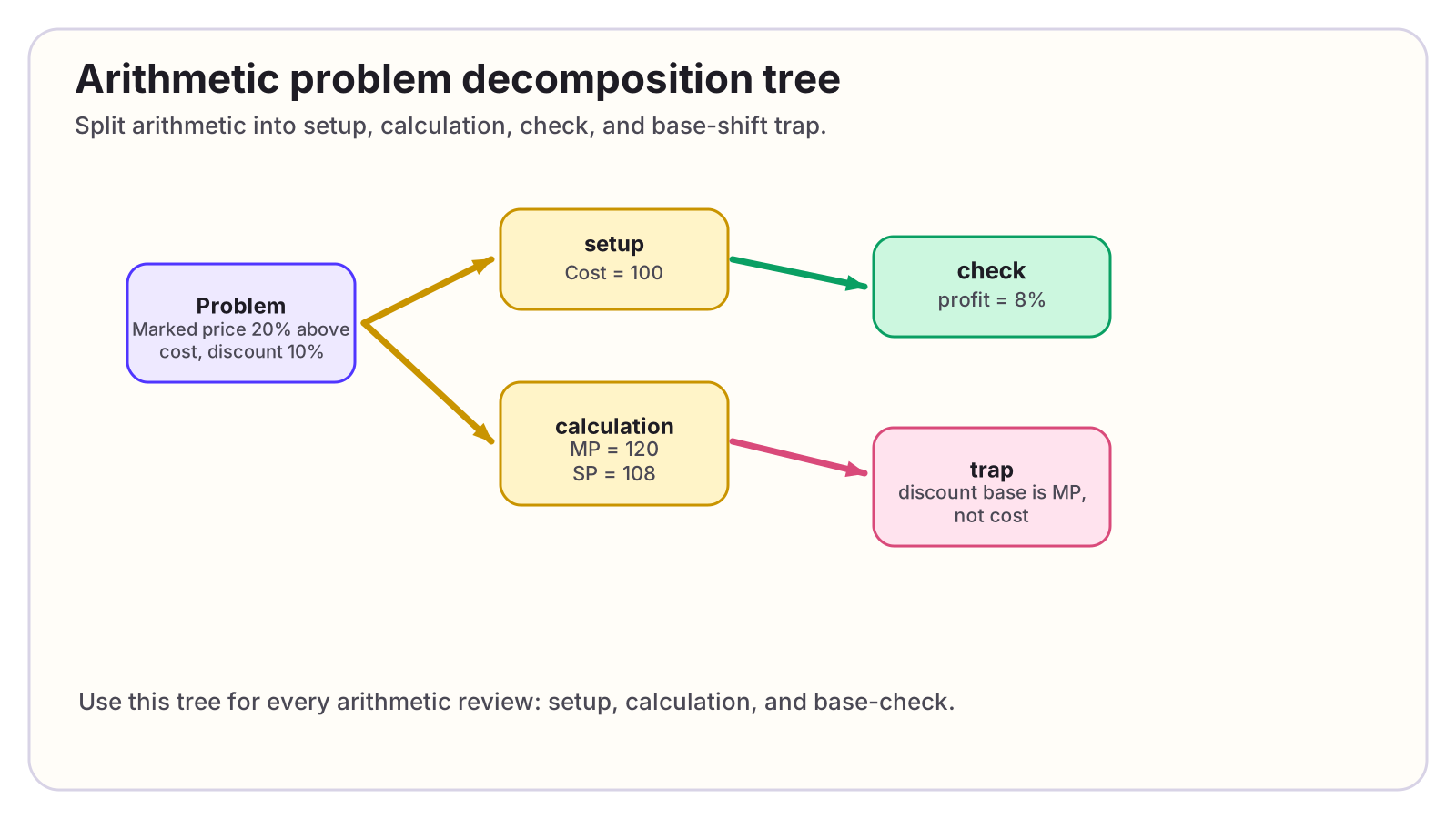
A percentage change must name the base. A ratio must name the total. If a question says a value increased by 20 percent and then fell by 20 percent, the final value is not the original because the bases differ. In ratios, converting shares to totals before equations prevents many mistakes.
The CAT official site remains the annual source for structure and notifications 1, but question families should be trained from past papers 2.
Rates - time-work and TSD together
For time-work, rate is work per unit time. For TSD, rate is distance per unit time. The same table works: entity, rate, time, output. Once the table is stable, equations become shorter.
This is why arithmetic practice should not be chapter-isolated forever. After week 4, merge time-work and TSD drills so the rate idea transfers.
Accuracy benchmark - 85 percent before volume
Do not move to 60 mixed questions while scoring 60 percent on a sub-topic. Stay with 25-30 questions until accuracy crosses 80 percent, then add speed pressure. Dunlosky et al. support distributed practice; repeated shorter sessions beat one large pile of unchecked questions 7.
For each topic, record correct, wrong by concept, wrong by calculation, and skipped.
This week - percentages first
This week, solve 25 percentage questions. Before every equation, write base = ___. Then review only the misses. Roediger and Karpicke’s retrieval-practice research supports attempt-first correction 8.
If you hit 80 percent accuracy, move to ratios next week. If not, repeat percentages with 20 fresh questions and 5 reviewed misses.
FAQs
Is arithmetic important for CAT QA?
Yes. Recent analyses place arithmetic among the largest QA areas, often alongside algebra as the highest-priority block.
How long does arithmetic take to prepare?
Use a 6-week foundation: percentages, ratios, profit-loss and interest, time-work, TSD, then mixed arithmetic.
What accuracy should I target in arithmetic?
Aim for 85 percent in untimed topic drills before increasing speed or mixed-set volume.
Which arithmetic topic should I start with?
Start with percentages because base identification carries into ratios, profit-loss, DI, and growth questions.
How many questions should I solve per week?
Begin with 25 questions in week 1 and ramp toward 60 mixed arithmetic questions by week 6.
Conclusion
Start with 25 percentage questions this week. Write the base before every equation. Move to ratios only after your accuracy crosses 80 percent.
Related reading
References
- Indian Institutes of Management, "CAT official website," 2026. [Online]. Available: https://iimcat.ac.in/. Accessed: Jun. 14, 2026. ↩
- 2IIM, "CAT previous year question papers (2017-2025) with solutions," 2026. [Online]. Available: https://online.2iim.com/CAT-question-paper/. Accessed: Jun. 14, 2026. ↩
- MBAUniverse, "CAT 2026 syllabus: section-wise topics and 5-year weightage analysis," 2026. [Online]. Available: https://www.mbauniverse.com/cat/syllabus. Accessed: Jun. 14, 2026. ↩
- Cracku, "CAT exam syllabus 2025," 2026. [Online]. Available: https://cracku.in/cat-exam-syllabus/. Accessed: Jun. 14, 2026. ↩
- IMS India, "CAT syllabus 2026: sections, topics, weightage, and exam pattern," 2026. [Online]. Available: https://www.imsindia.com/blog/cat/cat-syllabus/. Accessed: Jun. 14, 2026. ↩
- National Council of Educational Research and Training, "Textbooks PDF (I-XII)," 2026. [Online]. Available: https://ncert.nic.in/textbook.php. Accessed: Jun. 14, 2026. ↩
- J. Dunlosky, K. A. Rawson, E. J. Marsh, M. J. Nathan, and D. T. Willingham, "Improving students’ learning with effective learning techniques: Promising directions from cognitive and educational psychology," Psychological Science in the Public Interest, vol. 14, no. 1, pp. 4-58, 2013. [Online]. Available: https://journals.sagepub.com/doi/10.1177/1529100612453266. Accessed: Jun. 14, 2026. ↩
- H. L. Roediger III and J. D. Karpicke, "Test-enhanced learning: Taking memory tests improves long-term retention," Psychological Science, vol. 17, no. 3, pp. 249-255, 2006. [Online]. Available: https://doi.org/10.1111/j.1467-9280.2006.01693.x. Accessed: Jun. 14, 2026. ↩