Topic Guide
CAT exam pattern 2026: what is locked and what is still pending
CAT exam pattern changes less often than rumours suggest, but it still needs an annual refresh. As of this draft, the CAT 2026 notification should be treated as pending until the official CAT site publishes it. The safest article is therefore split into two parts: what the latest completed cycle tells us, and what must be verified when the 2026 notification appears.
The expected CAT 2026 structure
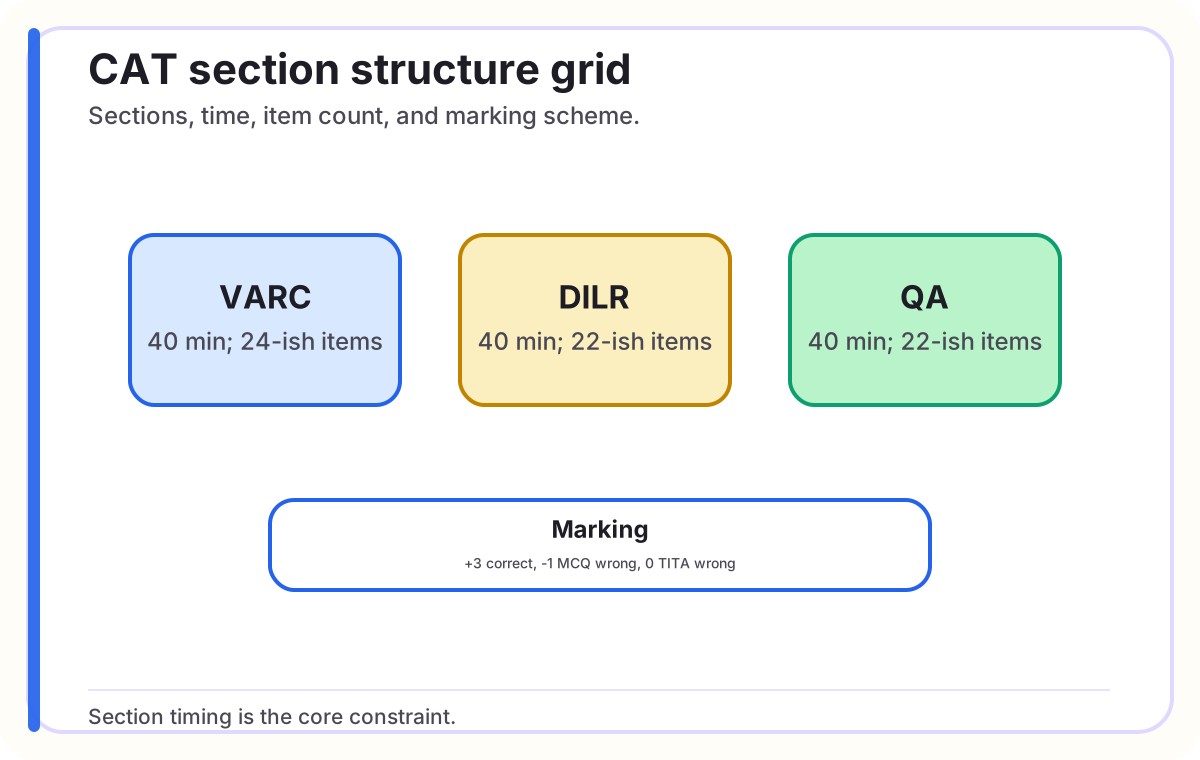
The latest cycles keep CAT as a computer-based test with VARC, DILR, and QA. The 2025 public reporting describes a two-hour structure with fixed sectional timing, but CAT 2026 must be refreshed from the official site once the notification is live 1, [2].
Use this as a preparation assumption, not as the final notification.
Read this section as a data-hygiene rule. For the expected cat 2026 structure, the safest source is the official CAT or institute page when the claim is about eligibility, timing, registration, or admissions screening 1. Coaching analyses are useful for paper shape and topic distribution, but they should not replace institute pages for cutoff rules. This separation keeps the article defensible during an annual refresh.
The reader action is to separate floor from probability. A published minimum can tell you whether an application may be screened; it cannot tell you the real call chance in a crowded cycle. Therefore the table or pattern note should always be paired with a caution sentence and a next check. The student should know which source to open before acting on a number.
Keep a refresh note under the expected cat 2026 structure. Mark whether the field is official, inferred from the previous year, or based on coaching analysis. That label tells the editor what must change when the CAT 2026 notification, official mock, or post-exam paper analysis becomes available.
Year-over-year pattern table
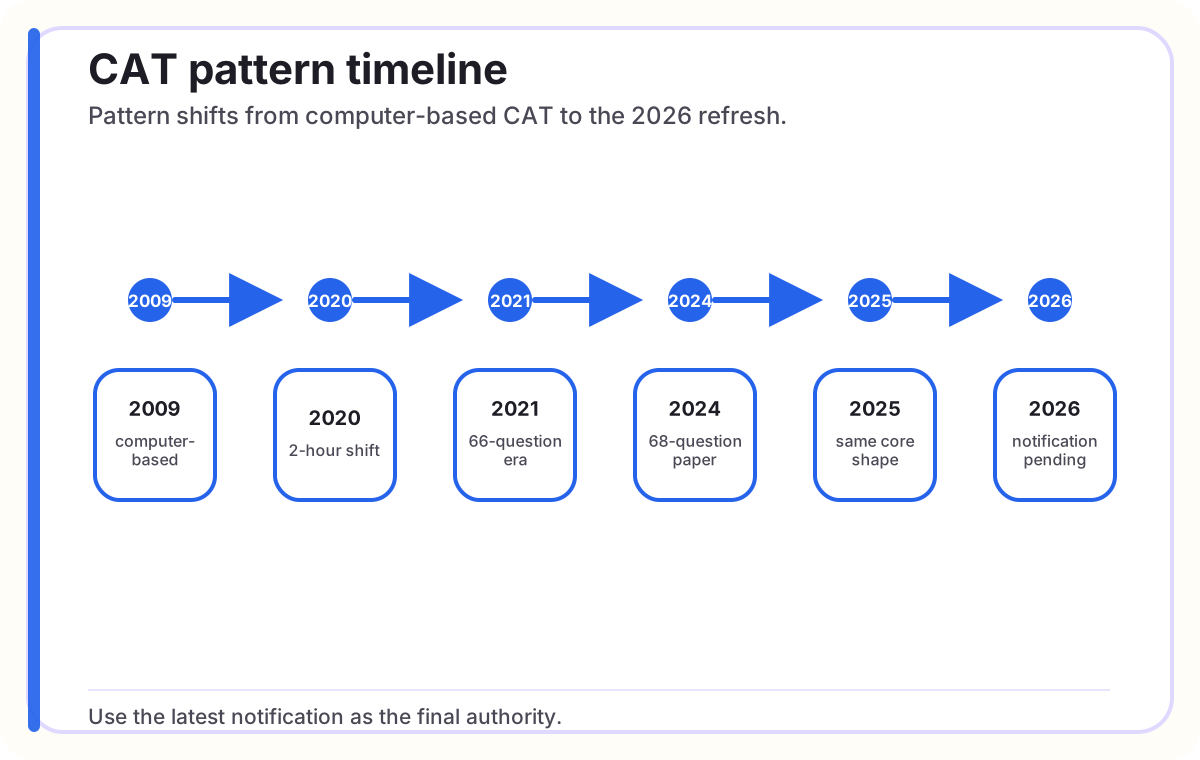
From 2021 onward, CAT has broadly stayed near the 66-68 question range in public analyses, with section-wise timing and mixed MCQ/TITA items. Past-paper repositories let you compare exact yearly distributions [4], [5].
The table should be refreshed within 2 weeks of the CAT 2026 notification.
Read this section as a data-hygiene rule. For year-over-year pattern table, the safest source is the official CAT or institute page when the claim is about eligibility, timing, registration, or admissions screening 1. Coaching analyses are useful for paper shape and topic distribution, but they should not replace institute pages for cutoff rules. This separation keeps the article defensible during an annual refresh.
The reader action is to separate floor from probability. A published minimum can tell you whether an application may be screened; it cannot tell you the real call chance in a crowded cycle. Therefore the table or pattern note should always be paired with a caution sentence and a next check. The student should know which source to open before acting on a number.
Keep a refresh note under year-over-year pattern table. Mark whether the field is official, inferred from the previous year, or based on coaching analysis. That label tells the editor what must change when the CAT 2026 notification, official mock, or post-exam paper analysis becomes available.
MCQ versus TITA
MCQs generally carry negative marking for wrong answers, while TITA questions have historically had no negative marking. The exact marking scheme should be verified annually from the official notification 1, [6], [7].
Do not apply MCQ skip rules blindly to TITA.
Read this section as a data-hygiene rule. For mcq versus tita, the safest source is the official CAT or institute page when the claim is about eligibility, timing, registration, or admissions screening 1. Coaching analyses are useful for paper shape and topic distribution, but they should not replace institute pages for cutoff rules. This separation keeps the article defensible during an annual refresh.
The reader action is to separate floor from probability. A published minimum can tell you whether an application may be screened; it cannot tell you the real call chance in a crowded cycle. Therefore the table or pattern note should always be paired with a caution sentence and a next check. The student should know which source to open before acting on a number.
Keep a refresh note under mcq versus tita. Mark whether the field is official, inferred from the previous year, or based on coaching analysis. That label tells the editor what must change when the CAT 2026 notification, official mock, or post-exam paper analysis becomes available.
Marking scheme
The current preparation model is +3 for a correct answer, -1 for a wrong MCQ, and 0 negative marks for a wrong TITA. If CAT 2026 changes this, revise attempt strategy immediately.
The marking scheme determines your risk threshold.
Read this section as a data-hygiene rule. For marking scheme, the safest source is the official CAT or institute page when the claim is about eligibility, timing, registration, or admissions screening 1. Coaching analyses are useful for paper shape and topic distribution, but they should not replace institute pages for cutoff rules. This separation keeps the article defensible during an annual refresh.
The reader action is to separate floor from probability. A published minimum can tell you whether an application may be screened; it cannot tell you the real call chance in a crowded cycle. Therefore the table or pattern note should always be paired with a caution sentence and a next check. The student should know which source to open before acting on a number.
Keep a refresh note under marking scheme. Mark whether the field is official, inferred from the previous year, or based on coaching analysis. That label tells the editor what must change when the CAT 2026 notification, official mock, or post-exam paper analysis becomes available.
What is volatile
Exact item count, VARC composition, DILR set sizes, and QA topic weight can change by year. Syllabus pages are useful maps, but official and post-exam analyses should update the final numbers [6], [8].
Build skills, then refresh numbers.
Read this section as a data-hygiene rule. For what is volatile, the safest source is the official CAT or institute page when the claim is about eligibility, timing, registration, or admissions screening 1. Coaching analyses are useful for paper shape and topic distribution, but they should not replace institute pages for cutoff rules. This separation keeps the article defensible during an annual refresh.
The reader action is to separate floor from probability. A published minimum can tell you whether an application may be screened; it cannot tell you the real call chance in a crowded cycle. Therefore the table or pattern note should always be paired with a caution sentence and a next check. The student should know which source to open before acting on a number.
Keep a refresh note under what is volatile. Mark whether the field is official, inferred from the previous year, or based on coaching analysis. That label tells the editor what must change when the CAT 2026 notification, official mock, or post-exam paper analysis becomes available.
What to do when notification drops
When the CAT 2026 notification drops, compare duration, sections, marking, and registration dates first. Then update item counts after the mock or paper analysis is available.
Your update checklist has 4 fields.
Read this section as a data-hygiene rule. For what to do when notification drops, the safest source is the official CAT or institute page when the claim is about eligibility, timing, registration, or admissions screening 1. Coaching analyses are useful for paper shape and topic distribution, but they should not replace institute pages for cutoff rules. This separation keeps the article defensible during an annual refresh.
The reader action is to separate floor from probability. A published minimum can tell you whether an application may be screened; it cannot tell you the real call chance in a crowded cycle. Therefore the table or pattern note should always be paired with a caution sentence and a next check. The student should know which source to open before acting on a number.
FAQs
Has the CAT 2026 pattern been released?
Treat CAT 2026 as pending until the official CAT website publishes the notification.
What is the expected CAT 2026 structure?
The expected preparation model is three sections: VARC, DILR, and QA, with sectional timing.
How many questions will CAT 2026 have?
Use recent cycles as a planning range, but confirm the exact count after official notification or mock release.
What is the CAT marking scheme?
The current planning model is +3 for correct answers, -1 for wrong MCQs, and no negative marking for TITA.
When should this article be refreshed?
Refresh it within 2 weeks of the CAT 2026 official notification and again after the official mock or paper analysis.
Conclusion
Use this page as a planning baseline, then refresh it when the official CAT 2026 notification is released. The first update check has 4 fields.
Related reading
References
- Indian Institutes of Management, "Common Admission Test official website," 2025. [Online]. Available: https://iimcat.ac.in/ [2] The Economic Times, "CAT 2025 Notification Released: Registration begins August 1 at iimcat.ac.in," 2025. [Online]. Available: https://economictimes.indiatimes.com/news/new-updates/cat-2025-notification-released-at-iimcat-ac-in-exam-on-november-30-registrations-begin-august-1-at-iimcat-ac-in/articleshow/122932378.cms [3] The Times of India, "CAT 2025 results: 12 candidates score 100 percentile, 9 from non-engineering backgrounds," 2025. [Online]. Available: https://timesofindia.indiatimes.com/education/news/cat-2025-results-12-candidates-score-100-percentile-9-from-non-engineering-backgrounds/articleshow/126171290.cms [4] 2IIM, "CAT previous year question papers," 2025. [Online]. Available: https://online.2iim.com/CAT-question-paper/ [5] Cracku, "CAT previous papers," 2025. [Online]. Available: https://cracku.in/cat-previous-papers [6] Career Launcher, "CAT exam pattern," 2025. [Online]. Available: https://www.careerlauncher.com/cat-mba/exam-pattern/ [7] Shiksha, "CAT exam pattern," 2025. [Online]. Available: https://www.shiksha.com/mba/cat-exam-pattern [8] MBAUniverse, "CAT syllabus and exam pattern," 2025. [Online]. Available: https://www.mbauniverse.com/articles/cat-syllabus ↩