Topic Guide
WAT-PI in IIM admissions: what gets tested
WAT-PI is not a polite add-on after CAT. It is a scored stage in which writing, spoken reasoning, and profile evidence are tested. Across old-IIM policies, interview-stage components can decide conversion after the percentile gate. CAT earns the room; WAT-PI often decides whether the room becomes an offer.
What WAT tests
A Written Ability Test usually gives a topic and a fixed time window. The evaluator is not looking for ornate writing. The answer needs a claim, two reasons, one counterpoint, and a conclusion that follows from the evidence.
A 25-minute WAT plan can be simple: 3 minutes outline, 18 minutes write, 4 minutes revise. That gives enough structure without turning the essay into a memorised template.
What PI tests
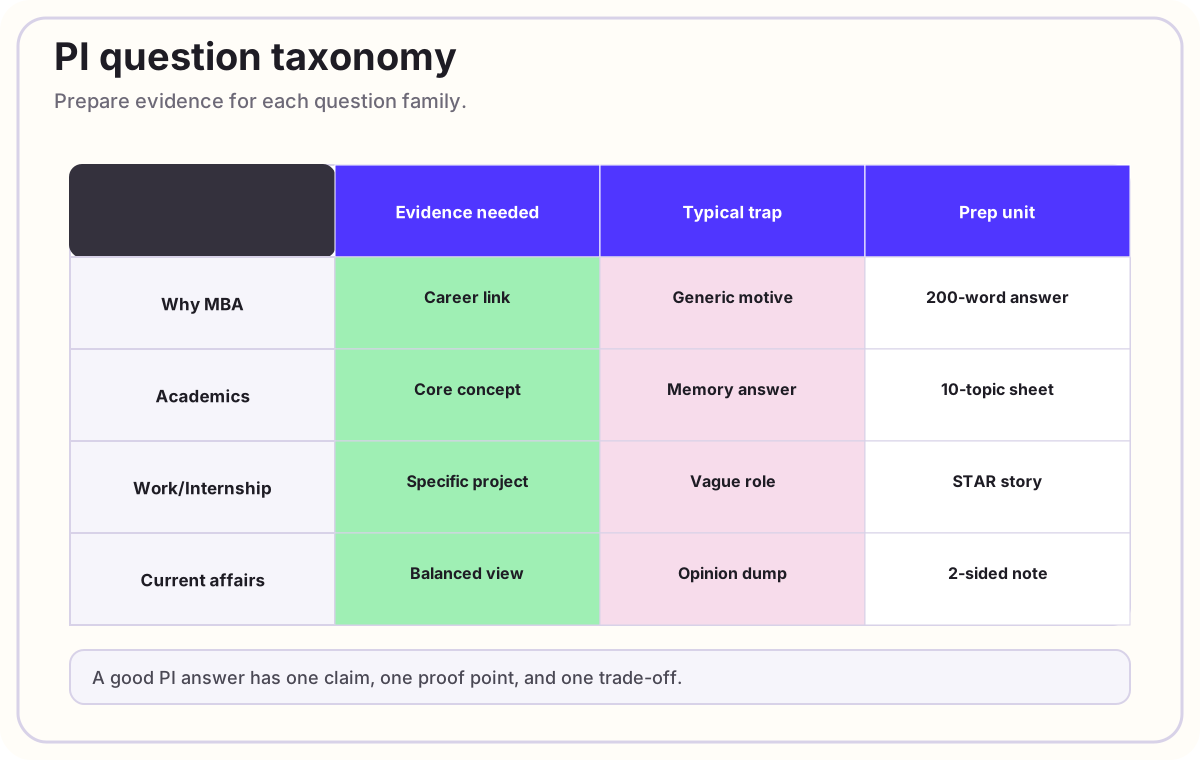
The recurring PI families are predictable: why MBA, why now, why this institute, and what evidence in your record supports the claim. Candidates weaken answers when they stack adjectives instead of proof.
A stronger answer uses one claim and one data point. For example, a work-experience answer should name the project, the role, the measurable outcome, and the trade-off faced.
How profile evidence works
Academic marks, work experience, internships, leadership roles, and category-specific context can appear in the conversation. The safest preparation file has one page per claim. If you say you solved a supply-chain problem, the page should name the baseline, action, result, and lesson.
Do not rehearse 100 answers. Build 12 evidence blocks that can support multiple questions.
How WAT-PI changes the shortlist story
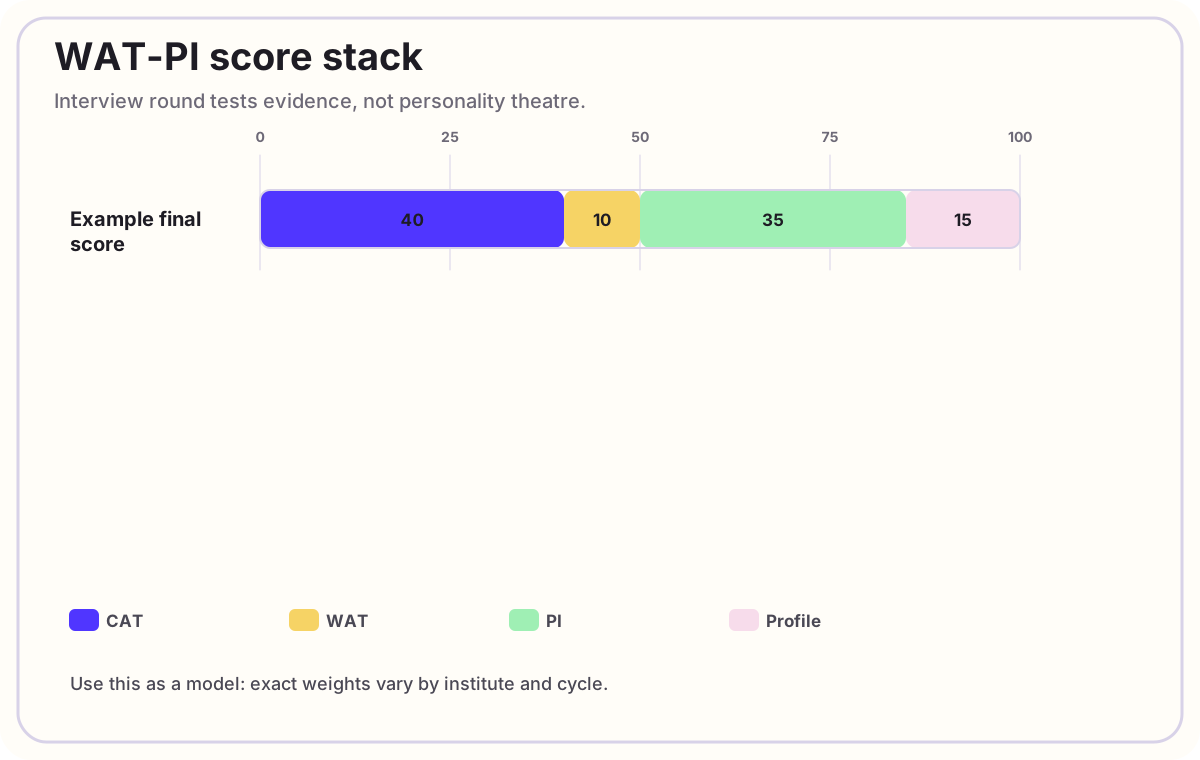
IIMs combine CAT, profile, WAT, and PI in different weights. A candidate can enter the interview stage with a strong CAT score and still lose ranking if the interview score is weak. That is not unfairness; it is the published composite model.
Read the policy as a scorecard. Then prepare for the scorecard, not for a generic interview.
The weekly prep routine
Pick 3 WAT topics from current affairs, business, and social policy. Write each in 25 minutes. Then record 4 PI answers: why MBA, why now, why this institute, and profile evidence.
Review the recordings for clarity, not polish. If the claim is unclear in 45 seconds, rewrite it.
The 25-minute WAT operating plan
A useful 25-minute WAT split is 3 minutes for outline, 18 minutes for writing, and 4 minutes for review. The outline should contain the position, two reasons, one counterpoint, and a closing implication. The review pass is for structure and claims, not ornamental language. IIM admission pages differ in how they name the written component, but the candidate's work remains the same: build a clear argument under time pressure 1, [2], [3].
The strongest WAT practice set uses real current-affairs themes, but the score does not come from trivia. It comes from a controlled argument. If a candidate cannot write a conclusion in the last 4 minutes, the issue is usually outline discipline, not vocabulary. Review three essays with that lens before adding more topics.
The PI evidence bank
A PI panel can test academics, work experience, graduation choices, current affairs, and the motivation for management education. The safe preparation object is an evidence bank: five academic stories, five work or internship stories, five failure or repair stories, and five leadership or collaboration stories. Each story should include a date, a measurable action, and a result [2], [4], [5].
This bank prevents generic answers. A candidate saying "I worked well in a team" is forgettable. A candidate saying "In April, I coordinated a 4-person sprint and reduced rework from 7 defects to 2" gives the panel something to test. The evidence bank also supports WAT because the same examples can become proof points in essays.
How to connect WAT-PI to composite score
Several IIMs publish selection processes that combine CAT performance with interview, writing, academic, and profile components 1, [2], [3], [4], [5]. That makes WAT-PI a conversion stage, not a formality. The student who treats it as a soft add-on is leaving a scored stage underprepared.
A practical planning rule is to start one WAT and one PI block per week after the main syllabus becomes stable. The block can be small: one 25-minute essay and one 20-minute interview rehearsal. The important part is evidence quality and feedback, not volume.
FAQs
What is WAT PI IIM?
WAT PI IIM is the article's main operating idea. Read it as a decision rule with a number attached, not as a loose definition.
Which source should I trust first?
Use official CAT or institute pages for policy claims, then use coaching analyses for paper-pattern interpretation and academic studies for learning-strategy claims.
How often should this article be refreshed?
Refresh it once every CAT admission cycle, and sooner if an official institute policy page publishes a new PDF.
What is the practical next step?
Write the main number from this article into your mock sheet or shortlist sheet today, then check it after the next mock.
How does this link to Clymber preparation?
It turns a vague CAT-prep question into one measurable decision that can be reviewed by a student or mentor within 7 days.
Conclusion
Use this article as a working sheet, not only as a reading page. Record the main number for your target case, apply it to the next mock or shortlist decision, and review the result within 7 days.
Related reading
- /glossary/composite-score
- /blog/wat-gd-pi-iim-playbook
- /blog/iim-cutoffs-explained
- /plans/mentor-pro
- /iim-cutoffs
References
- IIM Ahmedabad, "MBA admissions criteria for Indian candidates." Available: https://www.iima.ac.in/academics/mba/admissions/indians. Accessed: 15-Jun-2026. [2] IIM Bangalore, "PGP and PGP-BA admission process for 2026-28." Available: https://www.iimb.ac.in/sites/default/files/inline-files/PGP%20and%20PGP%20BA%20Admission%20process%20for%202026-28.pdf. Accessed: 15-Jun-2026. [3] IIM Lucknow, "Admission policy for MBA, MBA-ABM and MBA-SM 2026-28." Available: https://www.iiml.ac.in/sites/default/files/upload/admission_2026-28/AdmissionPolicy_2026-28.pdf. Accessed: 15-Jun-2026. [4] IIM Kozhikode, "PGP admissions and selection policy." Available: https://iimk.ac.in/academic-programmes/pgp/admission. Accessed: 15-Jun-2026. [5] J. Dunlosky et al., "Improving students' learning with effective learning techniques." Available: https://journals.sagepub.com/doi/10.1177/1529100612453266. Accessed: 15-Jun-2026. [6] H. L. Roediger III and J. D. Karpicke, "Test-enhanced learning: taking memory tests improves long-term retention." Available: https://doi.org/10.1111/j.1467-9280.2006.01693.x. Accessed: 15-Jun-2026. [7] A. Reddy et al., "Spaced learning and retrieval practice in education." Available: https://pmc.ncbi.nlm.nih.gov/articles/PMC5126970/. Accessed: 15-Jun-2026. [8] Times of India, "IIM Trichy joins Joint Admission Process 2026." Available: https://timesofindia.indiatimes.com/education/news/iim-trichy-joins-joint-admission-process-2026-for-mba-pgpm-admissions/articleshow/124348236.cms. Accessed: 15-Jun-2026. ↩