Pillar Guide
IIM cutoffs and shortlist criteria, explained
There is no single IIM cutoff. There are institute-wise gates, category-wise gates, sectional gates, total-percentile gates, and composite-score ranks. The right question is not whether a student has crossed the IIM cutoff. The right question is which campus, which category, which section, and which final scorecard. A 99 percentile can be strong for one scorecard and incomplete for another.
The three cutoff dimensions
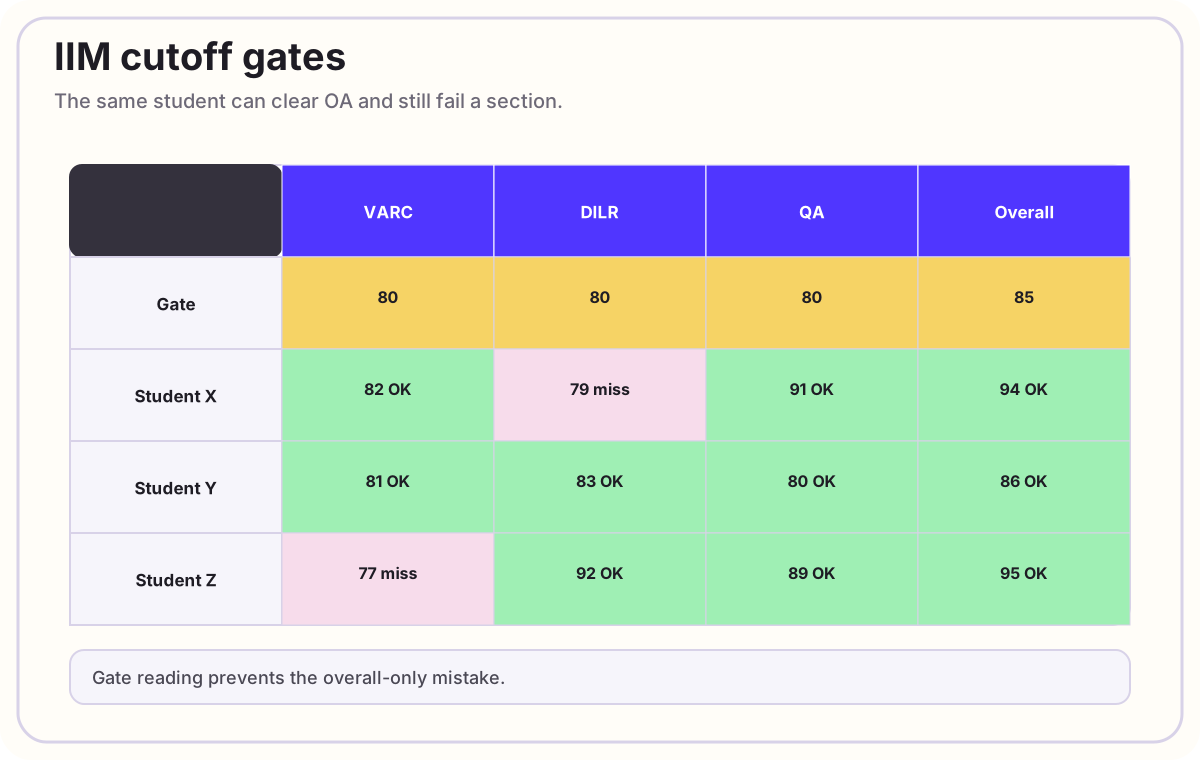
The first gate is section-wise: VARC, DILR, and QA must each clear a minimum. The second gate is overall percentile. The third gate is composite score, where CAT is mixed with academics, work experience, diversity, WAT, and PI depending on institute policy.
This is why a simple table of overall percentiles is not enough. A useful IIM cutoff page must show the gates separately and explain how they interact.
At a glance: the IIM cutoff pages on Clymber
Every old IIM applies all three gates — three sectional minimums plus an overall minimum — before the composite score decides the shortlist. The table below links each institute's full breakdown. Percentile figures move every cycle, so each page carries the current-cycle numbers and the source date; only IIM Ahmedabad's published General and EWS preliminary minimums are repeated here as a calibration point.
| Institute | Gates applied | General preliminary minimum | Full breakdown |
|---|---|---|---|
| IIM Ahmedabad | VARC, DILR, QA, overall | 95 overall / 85 sectional | /iim-cutoffs/ahmedabad |
| IIM Bangalore | VARC, DILR, QA, overall | See current-cycle policy | /iim-cutoffs/bangalore |
| IIM Calcutta | VARC, DILR, QA, overall | See current-cycle policy | /iim-cutoffs/calcutta |
| IIM Lucknow | VARC, DILR, QA, overall | See current-cycle policy | /iim-cutoffs/lucknow |
| IIM Kozhikode | VARC, DILR, QA, overall | See current-cycle policy | /iim-cutoffs/kozhikode |
The pattern repeats: clear all three sections, clear the overall, then the composite score — which mixes academics, work experience, diversity, WAT, and PI — decides the shortlist. A lopsided scorecard, strong overall with one weak section, is the most common way a profile that looks safe misses the gate.
Group the IIMs before reading individual policies
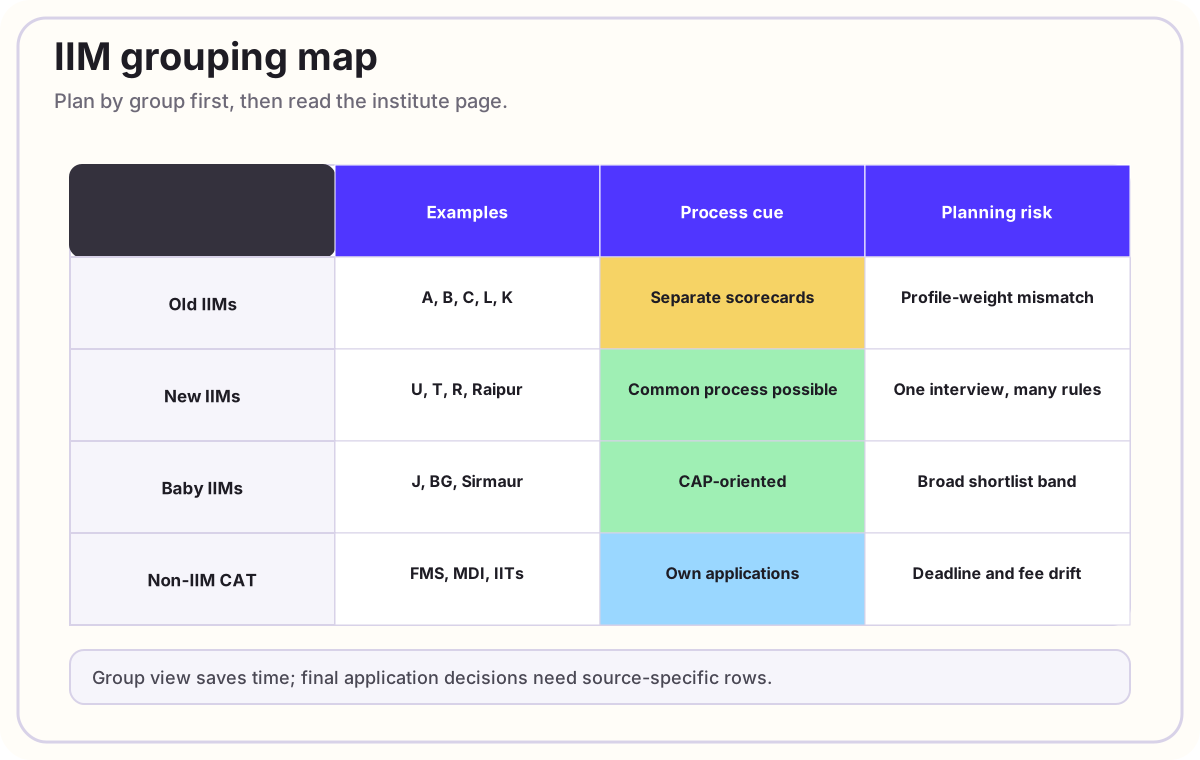
Old IIMs, newer IIMs, and baby IIMs often differ in brand pull, process, and weight structure. A group view helps students make a shortlist without reading 21 policy PDFs on day one. But it should not become the final source.
For publishing, each per-IIM page should cite the institute's own admission policy. For preparation, the student can begin with a group shortlist and refine it once the CAT percentile range becomes visible.
Read old-IIM shortlists as scorecards
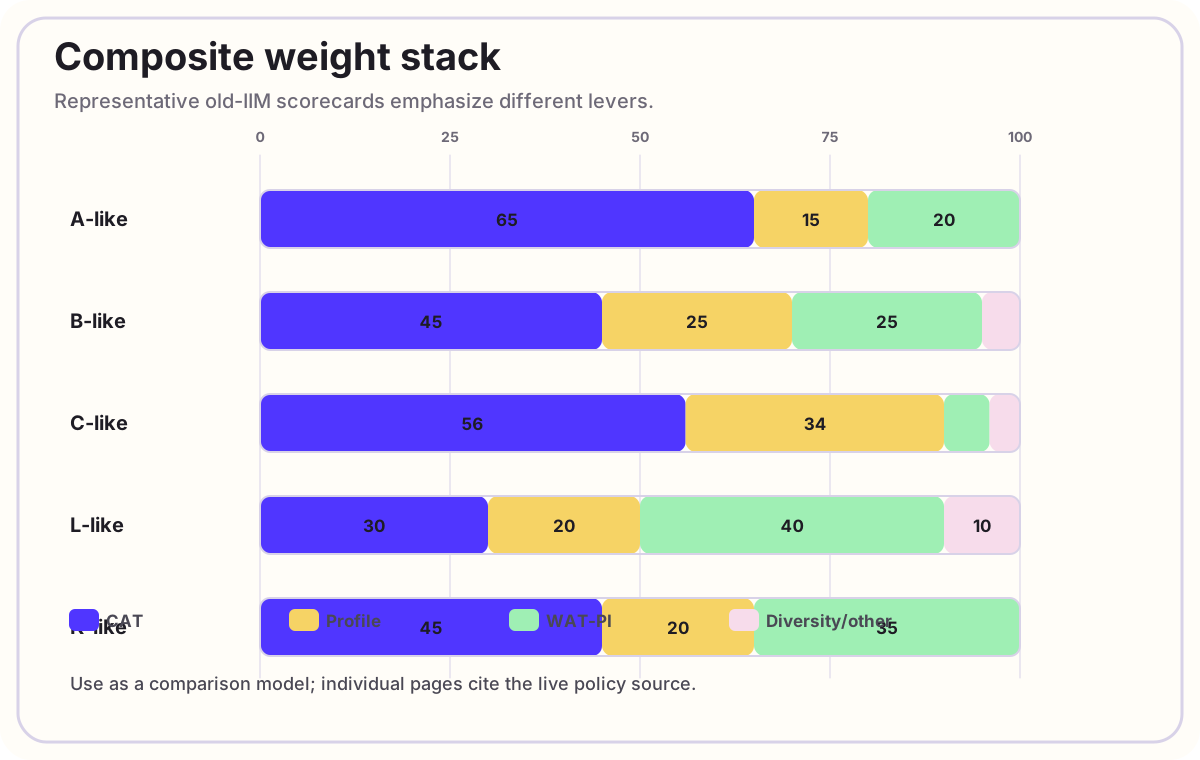
IIM Ahmedabad, Bangalore, Calcutta, Lucknow, Kozhikode, Indore, and Shillong do not operate one identical scorecard. Some are more CAT-heavy at the shortlist stage. Some give visible profile or diversity weight. Some put more weight on PI in the final stage.
The smart read is comparative. If your academics are strong, profile-sensitive scorecards may work in your favour. If your CAT score is strong but profile is uneven, CAT-heavy scorecards may be better targets.
Do not confuse shortlist cutoff with final admission
Many students read a cutoff and assume admission. That is the wrong mental model. The cutoff opens the next door. WAT, PI, and final composite scoring decide the offer.
This matters most in the 95–99 percentile band. A student in that band may be competitive for several institutes, but the conversion path changes across campuses. The shortlist sheet should have separate columns for gate, WAT/PI, and final score.
How new-IIM and common-process pages should be read
A shared process can reduce logistics. It does not remove institute-level final weights. Students should read the common process notice for scheduling and document instructions, then read the institute page for conversion logic.
This is especially important for candidates with a broad target list. The same interview performance may flow into multiple campuses, but the score interpretation can differ.
Non-IIM schools using CAT need a separate list
FMS, MDI, SPJIMR, IIT management schools, and other CAT-accepting programmes do not follow IIM cutoffs. They may use CAT score heavily, but they run their own admission systems.
A production content hub should link them from the IIM cutoff pillar without merging the criteria. For the student, keep a separate non-IIM shortlist with application dates and fee-return assumptions.
Four cutoff misreads to avoid
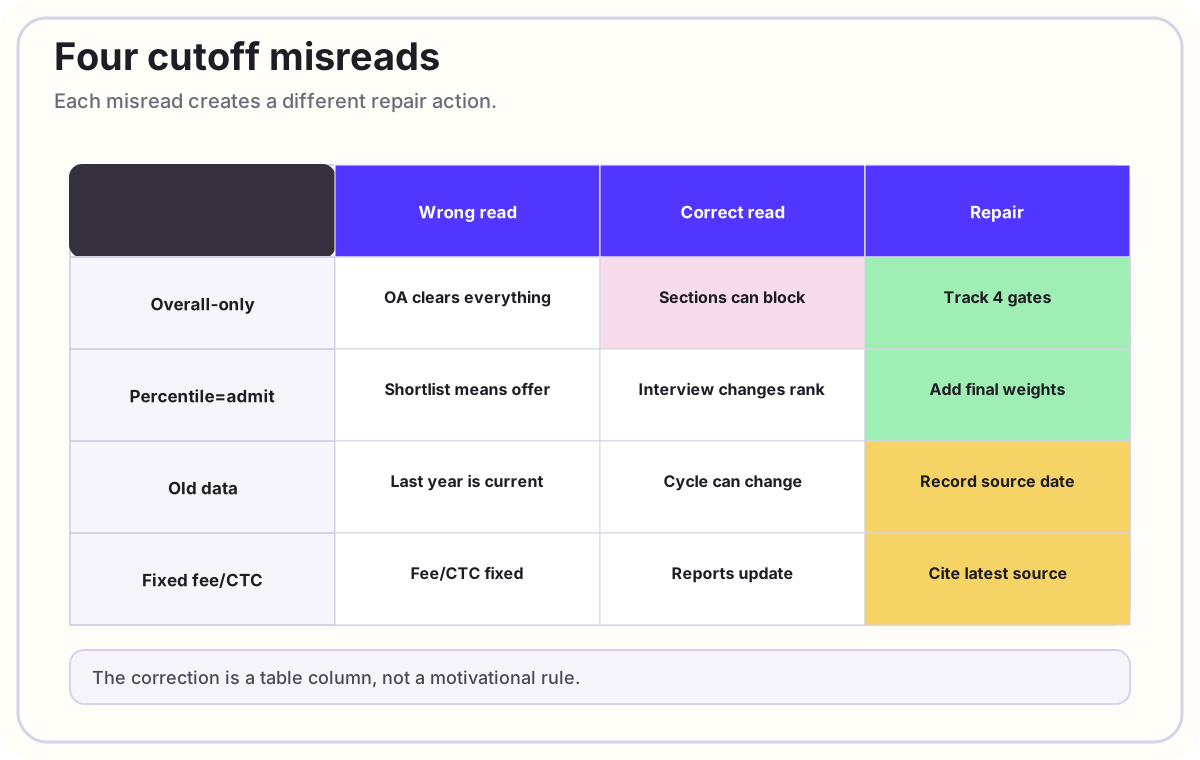
The first misread is overall-only tracking. The second is treating percentile as admission. The third is copying last year's table into a new cycle. The fourth is treating fees or placement outcomes as fixed figures without a current source.
The fix is one table: institute, category, VARC, DILR, QA, overall, CAT weight, profile weight, WAT/PI weight, source date.
What to do this week
Pick 3 target IIMs. For each one, record the sectional and overall gate from the latest official policy. Then add the composite weights and one personal risk note.
The mock review becomes sharper after that. You are no longer chasing a vague percentile. You are testing whether your current score clears the gates that matter.
Worked example: build a 3-IIM target sheet
Start with three target campuses, not 21. For each campus, record the current-cycle policy source, source date, category, VARC gate, DILR gate, QA gate, overall gate, CAT weight, profile weight, and interview or writing weight. The first six columns answer the eligibility question. The next three answer the ranking question. A final notes column should record the candidate's personal risk: weak section, weak academics, no work experience, or WAT-PI uncertainty 1, [2], [3], [4], [5].
This sheet changes how mocks are reviewed. A mock score of 98 overall is not one result. It becomes four checks: did VARC cross the relevant gate, did DILR cross it, did QA cross it, and did the overall percentile support the target campus. A profile-sensitive campus also asks whether the CAT score compensates for a weaker academic row. A CAT-heavy campus asks whether the score is high enough to carry the file into the interview stage.
For example, suppose a candidate's last mock shows VARC 88, DILR 79, QA 92, and overall 96. A campus with 80 in every section is mostly safe on section gates, although DILR still deserves a buffer. A campus with a higher DILR or VARC expectation becomes riskier. The conclusion is not "good" or "bad". The conclusion is a 7-day action: two DILR sectional drills, one full-length mock, and a table refresh after the next result.
The sheet should also separate current facts from planning buffers. If the official policy states 80, write 80 in the policy row. If your working target is 85, write 85 in the planning row. Mixing those two rows creates a false citation problem. The institute owns the policy number. The student owns the buffer.
Finally, keep the source URL visible. The annual refresh is not a clerical step. IIM admission pages can change the category gates, the composite-weight formula, the interview stage, and the document requirements. The page should therefore be treated as a live admissions object, not a permanent static table.
How percentile bands should change the target list
Below 90 percentile, the first task is usually not IIM targeting. It is repairing the section that blocks the steepest improvement. In the 90-95 band, students should start mapping newer IIMs, selected non-IIM CAT schools, and one or two stretch campuses. In the 95-98 band, the target list becomes broader, but sectional gates and profile-sensitive formulas still matter. In the 98-99.5 band, old-IIM calls become more realistic for some profiles, but conversion remains WAT-PI and composite-score dependent. Above 99.5, the candidate still needs to read campus-specific weights because a high CAT score does not erase profile and interview stages 1, [2], [3], [4], [5].
This banding prevents two errors. The first error is pessimism: assuming one missed mock closes every IIM path. The second error is overconfidence: reading one high overall percentile as admission. Both errors come from using a single number for a multi-stage process.
The action is to maintain three lists. List A contains campuses where current section scores clear the working gate. List B contains campuses where one section is within 5 percentile points of the working gate. List C contains stretch campuses where either composite weight or profile risk makes the path uncertain. After every two mocks, move campuses between lists using evidence, not mood.
Non-IIM CAT schools should be kept in the same workbook but in a separate tab. FMS, MDI, SPJIMR, IIT management schools, and other CAT-accepting programmes may use CAT heavily, but they do not share IIM shortlist rules. Mixing them into the same table without a separate process column makes the sheet harder to audit [9].
The band method is also useful for content architecture. The editorial pillar should link to per-IIM cutoff pages, percentile explanations, composite-score definitions, and CAT pattern resources. The reader should leave with both a definition and a next path through the site.
How to cite cutoff data without overclaiming
A cutoff can refer to minimum eligibility, shortlist creation, interview call, final admission, category-specific relaxation, or programme-specific criteria. A page that says "IIM cutoff is 90" without the stage label is incomplete. The correct citation pattern is: institute, programme, batch year, stage, category, section, number, and URL 1, [2], [3], [4], [5].
The stage label is especially important for old IIMs. A candidate may clear the minimum CAT gate and still not receive an interview call because the shortlist is based on an application rating or composite score. A candidate may receive a call and still not convert because the final composite score includes WAT, PI, academics, work experience, or diversity components. Each stage deserves its own row.
The publication workflow should treat coaching-site summaries as secondary. They can help compare patterns, but official pages and PDFs should be the primary citation for campus-specific numbers. When a PDF is blocked or moved, the safest production sentence is cautious: state the method, cite the official page, and instruct readers to refresh the current-cycle PDF before making application decisions.
This citation discipline also helps LLM visibility. When a page explains which source supports which claim, it is easier for external systems to quote the page responsibly. The goal is not to inflate the reference list. The goal is to ensure that a reader can trace every admissions number back to the source that owns it.
The weekly operating plan for cutoff work
A student can turn this pillar into a weekly routine. On Monday, pick 3 target campuses and refresh the official numbers. On Tuesday, compare the last mock's section percentiles against the working gates. On Wednesday and Thursday, repair the weakest section with timed sets. On Friday, revise the target list if one campus has become unrealistic for the current phase. On Sunday, take the next mock and record the four score numbers in the same sheet.
This is not application panic. It is structured targeting. The student still prepares for CAT sections, but the work now has a visible admissions map. A 2-point gain in DILR has meaning because it can move one campus from List B to List A. A flat QA score has meaning because it tells the student which gate is blocking the next shortlist.
For mentors, the sheet creates a better conversation. Instead of asking whether the student is "ready for IIMs," the mentor can ask which gate failed, which scorecard is profile-sensitive, and which 7-day repair is most efficient. That is the difference between motivation and admissions planning.
The final weekly output is one row: target campus, current gap, repair action, next check date. If there is no row, the cutoff research has not become preparation.
The same routine can be repeated after each admission-policy refresh. First, update the source row and never overwrite the previous source date; keep the older row archived so changes are visible. Second, compare the new section gates with the last three mock results. Third, check whether the composite-score formula rewards or penalises the candidate's current profile. Fourth, update the 3-IIM target list and remove campuses that have become unrealistic for the current phase. This is a 30-minute exercise when the sheet is already built.
For a working student, the routine should be shorter but stricter. Use one weekday for source refresh and one weekend block for score review. Do not read every IIM page every week. Read the three target campuses and one backup campus. That keeps the research load under control while still keeping the admissions plan current.
For a student without a stable percentile band yet, the cutoff sheet should not become a distraction. Use the published gates as orientation, then focus on section floors. The first target is to bring every section above a safe working line. After that, overall percentile and composite strategy become more meaningful.
For a student already in a high percentile band, the sheet becomes more strategic. Compare CAT-heavy and profile-heavy campuses. Read whether the institute uses writing, interview, academic record, work experience, or diversity components in a way that changes the final rank 1, [2], [3], [4], [5]. Then rehearse the stage that carries the largest uncertain weight.
The admissions plan should also name the evidence gap. If a page's latest policy PDF cannot be fetched, the page should say that the official institute source must be refreshed before final application decisions. If a placement or fee number is included, it needs its own source and date because admissions criteria and outcomes data are different evidence types [9], [10].
A useful final check is the 4-column mentor question: which gate is blocking me, which scorecard favours me, which source row changed this cycle, and what 7-day repair follows from that information. If the student can answer all four in writing, the cutoff work has become preparation rather than browsing.
The same sheet also prevents a common article-level SEO mistake: ranking for "IIM cutoff" while answering only one campus. A pillar page should explain the system and then send the reader to per-campus pages for current-cycle details. That means the pillar can describe old IIMs, newer IIMs, common processes, composite score, and non-IIM CAT schools without pretending that one table is enough for final decisions.
For engineering ingestion, every table row should have a source field. A future coding agent can then update the row without rewriting the article. The row should store campus, programme, batch, category, VARC, DILR, QA, overall, composite formula note, and source URL. This is also the right structure for schema or dataset expansion later if Clymber decides to publish machine-readable cutoff tables.
The reader-facing copy should stay calm. A cutoff page is not meant to scare the student with low conversion percentages. It should name the filter, state the stage, and give the next action. A candidate who misses one gate by 3 percentile points needs a repair plan, not a dramatic conclusion. A candidate who clears all gates still needs WAT-PI preparation and application discipline.
The last discipline is versioning. Put the fact-check date near the top of the page and repeat it in the asset manifest. If the article is refreshed after a new admission cycle, update the date, the affected table rows, the schema citation list, and the PDF package together. This avoids the worst outcome for a cutoff article: current prose sitting beside an outdated visual or stale schema. The student should see one coherent source trail from headline to bibliography.
A final quality check is to read the page like a parent or mentor would: can the student identify one target campus, one risk gate, one source, and one action within 5 minutes. If not, the page is informative but not yet usable.
FAQs
What is IIM cutoff?
IIM cutoff is the article's main operating idea. Read it as a decision rule with a number attached, not as a loose definition.
Which source should I trust first?
Use official CAT or institute pages for policy claims, then use coaching analyses for paper-pattern interpretation and academic studies for learning-strategy claims.
How often should this article be refreshed?
Refresh it once every CAT admission cycle, and sooner if an official institute policy page publishes a new PDF.
What is the practical next step?
Write the main number from this article into your mock sheet or shortlist sheet today, then check it after the next mock.
How does this link to Clymber preparation?
It turns a vague CAT-prep question into one measurable decision that can be reviewed by a student or mentor within 7 days.
Conclusion
Use this article as a working sheet, not only as a reading page. Record the main number for your target case, apply it to the next mock or shortlist decision, and review the result within 7 days.
Related reading
- /blog/cat-percentile-explained
- /glossary/composite-score
- /all-about-cat
- /iim-cutoffs/ahmedabad
- /iim-cutoffs/bangalore
- /iim-cutoffs/calcutta
- /iim-cutoffs/lucknow
- /iim-cutoffs/kozhikode
References
- IIM Ahmedabad, "MBA admissions criteria for Indian candidates." Available: https://www.iima.ac.in/academics/mba/admissions/indians. Accessed: 15-Jun-2026. [2] IIM Bangalore, "PGP and PGP-BA admission process for 2026-28." Available: https://www.iimb.ac.in/sites/default/files/inline-files/PGP%20and%20PGP%20BA%20Admission%20process%20for%202026-28.pdf. Accessed: 15-Jun-2026. [3] IIM Calcutta, "MBA admissions and selection criteria." Available: https://www.iimcal.ac.in/programs/pgp/admission. Accessed: 15-Jun-2026. [4] IIM Lucknow, "Admission policy for MBA, MBA-ABM and MBA-SM 2026-28." Available: https://www.iiml.ac.in/sites/default/files/upload/admission_2026-28/AdmissionPolicy_2026-28.pdf. Accessed: 15-Jun-2026. [5] IIM Kozhikode, "PGP admissions and selection policy." Available: https://iimk.ac.in/academic-programmes/pgp/admission. Accessed: 15-Jun-2026. [6] Times of India, "IIM Trichy joins Joint Admission Process 2026." Available: https://timesofindia.indiatimes.com/education/news/iim-trichy-joins-joint-admission-process-2026-for-mba-pgpm-admissions/articleshow/124348236.cms. Accessed: 15-Jun-2026. [7] IIM CAT, "CAT official website." Available: https://iimcat.ac.in. Accessed: 15-Jun-2026. [8] MBAUniverse, "CAT exam pattern and syllabus guide." Available: https://www.mbauniverse.com/cat/exam-pattern. Accessed: 15-Jun-2026. [9] NIRF, "India rankings management category." Available: https://www.nirfindia.org/Rankings/2025/ManagementRanking.html. Accessed: 15-Jun-2026. [10] The Economic Times, "IIM Calcutta final placements 2026." Available: https://economictimes.indiatimes.com/industry/services/education/iim-calcutta-final-placements-2026-458-students-get-542-offers-from-202-recruiters-average-ctc-stands-at-rs-36-lakh/articleshow/125011031.cms. Accessed: 15-Jun-2026. [11] 2IIM, "CAT previous year papers and CAT paper database." Available: https://online.2iim.com/CAT-question-paper/. Accessed: 15-Jun-2026. [12] Cracku, "CAT previous year papers and section-wise analysis." Available: https://cracku.in/cat-previous-papers. Accessed: 15-Jun-2026. ↩