Topic Guide
Parajumbles for CAT: the 4-step decoder
Most students lose parajumbles before they start solving. They chase a full order too early, then rebuild the same five sentences. A better route is narrower: anchor, pair-link, eliminate, verify. The result is a 90-second system that makes the answer defensible even when the item is TITA-style.
The 90-second decoder - the order of work matters
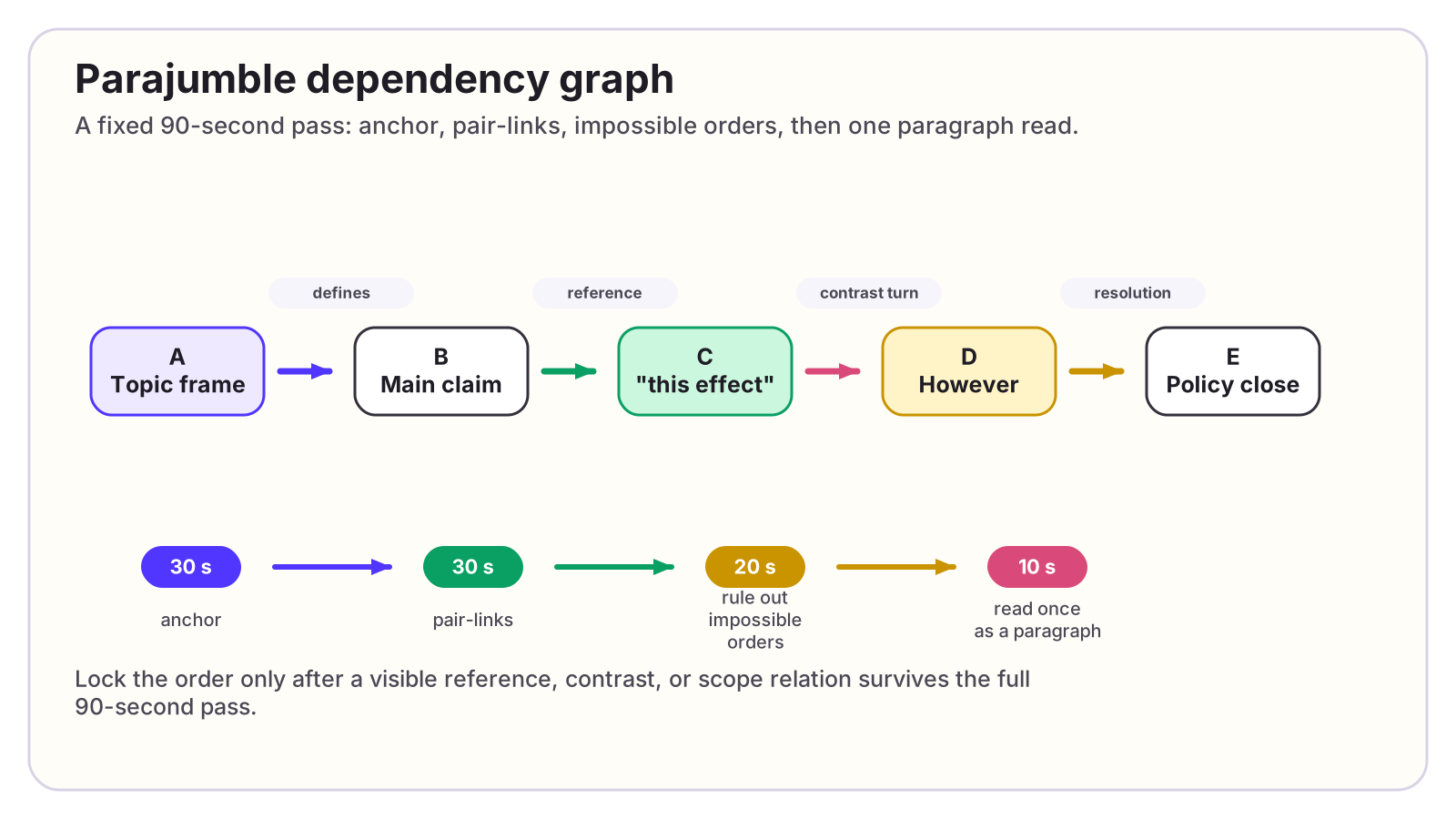
Most CAT parajumbles are TITA-style, so option elimination cannot rescue a weak chain. The official CAT site remains the annual authority for format updates 1, and 2IIM’s paper database lets you practise slot-wise VA questions from 2017-2025 2. Start with a 90-second cap: 30 seconds for the anchor, 30 for pair-links, 20 for impossible-order elimination, and 10 for a final paragraph read.
Anchor sentence - find the doorway before the room
An opener tends to define the topic, introduce a debate, or frame a problem. A closer tends to judge, conclude, or widen the implication. A sentence beginning with a pronoun, a demonstrative, or a consequence marker is rarely a stable opener. Cracku’s VARC trend page records that CAT 2024 had no parajumbles, but CAT 2023, 2022, and 2021 each retained VA questions around sentence ordering and summary tasks 3. That history is why the skill remains worth training even when one year de-emphasises it.
Label each sentence as opener, bridge, evidence, contrast, or closer. You are reducing possible positions before solving.
Pair-links - the 30 seconds that score the question
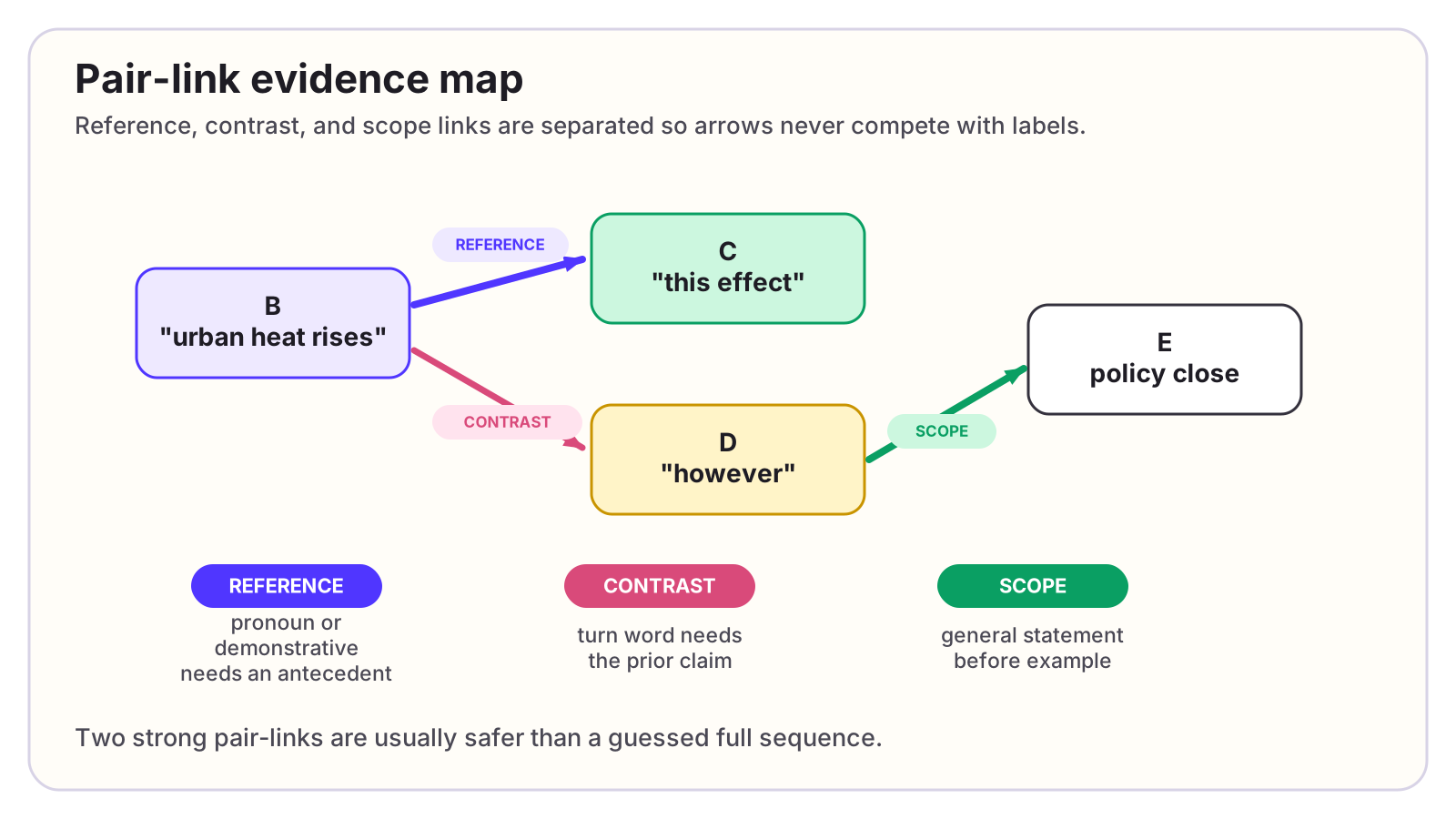
A pair-link is a visible dependency. “This claim” must come after a claim. “However” must come after the position being qualified. “For example” follows a general statement, not the other way around. IMS lists para-jumbles, para-summary, and odd-one-out among recurring VA task types, which makes these language signals central to CAT VARC preparation 5.
Use three tests: reference, chronology, and scope. Two strong pair-links usually solve the item.
Eliminate impossible orders - do not build five full chains
After you identify anchor and pairs, test only the remaining viable chains. A chain fails if a pronoun has no antecedent, a contrast appears before the contrasted idea, or a conclusion arrives before evidence. MBAUniverse notes that CAT VARC usually pairs RC dominance with a smaller VA sub-section, so every VA item needs a low-waste method 4.
Worked example - use structure, not memory
Consider five exam-style sentences about urban heat. Sentence A defines the problem, C says “this effect,” D begins with “however,” and E concludes with a policy implication. The safest chain is A -> B -> C -> D -> E because each reference lands cleanly. Retrieval-practice research supports attempt-before-solution review 7.
Practice routine - 5 questions, 4 error labels
Attempt five parajumbles twice a week. For each miss, label the error as anchor, pair-link, elimination, or verification. Dunlosky et al. support practice testing and distributed practice 6. If one label appears three times in two sessions, isolate that stage next.
FAQs
How much time should I spend on a CAT parajumble?
Use a 90-second cap in practice. If the anchor and at least one pair-link are not visible by 60 seconds, mark the item for later review and move on.
Are parajumbles always asked in CAT?
No. CAT 2024 VARC analysis from Cracku says parajumbles were excluded that year, while earlier recent papers retained VA sequencing tasks. Prepare the skill, but do not build the whole VARC plan around it 3.
What is the first step in parajumbles?
Find the anchor sentence. It is the sentence that introduces the topic, debate, or problem before references begin.
How do I review parajumble mistakes?
Record the failed stage: anchor, pair-link, elimination, or verification. The label tells you what to drill next.
Should I read all possible sequences aloud?
No. Build two viable chains at most, then verify the stronger one with reference and contrast signals.
Conclusion
Tonight, attempt 5 parajumbles with the 90-second decoder. Record the failed step for every miss. If anchor errors dominate, spend the next session only on first-sentence classification.
Related reading
References
- Indian Institutes of Management, "CAT official website," 2026. [Online]. Available: https://iimcat.ac.in/. Accessed: Jun. 14, 2026. ↩
- 2IIM, "CAT previous year question papers (2017-2025) with solutions," 2026. [Online]. Available: https://online.2iim.com/CAT-question-paper/. Accessed: Jun. 14, 2026. ↩
- Cracku, "CAT VARC topic-wise weightage," 2026. [Online]. Available: https://cracku.in/cat-varc-topic-wise-weightage/. Accessed: Jun. 14, 2026. ↩
- MBAUniverse, "CAT 2026 syllabus: section-wise topics and 5-year weightage analysis," 2026. [Online]. Available: https://www.mbauniverse.com/cat/syllabus. Accessed: Jun. 14, 2026. ↩
- IMS India, "CAT syllabus 2026: sections, topics, weightage, and exam pattern," 2026. [Online]. Available: https://www.imsindia.com/blog/cat/cat-syllabus/. Accessed: Jun. 14, 2026. ↩
- J. Dunlosky, K. A. Rawson, E. J. Marsh, M. J. Nathan, and D. T. Willingham, "Improving students’ learning with effective learning techniques: Promising directions from cognitive and educational psychology," Psychological Science in the Public Interest, vol. 14, no. 1, pp. 4-58, 2013. [Online]. Available: https://journals.sagepub.com/doi/10.1177/1529100612453266. Accessed: Jun. 14, 2026. ↩
- H. L. Roediger III and J. D. Karpicke, "Test-enhanced learning: Taking memory tests improves long-term retention," Psychological Science, vol. 17, no. 3, pp. 249-255, 2006. [Online]. Available: https://doi.org/10.1111/j.1467-9280.2006.01693.x. Accessed: Jun. 14, 2026. ↩
- S. Reddy, I. Labutov, S. Banerjee, and T. Joachims, "Unbounded human learning: Optimal scheduling for spaced repetition," 2016. [Online]. Available: https://arxiv.org/abs/1602.07032. Accessed: Jun. 14, 2026. ↩