Pillar Guide
Complete VARC Strategy for CAT 2026
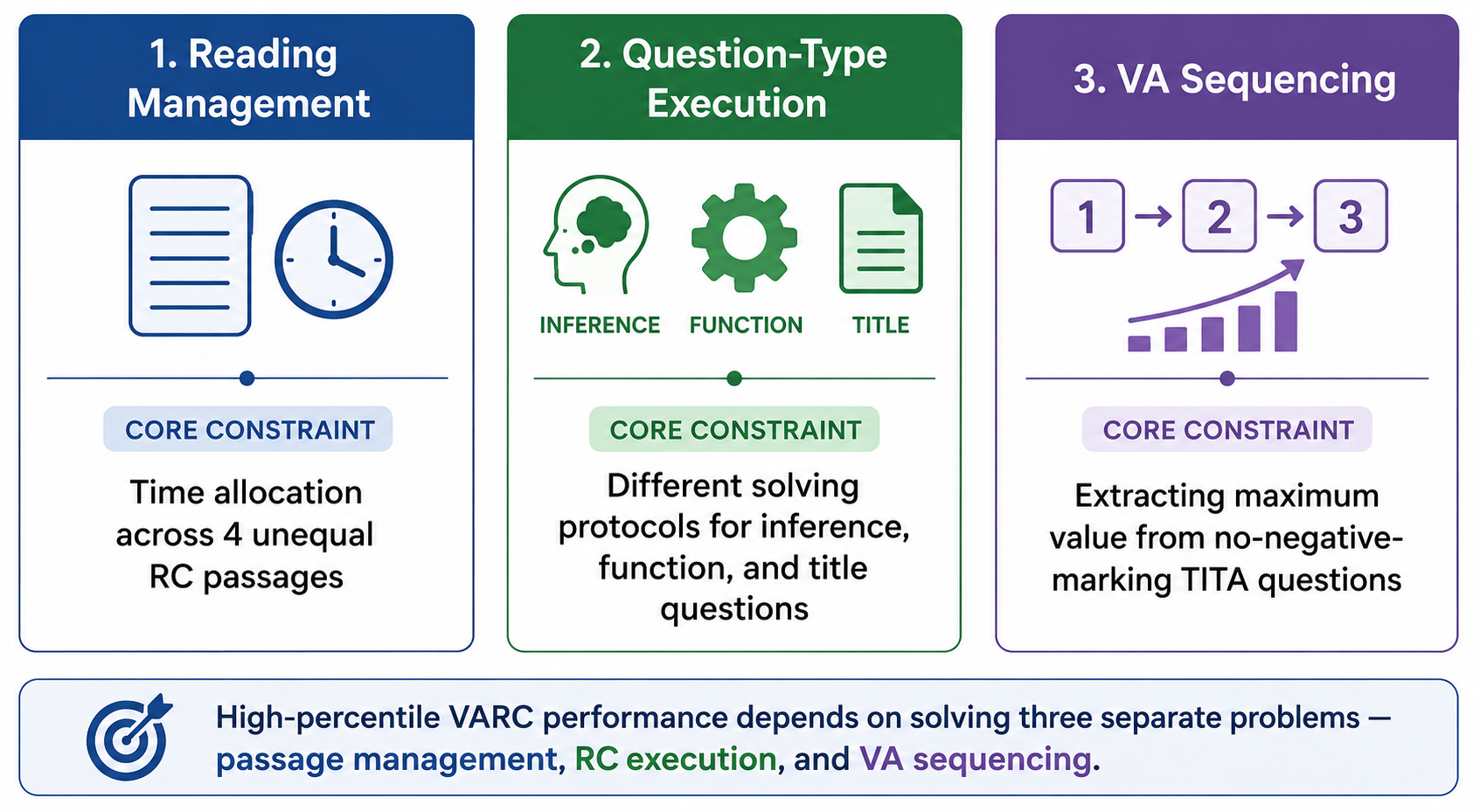
Most VARC scores do not rise because the student reads more passages. They rise when the student stops donating minutes to passages that were never worth attempting. Use CAT 2026 preparation to build three separate skills: choose the right passage in under 90 seconds, read the argument without drifting, and answer only when the text supports the option. That is a 40-minute decision system, not a reading-speed contest.
What VARC actually tests - 24-ish questions inside 40 minutes
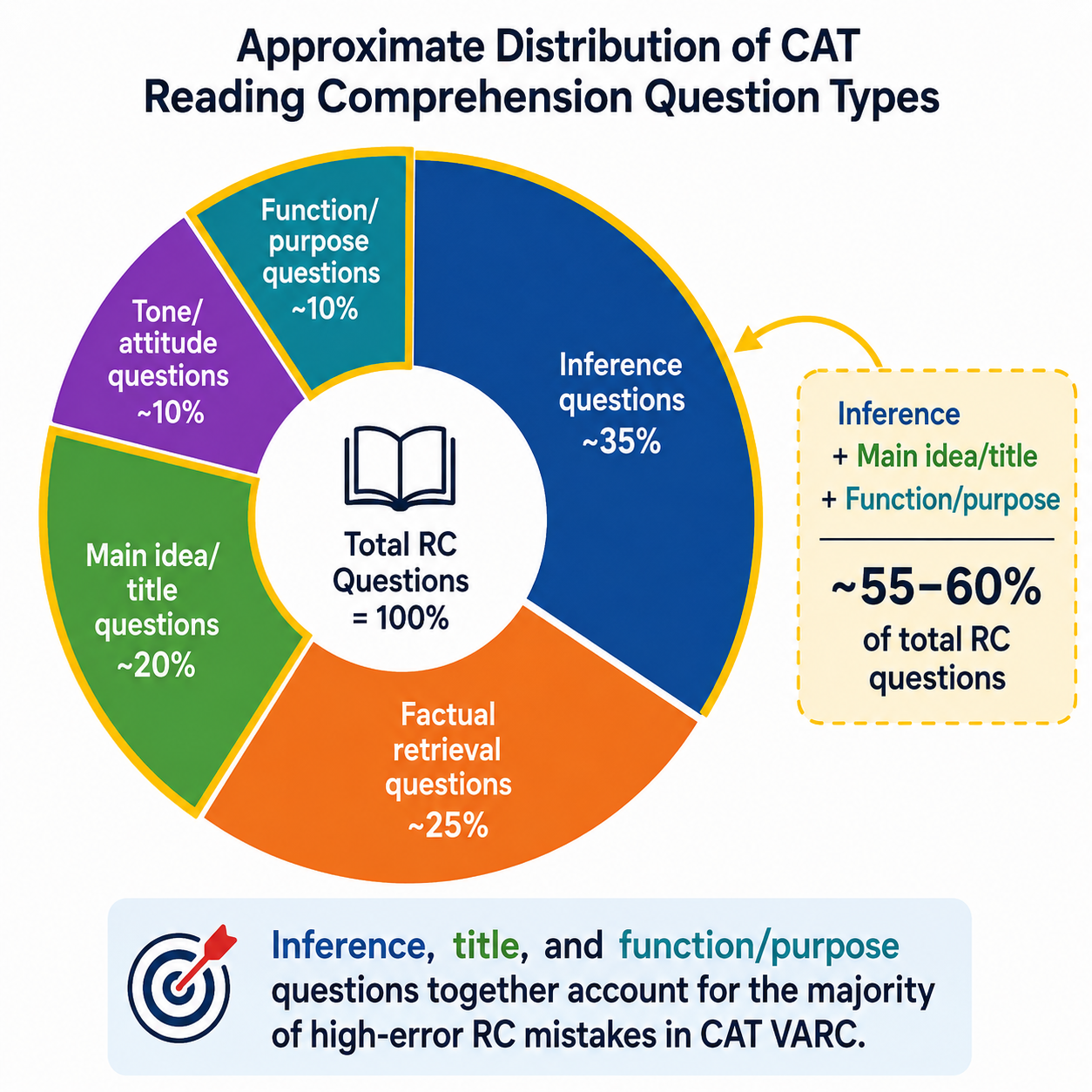
Recent CAT papers have used a separately timed VARC section of 40 minutes with roughly 24 questions, with Reading Comprehension accounting for 16 questions across four passages and Verbal Ability supplying the remaining 8 questions 1, 3. The CAT 2024 paper, for example, dropped para-jumbles and shifted the VA block toward para-summary, odd-one-out, and para-insertion; the CAT 2023 paper kept all four VA formats with a 2-2-2-2 distribution 3. The exact mix can move by notification, so refresh the count from the official CAT bulletin before the cycle begins 1.
Passage selection - 5 signals in 90 seconds
Most students open the section, start passage 1, and only realise mid-paragraph that the topic was the hardest of the four. A trained reader spends the first 90 seconds on five signals — domain familiarity, paragraph density, abstraction level, question-stem mix, and first-line clarity — and ranks the four passages from most-likely-attempt to last-resort before reading any of them. The signals are not equally weighted; first-line clarity and question-stem mix are the heaviest predictors of accuracy 3, 4.
| Signal | What to look for | Strong attempt signal | Weak attempt signal |
|---|---|---|---|
| Domain familiarity | Topic vocabulary in line 1 | Economics, history, behavioural science | Phenomenology, post-structuralism, art theory |
| Paragraph density | Visual block depth | 3-5 short paragraphs | 1-2 long unbroken blocks |
| Abstraction level | Concrete examples in passage | Cases, dates, named studies | Pure conceptual argument with no examples |
| Question-stem mix | Glance at question prompts | Main idea, detail, inference | Tone, author's likely view on X |
| First-line clarity | Opening sentence readability | Single claim, plain syntax | Sub-clauses, jargon, two qualifiers |
A practical rule: rank all four passages on these signals, then attempt your top two in full, your third selectively, and treat the fourth as a single-question raid only if time remains. Notice that this is a ranking decision, not a skip decision — the goal is to spend reading minutes where evidence is easiest to locate, not to prove you can survive the hardest passage in the section.
The 40-minute allocation - 27 minutes for core RC, 8 minutes for VA, 5 minutes for judgment
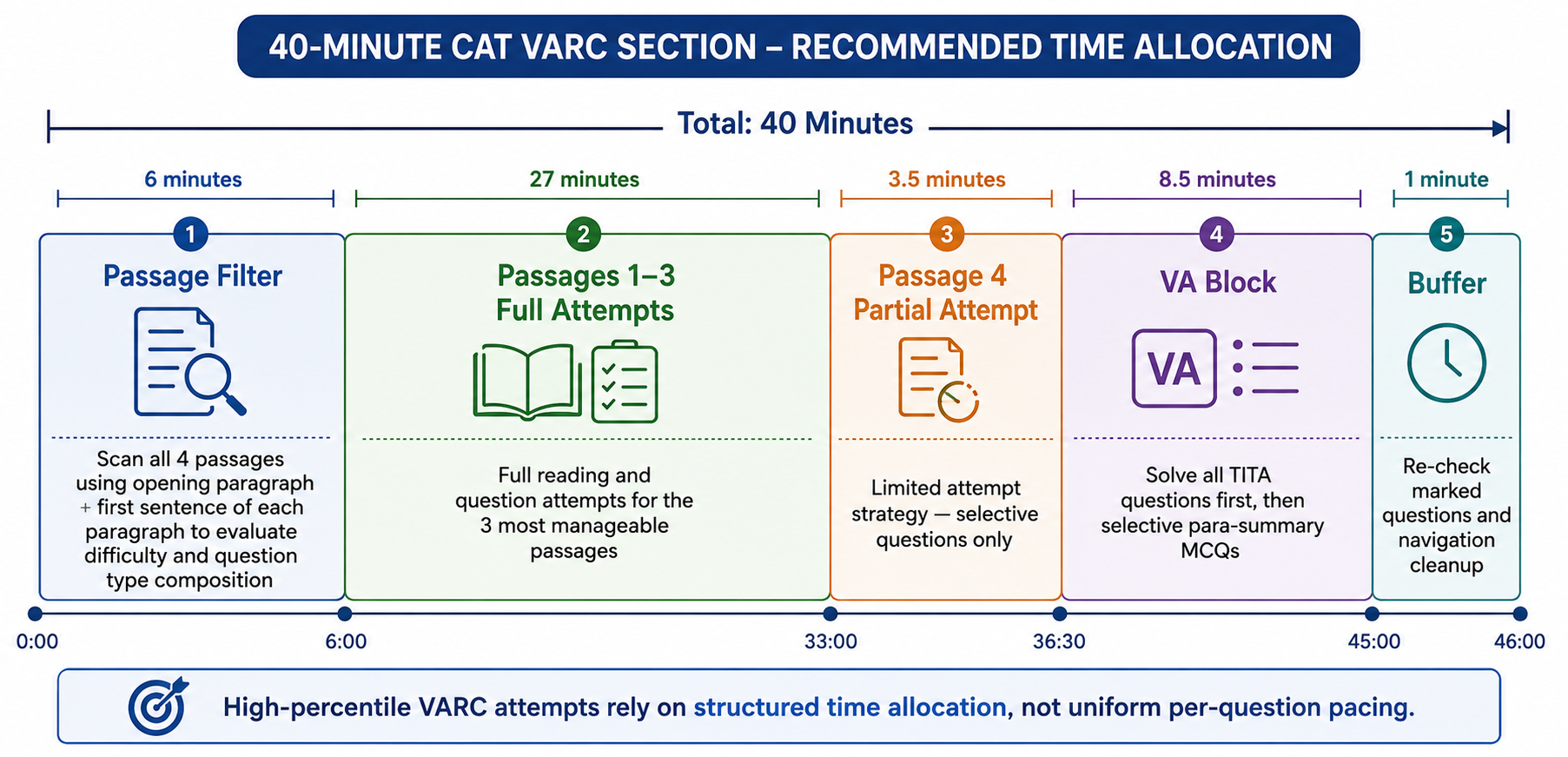
Use the first 5-6 minutes to scan domains, length, and question mix. Then commit to three full RC passages and keep one passage as a selective source of 1-2 answers. This protects the VA block and prevents the first hard passage from consuming the section. This is a preparation recommendation derived from mentor review patterns; it should be presented as strategy, not official data.
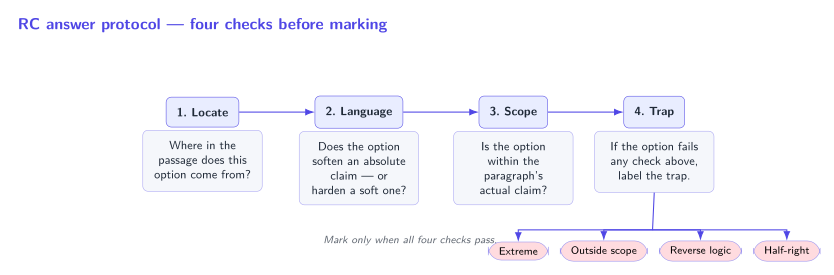
RC answer protocol - 4 checks before marking
First, locate the sentence or paragraph that supports the option. Second, check whether the option changes the author's language from limited to absolute. Third, match the scope: the passage may discuss one cause, not all causes. Fourth, label the trap if you reject it: extreme, outside scope, reverse logic, or half-right paraphrase. The review log matters more than the number of passages attempted in a day.
| Trap type | Signal | Repair drill |
|---|---|---|
| Extreme | Always / never / only | Rewrite option in softer terms |
| Outside scope | True but not in passage | Name the missing paragraph |
| Reverse logic | Cause and effect flipped | Draw arrow before answer |
| Half-right | First clause right, second wrong | Underline the break point |
Worked RC example - location, language, scope, trap
Below is a paraphrase example, not an actual CAT passage. It is written in a philosophy-of-science register, the kind of register CAT has used in roughly one passage per paper across recent cycles 3, 4.
Paraphrase passage (4 lines): Popper argued that a theory earns scientific status only when it forbids something — when an observation could, in principle, falsify it. Theories that explain every outcome equally well, he claimed, are weaker, not stronger. He treated this asymmetry between confirmation and refutation as the dividing line between science and pseudo-science. He did not, however, claim that unfalsifiable ideas are meaningless or that scientists must abandon them.
Question (inference): Which of the following can be most reasonably inferred from the passage about Popper's view?
Option A: Popper believed that any theory which explains many phenomena is unscientific.
Option B: Popper held that the value of a scientific theory lies in what it forbids, not only in what it predicts.
Option C: Popper considered all unfalsifiable theories to be meaningless and unworthy of study.
Option D: Popper claimed that confirmation and refutation contribute equally to a theory's scientific status.
Work through the four checks before marking. Notice that the correct option is the one that survives all four checks, not the one that sounds most sophisticated.
| Option | Location check | Language / scope check | Trap label | Decision |
|---|---|---|---|---|
| A | Line 2 supports the idea that "explains every outcome" is weaker | The option converts "explains every outcome equally well" to "explains many phenomena" — a scope shift from universal to merely broad | Outside scope | Reject |
| B | Lines 1 and 3 support "forbids" as the marker of scientific status | Language stays close to the passage; "not only in what it predicts" softens correctly without overclaiming | None — survives all four | Accept |
| C | Line 4 explicitly contradicts this | Passage states unfalsifiable ideas are not called meaningless | Reverse logic | Reject |
| D | Line 3 names an asymmetry, not equality | Option flips asymmetry to equality | Extreme / reverse | Reject |
The accuracy gain comes from refusing to mark Option A. It is the half-right distractor that lifts a phrase from the passage and pushes it past the author's actual scope. Most students who get this question wrong mark A; the repair drill is to underline the break point — the exact word where the option leaves the passage — before moving on.
VA sequencing - clear TITA before low-confidence MCQ
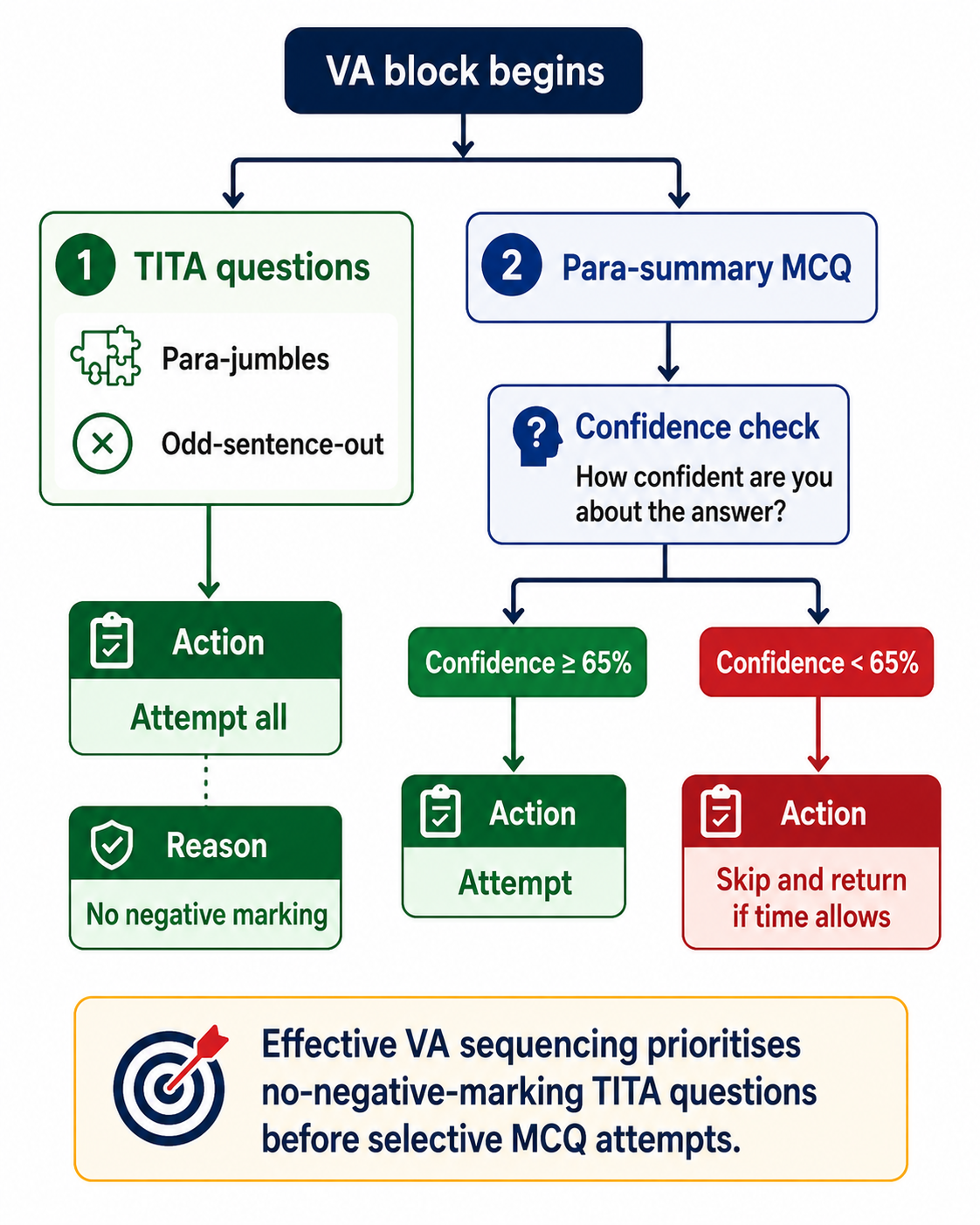
Para-jumbles and odd-sentence-out require structure, not guesswork. Start with opening-closing sentence markers, pronoun references, contrast markers, and chronology. Para-summary should be attempted after RC if your RC fatigue is high, because it uses the same scope-control skill. The safe rule: spend 8 planned minutes on VA, and do not steal those minutes for an uncertain fourth RC passage.
The 56-day VARC build - 6 days of practice plus 1 day of review
For 56 days, run a weekly loop: 8 RC passages, 20 VA questions, 1 sectional test, and 1 error-review block. Track only four metrics: passages skipped, answers changed after evidence check, trap type, and net score. If those four metrics improve, percentile usually follows. Do not publish a percentile promise here; the score conversion varies by year and slot 6, 7.
56-day weekly drill template - week-by-week
Most students collapse the eight weeks into a single uniform loop and then notice, in Week 6, that they have built reading volume but not selection discipline. The phased template below separates the foundation reading habit from the scope-control phase, then layers sectional sequencing, then peak rehearsal. Each phase keeps the weekly loop intact — 8 RC passages, 20 VA questions, 1 sectional, 1 review — but shifts the dominant drill so the four target metrics improve sequentially rather than in parallel.
| Phase | Weeks | Dominant drill | Weekly task mix | Target metric |
|---|---|---|---|---|
| 1. Foundation reading habit | Week 1-2 | Daily 30-minute long-form read with paragraph-by-paragraph summary | 8 RC + 20 VA + 1 sectional + 1 review; add daily editorial / long-form article | Reading sessions completed (consistency) |
| 2. Scope discipline | Week 3-4 | Evidence-location drill: for every wrong RC answer, write the exact line that supports the correct option | 8 RC + 20 VA + 1 sectional + 1 review; tag every wrong answer with a trap label | Trap-labelled wrong answers as a share of total errors |
| 3. Sectional sequencing | Week 5-6 | Full 40-minute sectionals under time pressure; passage selection in the first 5 minutes | 6 RC + 20 VA + 2 sectionals + 1 review; passage ranking written down before reading | Passages skipped on selection signal, not on fatigue |
| 4. Peak rehearsal | Week 7-8 | Two full mocks per week with section-debrief; no new content | 4 RC + 16 VA + 2 full mocks + 2 reviews; one mock simulated at exam time-of-day | Net VARC score and answer-change rate after evidence check |
A practical rule: do not advance to the next phase if the target metric has not moved for two consecutive weeks. Most students who plateau in Week 5 advanced too early from foundation reading; the repair is to drop back to Phase 1 for three days, then re-enter Phase 3 with the daily long-form read still running underneath.
VARC failure modes and repair drills
A common error in mock review is to treat every wrong answer as an isolated case. In practice, a student's wrong answers cluster: the same failure mode repeats across passages because the underlying habit has not been broken. Run the next three sectionals through this list, count which row appears most often in your error log, and run only that repair drill for a week.
| Failure mode | What it looks like | Repair drill |
|---|---|---|
| Over-attempting the hardest passage | Time-on-passage is highest on the passage with the lowest accuracy | Force a 6-minute hard stop on any passage where you have not finished the first read; reassign minutes to the easier passage you skipped |
| Marking the first plausible option | Answer chosen in under 20 seconds; rarely revisits the passage | Add a 10-second "find the line" pause before clicking; if you cannot point at a line, do not mark the option |
| Ignoring para-summary because of fatigue | Para-summary attempted last, accuracy below RC accuracy | Move para-summary into the VA block earlier; treat it as a fifth scope-control rep, not as a tail-end VA question |
| Confusing tone with content | Option chosen because it "sounds like the author" rather than because it restates the argument | For one week, force a written one-line summary of the author's claim before reading any option |
| Reading every passage at the same speed | No timestamp variance across the four passages in your sectional log | Set a different per-passage budget before reading, based on the selection ranking; review the variance, not the average |
Notice the pattern: every repair drill is a constraint, not a new skill. The skill is already there; the failure mode is a habit overriding it under time pressure.
Section debrief template - 4 questions after every mock
Most students review a VARC sectional by reading the answer key, marking the wrong answers in red, and moving on. That is review, not debrief. A debrief is a written answer to four specific questions, completed within 30 minutes of finishing the mock while the decisions are still recoverable. Do not skip the writing step — the act of forming a sentence forces the recall that mental review skips.
- Which passage should I have skipped, and what was the signal I missed? Name the passage by topic, name the signal from the five-signal list, and write one sentence on why the signal was visible in the first 90 seconds. If the answer is "no signal was missed," confirm the passage was attempted in your top two by ranking.
- For every wrong RC answer, which of the four traps was it — and which check did I skip? Write the trap label (extreme, outside scope, reverse logic, half-right) and the check you skipped (location, language, scope, trap). The pair matters; the trap names the option, the skipped check names the habit.
- Did I run the VA block as planned, or did I steal minutes from it? Write the actual VA minutes versus the planned 8. If they differ by more than 2 minutes, the next sectional starts with a VA-first dry run.
- What is the one process change for the next sectional? One change, not three. Most students who try to fix everything fix nothing; the discipline is to ship one constraint into the next mock and measure it.
The debrief is the artefact your mentor reads, not the answer key. If you are self-studying, keep the four answers in a single running document so the patterns across mocks become visible by Week 4.
FAQs
How many RC passages should I attempt in CAT VARC?
Most aspirants should train for three full passages plus selective questions from the fourth. High-accuracy readers can stretch, but only after mock data proves it.
Should I practise VA before RC or after RC?
Practise both. In the exam, reserve a planned VA block so no-penalty questions are not ignored.
Is reading speed the main VARC problem?
Not usually. The main problem is evidence discipline: options are marked without locating the exact support in the passage.
What if my mock scores plateau at 85 percentile?
A plateau at 85 usually traces to one habit, not a skill gap. Audit the last three sectionals against the five failure modes, and run the single most frequent repair drill for two weeks before changing your content plan.
How do I handle a passage in a domain I don't know?
Treat domain unfamiliarity as one of the five selection signals, not as a verdict. If the question-stem mix is favourable and the first line is clear, the passage may still be a strong attempt; if the stems are inference-heavy and the first line is dense, demote it to selective.
Should I read newspapers for VARC?
Editorials and long-form features train scope control more than news reports do. Read one editorial-grade piece per day from a source like The Hindu, Mint Lounge, Aeon, or The Atlantic, and write a one-line summary of the author's claim before moving on.
How is CAT VARC different from GMAT verbal?
CAT VARC is passage-heavy and evidence-driven; GMAT verbal mixes critical reasoning, sentence correction, and shorter RC. A GMAT-trained reader often over-attempts CAT passages because the GMAT rewards finishing every question — CAT VARC rewards skipping a hard passage entirely 4.
Conclusion
This week, attempt 8 RC passages and 20 VA questions. After each session, record one trap label and one timing decision. By Day 7, you should have at least 28 labeled errors to repair before the next sectional test. By Day 56, you should have 4 phases of weekly logs, a written debrief for every sectional, and a single dominant failure mode that you have either repaired or escalated to your mentor for review. The composite score conversion varies by year and slot, so anchor your progress to the four metrics — not to a target percentile — until your last two mocks agree within 3 marks 6, 7.
For institute-level grounding, the IIM Ahmedabad PGP 2026-28 cycle uses a VARC sectional cutoff of 85 percentile for General / EWS candidates and an overall cutoff of 95 percentile at the Preliminary Screening stage 13. Other IIMs publish their own sectional minima; the VARC discipline above is the floor, not the ceiling.
Related reading
- CAT exam overview
- RC strategy for CAT
- DILR strategy for CAT 2026
- QA strategy for CAT 2026
- How to prepare for CAT - full timeline
- CAT mock-test playbook
- CAT percentile explained
- Normalization glossary
- Composite score glossary
- IIM Ahmedabad cutoffs
- Clymber Foundation plan
- Clymber Mentor Pro plan
References
- Indian Institutes of Management, "CAT official website," 2025. [Online]. Available: https://iimcat.ac.in/. Accessed: Jun. 15, 2026. ↩
- Times of India Education, "CAT 2025 exam pattern and strategy reporting," 2025. [Online]. Available: https://timesofindia.indiatimes.com/education/news. Accessed: Jun. 15, 2026. ↩
- Cracku, "CAT VARC topic-wise weightage," 2025. [Online]. Available: https://cracku.in/cat-varc-topic-wise-weightage/. Accessed: Jun. 15, 2026. ↩
- 2IIM, "CAT previous-year question papers," 2025. [Online]. Available: https://online.2iim.com/CAT-question-paper/. Accessed: Jun. 15, 2026. ↩
- InsideIIM, "CAT preparation and admission analysis," 2025. [Online]. Available: https://insideiim.com/. Accessed: Jun. 15, 2026. ↩
- 2IIM, "CAT score calculator and score-vs-percentile estimates," 2025. [Online]. Available: https://online.2iim.com/CAT-question-paper/. Accessed: Jun. 15, 2026. ↩
- Career Launcher, "CAT marks vs percentile," 2025. [Online]. Available: https://www.careerlauncher.com/cat-mba/cat-marks-vs-percentile/. Accessed: Jun. 15, 2026. ↩
- Cracku, "CAT score calculator," 2025. [Online]. Available: https://cracku.in/cat-score-calculator/. Accessed: Jun. 15, 2026. ↩
- MBAUniverse, "CAT score vs percentile analysis," 2025. [Online]. Available: https://www.mbauniverse.com/articles/cat-score-vs-percentile. Accessed: Jun. 15, 2026. ↩
- IMS India, "CAT analysis and preparation resources," 2025. [Online]. Available: https://www.imsindia.com/blog/cat/. Accessed: Jun. 15, 2026. ↩
- Career Launcher, "CAT preparation resources," 2025. [Online]. Available: https://www.careerlauncher.com/cat-mba/. Accessed: Jun. 15, 2026. ↩
- National Institutional Ranking Framework, Ministry of Education, "India Rankings 2025: Management," 2025. [Online]. Available: https://www.nirfindia.org/Rankings/2025/ManagementRanking.html. Accessed: Jun. 15, 2026. ↩
- Indian Institute of Management Ahmedabad, "MBA Admissions - Indian Applicants, PGP 2026-28," 2026. [Online]. Available: https://www.iima.ac.in/academics/mba/admissions/indians. Accessed: Jun. 15, 2026. ↩