Topic Guide
RC inference questions for CAT: the qualifier check
Inference accuracy does not rise because you read more pages. It rises when you stop accepting options that overstate the passage. In CAT RC, the safest answer is often the most limited one. The qualifier check gives you a 45-second way to prove that limit before you click.
Inference is proof under limits
Inference questions feel subjective because the option is rarely a copied line. The guardrail is proof. Find the smallest passage statement that makes the option necessary, then ask whether the option stretches scope. 2IIM’s slot-wise CAT paper database is useful because it lets you practise inference across real RC sets rather than isolated drills 2.
Cracku’s 2024 analysis records 16 RC questions out of 24 VARC questions, so inference discipline affects more marks than most VA micro-topics 3.
The qualifier check - 45 seconds per inference item
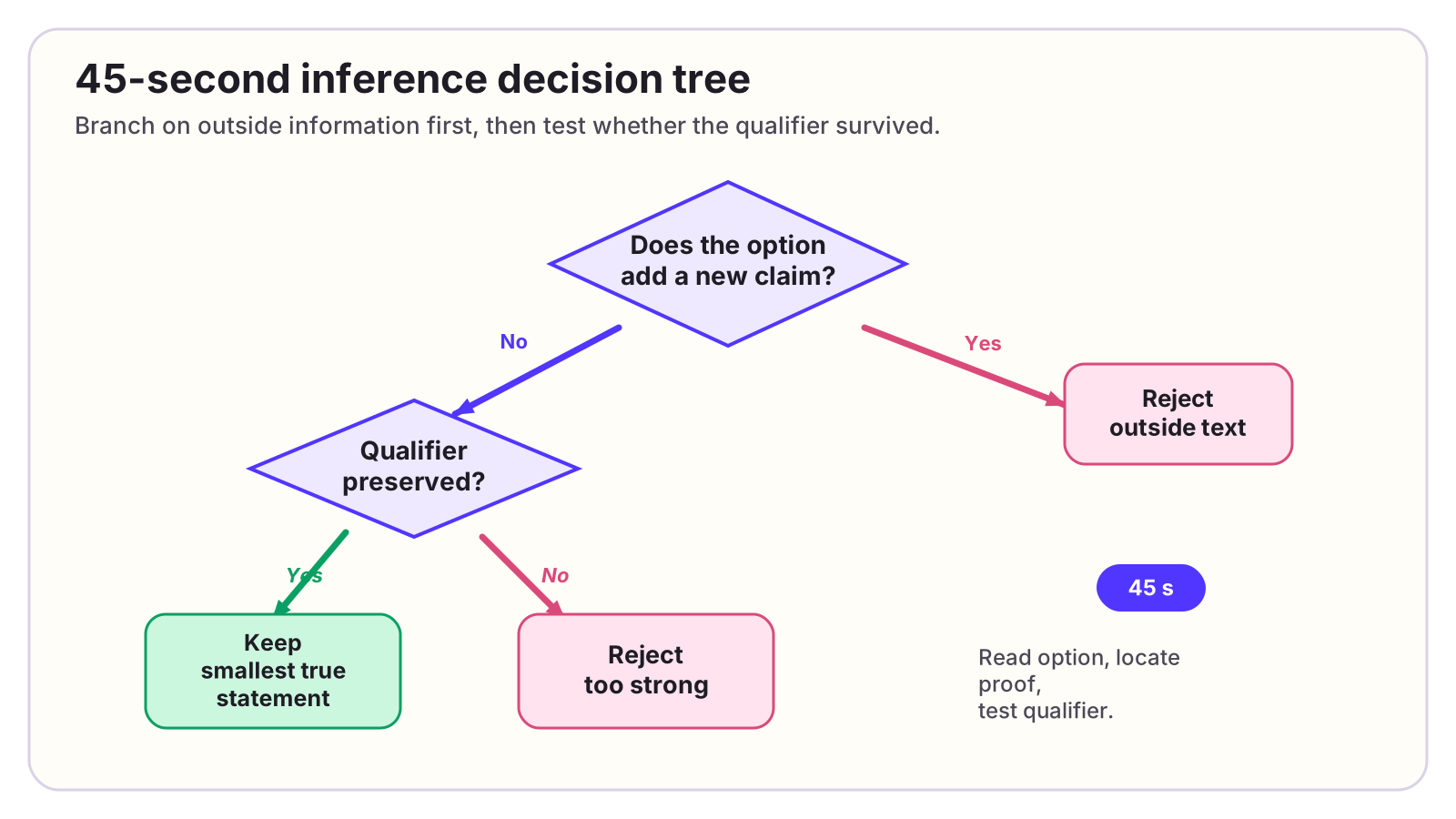
Run the qualifier check in three moves. Locate the relevant 2-3 lines. Mark qualifiers: some, most, may, rarely, only, unless, can, tends to. Then test the option for expansion. If the passage says “may weaken,” the option cannot say “will destroy.”
IMS describes inference-based questions as a common RC type, and the 40-minute section constraint keeps the method time-bound 5.
Main idea is not inference
A main-idea answer should cover the author’s central position. An inference answer may live in a smaller paragraph, a contrast, or a qualifier. MBAUniverse’s syllabus page notes that RC passages span literature, business, science, philosophy, and social sciences 4. In abstract passages, the temptation is to answer from theme familiarity. Resist it.
Ask: would the author have to accept this option if the quoted lines are true? If the answer is only “maybe,” reject it.
The four traps - name the error before you move on
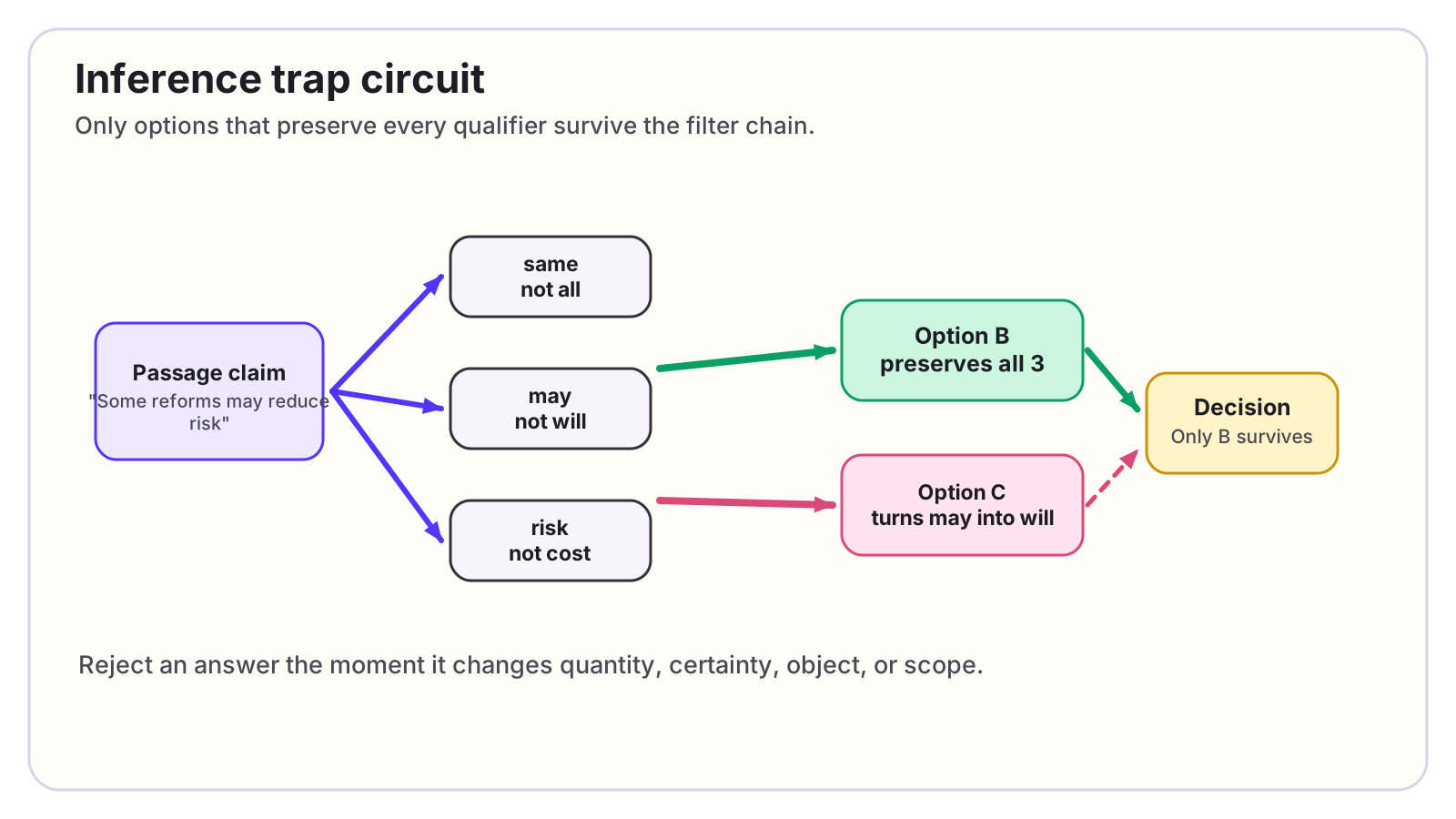
Use four labels. Too broad means the option expands the claim. Too causal means a relationship becomes cause. Too extreme means a qualified claim becomes absolute. Too external means the option may be true in the world but is not proved in the passage.
Refresh the official CAT site for annual format details 1. Keep the error label in your review sheet beside the question number.
Worked example - the smallest true statement wins
Suppose a passage says, “The policy reduced reported emissions, although measurement changed during the same period.” A safe inference is that the reduction should be interpreted with caution. An unsafe inference is that the policy failed, because the passage has not proved failure. The qualifier “although” limits confidence; it does not reverse the claim.
Roediger and Karpicke’s work on test-enhanced learning supports this attempt-first review pattern 7. Write your inference in 12 words before checking the option.
Practice protocol - 10 items for 4 weeks
Attempt 10 inference questions per week for 4 weeks. After every miss, copy the qualifier you ignored. Dunlosky et al. identify practice testing and distributed practice as high-utility methods 6, and spaced-review models show why old misses should return after a delay 8. Repeat misses on day 3 and day 7.
FAQs
What is an RC inference question in CAT?
It asks what must be true if the passage is true. The answer may not be copied from the passage, but it must be forced by passage evidence.
How much time should I give an inference question?
Train with a 45-second qualifier check after you locate the relevant lines. If proof is not visible, mark it and return after safer questions.
Why do I miss inference questions after understanding the passage?
Most misses come from scope. The option widens, intensifies, or adds a cause the passage did not prove.
Should I use outside knowledge in inference questions?
No. Outside knowledge may make an option sound plausible, but CAT RC rewards passage-bound reasoning.
How should I review inference errors?
Record the missed qualifier and tag the trap: too broad, too causal, too extreme, or too external.
Conclusion
This week, attempt 10 inference questions and write the proof line before each option choice. Your metric is not attempts; it is the count of scope errors that disappear by the fourth session.
Related reading
References
- Indian Institutes of Management, "CAT official website," 2026. [Online]. Available: https://iimcat.ac.in/. Accessed: Jun. 14, 2026. ↩
- 2IIM, "CAT previous year question papers (2017-2025) with solutions," 2026. [Online]. Available: https://online.2iim.com/CAT-question-paper/. Accessed: Jun. 14, 2026. ↩
- Cracku, "CAT VARC topic-wise weightage," 2026. [Online]. Available: https://cracku.in/cat-varc-topic-wise-weightage/. Accessed: Jun. 14, 2026. ↩
- MBAUniverse, "CAT 2026 syllabus: section-wise topics and 5-year weightage analysis," 2026. [Online]. Available: https://www.mbauniverse.com/cat/syllabus. Accessed: Jun. 14, 2026. ↩
- IMS India, "CAT syllabus 2026: sections, topics, weightage, and exam pattern," 2026. [Online]. Available: https://www.imsindia.com/blog/cat/cat-syllabus/. Accessed: Jun. 14, 2026. ↩
- J. Dunlosky, K. A. Rawson, E. J. Marsh, M. J. Nathan, and D. T. Willingham, "Improving students’ learning with effective learning techniques: Promising directions from cognitive and educational psychology," Psychological Science in the Public Interest, vol. 14, no. 1, pp. 4-58, 2013. [Online]. Available: https://journals.sagepub.com/doi/10.1177/1529100612453266. Accessed: Jun. 14, 2026. ↩
- H. L. Roediger III and J. D. Karpicke, "Test-enhanced learning: Taking memory tests improves long-term retention," Psychological Science, vol. 17, no. 3, pp. 249-255, 2006. [Online]. Available: https://doi.org/10.1111/j.1467-9280.2006.01693.x. Accessed: Jun. 14, 2026. ↩
- S. Reddy, I. Labutov, S. Banerjee, and T. Joachims, "Unbounded human learning: Optimal scheduling for spaced repetition," 2016. [Online]. Available: https://arxiv.org/abs/1602.07032. Accessed: Jun. 14, 2026. ↩