Quick Read
Vocabulary in context for CAT: why word lists do not work
I have seen students remember hundreds of definitions and still freeze on an RC line. CAT vocabulary is not a spelling bee; it is a context test. The useful word is the one you can infer, explain, and reuse inside a sentence. That is why this routine starts with one article, not one list.
The wrong goal - 1,000 words on a sheet
A long word list can make preparation feel measurable, but RC does not ask you to recite meanings. It asks whether you can use the surrounding sentence, author tone, and paragraph role. MBAUniverse describes CAT RC passages as coming from areas such as literature, business, science, philosophy, and social sciences 4. That range rewards reading breadth more than memorised lists.
The better goal is smaller: 40 words you can understand inside real sentences by the end of 6 weeks.
The context protocol - 8 words per week
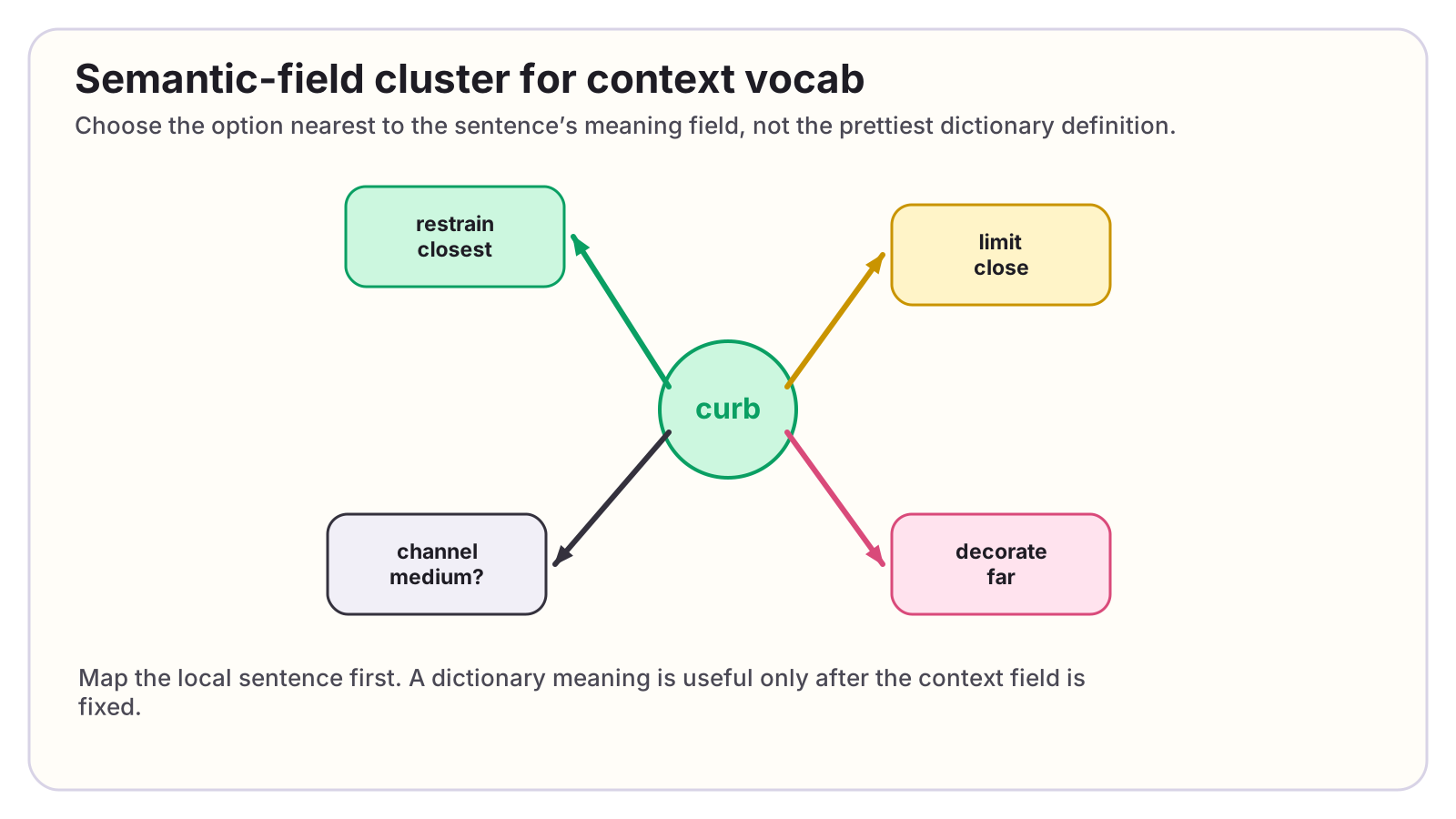
Each week, read one serious article from a source with dense prose. Mark only 8 words you do not own. For each word, write the original sentence, your context guess, the dictionary sense that fits, and your own sentence. Spaced-repetition research shows that timing of review matters, so return to the same 8 words on day 3 and day 7 8.
Eight words sound modest. That is the advantage: you can review them properly.
The word card - definition is only one field
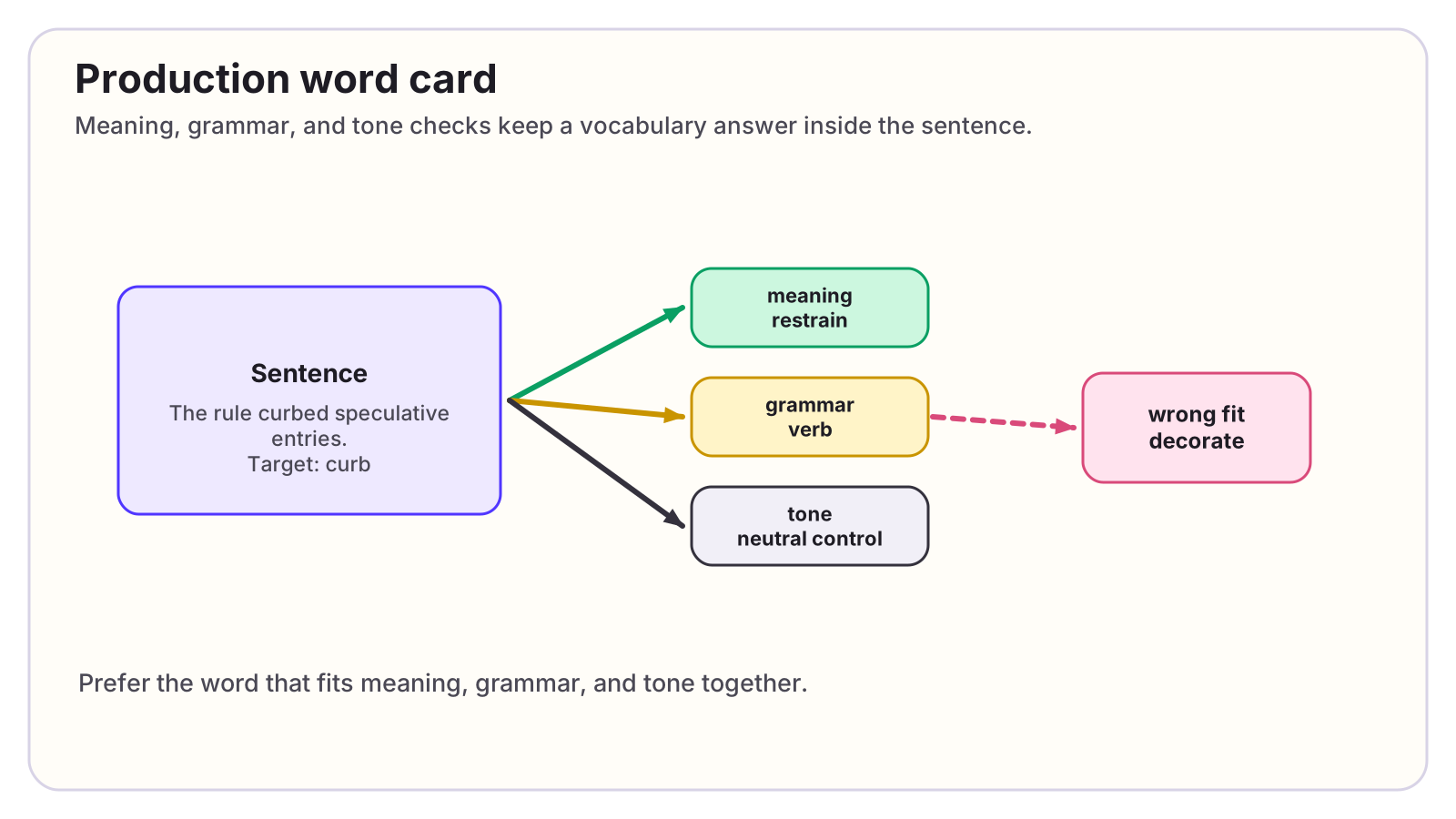
Do not write only “alacrity = eagerness.” Write the sentence, the author’s tone, the meaning you inferred, and one new sentence of your own. Retrieval practice research supports active recall over passive rereading 7. Your card should make you recall the meaning before you see it.
A strong card has four fields: line, guess, meaning, reuse. Any more becomes maintenance.
How vocabulary connects to RC accuracy
IMS lists vocabulary questions as one RC question type, but vocabulary also affects inference, tone, and author-purpose items 5. When one word blocks a sentence, ask whether it is essential to the argument. If not, move on. If yes, infer from contrast, example, or cause signals.
CAT official updates should still be refreshed annually 1, but context vocabulary is stable because it is reading behaviour rather than a fixed syllabus.
Review schedule - day 0, day 3, day 7
On day 0, create 8 cards. On day 3, cover the meaning and infer again from the original line. On day 7, use the word in a fresh sentence. Dunlosky et al. identify distributed practice as high utility, which is why this schedule beats one long vocabulary session 6.
If a word fails twice, keep it. If it passes twice, retire it and add a new word next week.
What to read - breadth beats comfort
Rotate four domains: economics, science, society, and culture. Cracku’s VARC analysis lists RC passages across varied genres and sources in recent CAT cycles 3. This does not mean you must predict the source. It means you should practise switching domains without losing structure.
One article per week is enough for vocabulary if you read it deeply and return to it twice.
FAQs
Is vocabulary important for CAT VARC?
Yes, but context matters more than isolated definitions. CAT RC usually rewards sentence-level inference and author tone.
How many words should I learn each week?
Use 8 words per week from one article. Over 6 weeks, that gives roughly 40 usable words after repeats and retirements.
Should I use GRE word lists for CAT?
Use them sparingly. A CAT routine should start from real reading because the exam tests words inside arguments.
How do I review vocabulary?
Review on day 0, day 3, and day 7. Cover the definition and infer from the original sentence before checking.
What sources should I read?
Rotate economics, science, society, and culture so you build comfort across passage domains.
Conclusion
Choose one serious article this week and extract 8 words from it. Build the 4-field cards, review them on day 3 and day 7, then retire only the words you can reuse accurately.
Related reading
References
- Indian Institutes of Management, "CAT official website," 2026. [Online]. Available: https://iimcat.ac.in/. Accessed: Jun. 14, 2026. ↩
- 2IIM, "CAT previous year question papers (2017-2025) with solutions," 2026. [Online]. Available: https://online.2iim.com/CAT-question-paper/. Accessed: Jun. 14, 2026. ↩
- Cracku, "CAT VARC topic-wise weightage," 2026. [Online]. Available: https://cracku.in/cat-varc-topic-wise-weightage/. Accessed: Jun. 14, 2026. ↩
- MBAUniverse, "CAT 2026 syllabus: section-wise topics and 5-year weightage analysis," 2026. [Online]. Available: https://www.mbauniverse.com/cat/syllabus. Accessed: Jun. 14, 2026. ↩
- IMS India, "CAT syllabus 2026: sections, topics, weightage, and exam pattern," 2026. [Online]. Available: https://www.imsindia.com/blog/cat/cat-syllabus/. Accessed: Jun. 14, 2026. ↩
- J. Dunlosky, K. A. Rawson, E. J. Marsh, M. J. Nathan, and D. T. Willingham, "Improving students’ learning with effective learning techniques: Promising directions from cognitive and educational psychology," Psychological Science in the Public Interest, vol. 14, no. 1, pp. 4-58, 2013. [Online]. Available: https://journals.sagepub.com/doi/10.1177/1529100612453266. Accessed: Jun. 14, 2026. ↩
- H. L. Roediger III and J. D. Karpicke, "Test-enhanced learning: Taking memory tests improves long-term retention," Psychological Science, vol. 17, no. 3, pp. 249-255, 2006. [Online]. Available: https://doi.org/10.1111/j.1467-9280.2006.01693.x. Accessed: Jun. 14, 2026. ↩
- S. Reddy, I. Labutov, S. Banerjee, and T. Joachims, "Unbounded human learning: Optimal scheduling for spaced repetition," 2016. [Online]. Available: https://arxiv.org/abs/1602.07032. Accessed: Jun. 14, 2026. ↩