Topic Guide
The 12-month CAT plan: month by month
A 12-month CAT plan is not 12 months of mocks. It is 4 months of skill, 4 months of sectional and full-test build-up, and 4 months of refinement. Students who invert that order often plateau by mock 8 because they start measuring before they have built the skills being measured. This plan gives you the month-by-month load.
Months 1-4 - concept-building
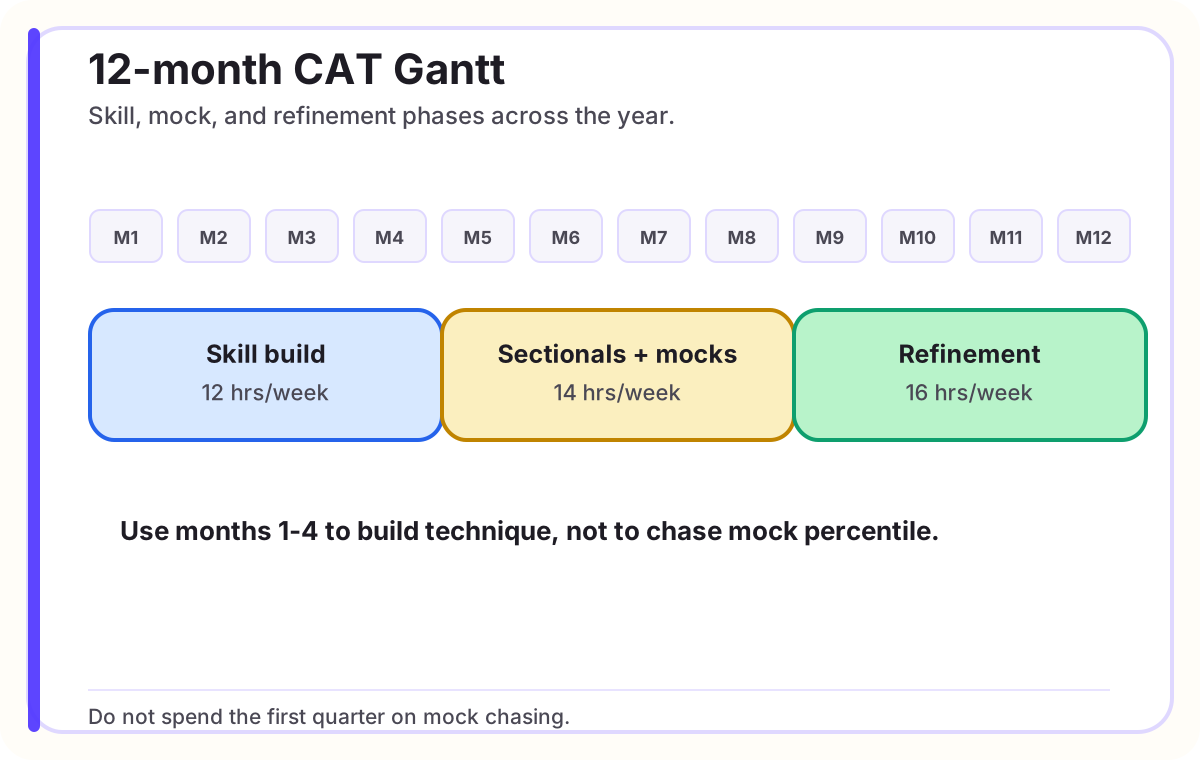
Block 12 hours per week. Split the hours across QA foundations, VARC reading, DILR set reading, and error-log writing. Use past papers for examples, not as weekly score events yet [2], [3].
The target by month 4 is not a percentile. It is topic coverage plus the ability to explain each error in one sentence.
Treat months 1-4 - concept-building as a capacity decision, not a motivation decision. The official CAT site controls dates and registration facts; the plan controls training load 1. Write the planned hours, completed hours, and review hours in the same row every Sunday. If one of those three numbers is missing, the next week will repeat the same mistake with a cleaner calendar but weaker evidence.
The review routine should be narrower than the study routine. Pick one VARC behaviour, one DILR behaviour, and one QA behaviour to observe during the week. Examples: re-reading too often, abandoning DILR sets too late, or starting QA without a skip threshold. The plan becomes useful only when it changes a decision inside a timed session, not when it adds another topic name.
Use the mentor or peer check as an audit of evidence. Bring three items: last test score, two recurring error tags, and the hours actually completed. Do not ask whether the plan looks strong. Ask which one action should change before the next test. That keeps months 1-4 - concept-building tied to one correction and one measurable follow-up.
The operating rhythm is weekly, even when the article is monthly. Convert months 1-4 - concept-building into seven-day tasks: reading blocks, problem blocks, sectional review, and one protected recovery slot. A plan that cannot survive one normal week of college, office, travel, or family load will not survive the full season.
Months 5-8 - sectional plus mock build
Move to 14 hours per week. From month 6, add one full mock per week and one sectional per weak area. The CAT official schedule changes yearly, so keep the annual notification as the date authority while using this plan as the training shape 1, [2].
A mock without review is a score screenshot. Budget at least the same time for analysis.
Treat months 5-8 - sectional plus mock build as a capacity decision, not a motivation decision. The official CAT site controls dates and registration facts; the plan controls training load 1. Write the planned hours, completed hours, and review hours in the same row every Sunday. If one of those three numbers is missing, the next week will repeat the same mistake with a cleaner calendar but weaker evidence.
The review routine should be narrower than the study routine. Pick one VARC behaviour, one DILR behaviour, and one QA behaviour to observe during the week. Examples: re-reading too often, abandoning DILR sets too late, or starting QA without a skip threshold. The plan becomes useful only when it changes a decision inside a timed session, not when it adds another topic name.
Use the mentor or peer check as an audit of evidence. Bring three items: last test score, two recurring error tags, and the hours actually completed. Do not ask whether the plan looks strong. Ask which one action should change before the next test. That keeps months 5-8 - sectional plus mock build tied to one correction and one measurable follow-up.
The operating rhythm is weekly, even when the article is monthly. Convert months 5-8 - sectional plus mock build into seven-day tasks: reading blocks, problem blocks, sectional review, and one protected recovery slot. A plan that cannot survive one normal week of college, office, travel, or family load will not survive the full season.
Months 9-12 - refinement
Move toward 16 hours per week if work or college load allows. Keep two mocks per week only when both are reviewed. Stop adding new rare topics once they displace repair work.
The refinement phase is where skip rules, sectional order, and stamina become visible.
Treat months 9-12 - refinement as a capacity decision, not a motivation decision. The official CAT site controls dates and registration facts; the plan controls training load 1. Write the planned hours, completed hours, and review hours in the same row every Sunday. If one of those three numbers is missing, the next week will repeat the same mistake with a cleaner calendar but weaker evidence.
The review routine should be narrower than the study routine. Pick one VARC behaviour, one DILR behaviour, and one QA behaviour to observe during the week. Examples: re-reading too often, abandoning DILR sets too late, or starting QA without a skip threshold. The plan becomes useful only when it changes a decision inside a timed session, not when it adds another topic name.
Use the mentor or peer check as an audit of evidence. Bring three items: last test score, two recurring error tags, and the hours actually completed. Do not ask whether the plan looks strong. Ask which one action should change before the next test. That keeps months 9-12 - refinement tied to one correction and one measurable follow-up.
The operating rhythm is weekly, even when the article is monthly. Convert months 9-12 - refinement into seven-day tasks: reading blocks, problem blocks, sectional review, and one protected recovery slot. A plan that cannot survive one normal week of college, office, travel, or family load will not survive the full season.
Four monthly checkpoints
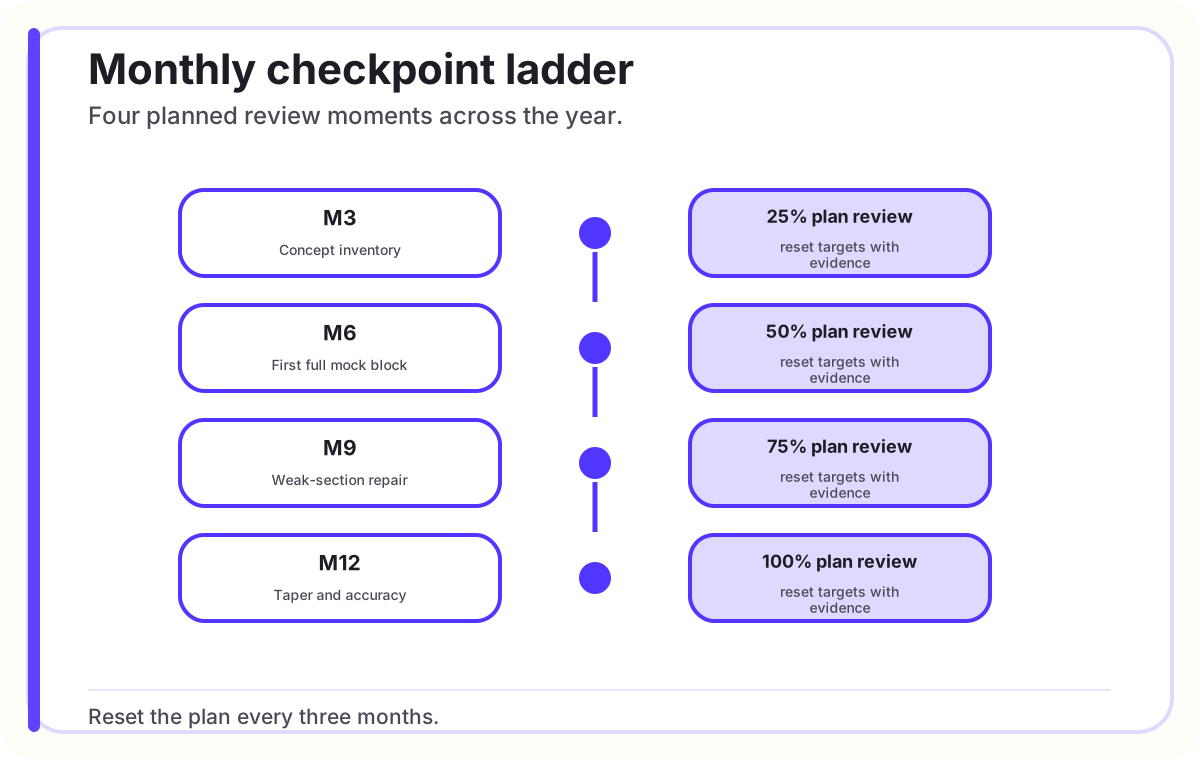
The four checkpoints are concept inventory at month 3, mock-readiness at month 6, weak-section repair at month 9, and taper discipline at month 12. Use the same evidence every time: last 3 test scores, error categories, and hours actually completed.
Do not change the plan because of one good or bad test.
Treat four monthly checkpoints as a capacity decision, not a motivation decision. The official CAT site controls dates and registration facts; the plan controls training load 1. Write the planned hours, completed hours, and review hours in the same row every Sunday. If one of those three numbers is missing, the next week will repeat the same mistake with a cleaner calendar but weaker evidence.
The review routine should be narrower than the study routine. Pick one VARC behaviour, one DILR behaviour, and one QA behaviour to observe during the week. Examples: re-reading too often, abandoning DILR sets too late, or starting QA without a skip threshold. The plan becomes useful only when it changes a decision inside a timed session, not when it adds another topic name.
Use the mentor or peer check as an audit of evidence. Bring three items: last test score, two recurring error tags, and the hours actually completed. Do not ask whether the plan looks strong. Ask which one action should change before the next test. That keeps four monthly checkpoints tied to one correction and one measurable follow-up.
Common 12-month mistakes
Early mock obsession creates anxiety without skill. Late topic hoarding creates shallow coverage. Syllabus sources are useful to keep the map complete, but the plan must decide what to postpone [4], [5], [6].
Use the monthly checkpoint to prevent both errors.
Treat common 12-month mistakes as a capacity decision, not a motivation decision. The official CAT site controls dates and registration facts; the plan controls training load 1. Write the planned hours, completed hours, and review hours in the same row every Sunday. If one of those three numbers is missing, the next week will repeat the same mistake with a cleaner calendar but weaker evidence.
The review routine should be narrower than the study routine. Pick one VARC behaviour, one DILR behaviour, and one QA behaviour to observe during the week. Examples: re-reading too often, abandoning DILR sets too late, or starting QA without a skip threshold. The plan becomes useful only when it changes a decision inside a timed session, not when it adds another topic name.
Use the mentor or peer check as an audit of evidence. Bring three items: last test score, two recurring error tags, and the hours actually completed. Do not ask whether the plan looks strong. Ask which one action should change before the next test. That keeps common 12-month mistakes tied to one correction and one measurable follow-up.
What to do this week
Do not build a beautiful calendar for 12 months. Build the next 7 days. Put 12 hours on the calendar and record how many you actually complete.
Your first metric is hours hit, not score improvement.
Treat what to do this week as a capacity decision, not a motivation decision. The official CAT site controls dates and registration facts; the plan controls training load 1. Write the planned hours, completed hours, and review hours in the same row every Sunday. If one of those three numbers is missing, the next week will repeat the same mistake with a cleaner calendar but weaker evidence.
The review routine should be narrower than the study routine. Pick one VARC behaviour, one DILR behaviour, and one QA behaviour to observe during the week. Examples: re-reading too often, abandoning DILR sets too late, or starting QA without a skip threshold. The plan becomes useful only when it changes a decision inside a timed session, not when it adds another topic name.
Use the mentor or peer check as an audit of evidence. Bring three items: last test score, two recurring error tags, and the hours actually completed. Do not ask whether the plan looks strong. Ask which one action should change before the next test. That keeps what to do this week tied to one correction and one measurable follow-up.
FAQs
Is 12 months enough for CAT preparation?
Yes, for many students, if the year is sequenced into skill building, mock building, and refinement rather than filled with early mocks.
How many hours per week should I study in a 12-month plan?
Start around 12 hours per week, move toward 14 in the middle phase, and use 16 only when mocks and review can both fit.
When should full mocks start?
Use full mocks from around month 6. Before that, sectionals and concept drills are usually more useful.
Should I cover every QA topic in 12 months?
Cover the major topics, but keep a priority order. Rare topics should not displace arithmetic, algebra, geometry, and number theory.
How often should I review the plan?
Run a formal review every 3 months using scores, error types, and actual hours completed.
Conclusion
Choose the next 7 days, not the full season. Put the hours or mocks on the calendar, then review what actually happened before you expand the plan.
Related reading
References
- Indian Institutes of Management, "Common Admission Test official website," 2025. [Online]. Available: https://iimcat.ac.in/ [2] The Economic Times, "CAT 2025 Notification Released: Registration begins August 1 at iimcat.ac.in," 2025. [Online]. Available: https://economictimes.indiatimes.com/news/new-updates/cat-2025-notification-released-at-iimcat-ac-in-exam-on-november-30-registrations-begin-august-1-at-iimcat-ac-in/articleshow/122932378.cms [3] 2IIM, "CAT previous year question papers," 2025. [Online]. Available: https://online.2iim.com/CAT-question-paper/ [4] Cracku, "CAT previous papers," 2025. [Online]. Available: https://cracku.in/cat-previous-papers [5] IMS India, "CAT syllabus and preparation guide," 2025. [Online]. Available: https://www.imsindia.com/blog/cat/cat-syllabus/ [6] MBAUniverse, "CAT syllabus and exam pattern," 2025. [Online]. Available: https://www.mbauniverse.com/articles/cat-syllabus [7] Career Launcher, "CAT exam pattern," 2025. [Online]. Available: https://www.careerlauncher.com/cat-mba/exam-pattern/ [8] Shiksha, "CAT exam pattern," 2025. [Online]. Available: https://www.shiksha.com/mba/cat-exam-pattern ↩