Pillar Guide
How to Prepare for CAT: Realistic Timelines for 2026
The best CAT timeline is not the longest one. It is the one that fits your current score, weekly hours, and review discipline. A 12-month plan without mocks can be weaker than a 6-month plan with honest review. Start with time available, then decide syllabus speed, mock frequency, and repair depth.
This guide gives four runway options — 12, 9, 6, and 3 months — and three real-life templates for students, working professionals, and final-year undergrads. Pick the runway that matches your calendar, then borrow the weekly template that matches your life.
12 months left - build the base before mock pressure
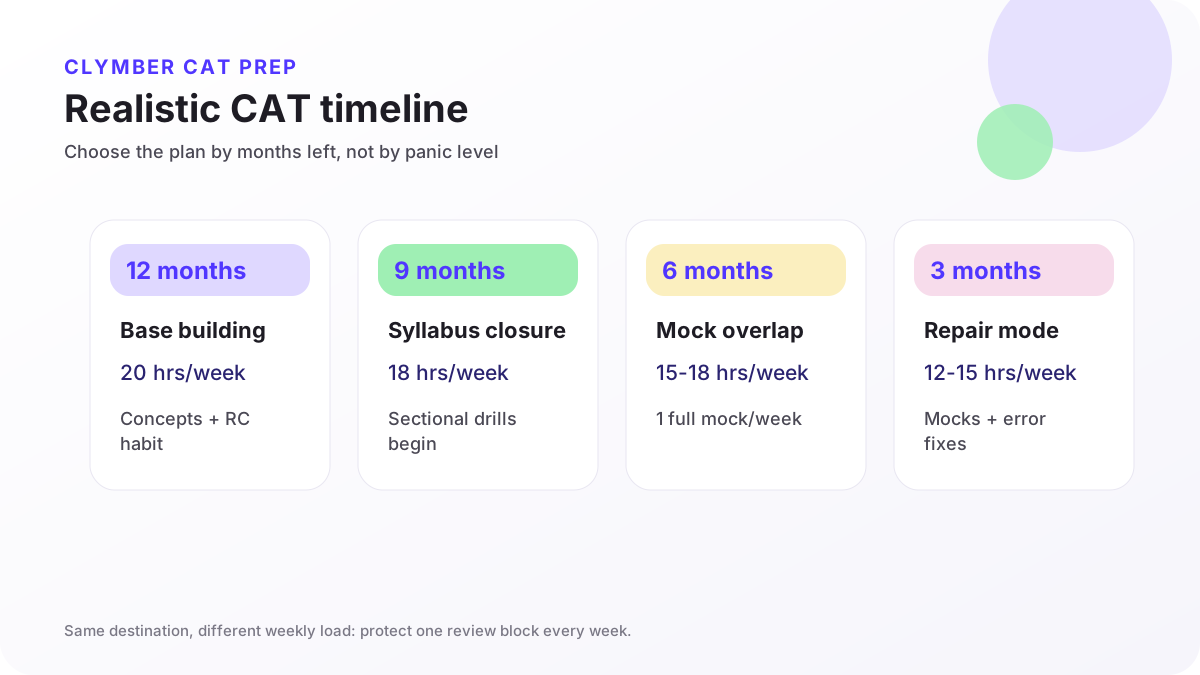

Use 8-10 hours per week. Spend the first 4 months on fundamentals, the next 4 on sectionals and mixed sets, and the last 4 on mocks. Begin light mocks by month 4 so exam temperament is not discovered too late.
12-month plan: month-by-month milestones
The table below assumes a December 2025 start for the CAT 2026 attempt. Months are calendar months, not abstract units. Sectional cadence refers to single-section timed tests (40 minutes for VARC and QA, 45 minutes for DILR — mirroring the live exam) 2. Full-mock cadence refers to 3-hour proctored attempts under exam conditions.
| Month | Primary focus | Sub-skills | Mock cadence | Section-test cadence |
|---|---|---|---|---|
| Dec 2025 (M1) | QA arithmetic + RC reading habit | Percentages, ratios, averages; 4 RC passages per week | None | None |
| Jan 2026 (M2) | QA algebra + RC question types | Linear and quadratic equations, inequalities; main-idea and inference tags | None | 1 VARC sectional |
| Feb 2026 (M3) | QA number system + VA grammar | Divisibility, remainders; para-jumble logic, summary, odd-one-out | 1 diagnostic mock | 1 VARC + 1 QA |
| Mar 2026 (M4) | DILR set classification + QA geometry | Tables, bar graphs, caselets, LR puzzles; triangles, circles, mensuration | 1 mock | 1 of each section |
| Apr 2026 (M5) | QA modern math + DILR caselets | P&C, probability, sequences; data caselets, growth tables | 2 mocks | 1 of each section |
| May 2026 (M6) | Cross-section mixed practice | Topic interleaving across all 3 sections | 2 mocks | 2 of each section |
| Jun 2026 (M7) | Weakness repair from M3-M6 mocks | Top 3 error causes per section | 2 mocks | 2 of each section |
| Jul 2026 (M8) | DILR set selection drill | Skip-decision protocol within first 4 minutes per set | 2 mocks | 2 of each section |
| Aug 2026 (M9) | VARC inference and assumption | High-difficulty RC, critical reasoning | 3 mocks | 3 of each section |
| Sep 2026 (M10) | Full-mock rhythm + review depth | Section-wise time allocation under pressure | 3 mocks | 2 of each section |
| Oct 2026 (M11) | Repair-only month | No new content; only error-log resolution | 4 mocks | 2 of each section |
| Nov 2026 (M12) | Peak rehearsal + taper | 3 mocks in first 3 weeks, 1 light mock 8-10 days before exam day | 3 mocks + 1 taper | 1 of each section |
Notice the cadence is not flat. Mock frequency steps up only after fundamentals settle, then plateaus through October so review depth catches up with attempt volume. November is taper, not a final sprint — the goal is to enter exam day with a calm nervous system, not a fresh muscle strain 3.
The "primary focus" column is what gets fresh-mind time in the morning or first session of the day. The "sub-skills" column is what gets evening repetition. Keep the split: morning is for new patterns, evening is for repetition and review.
9 months left - finish syllabus and sectionals together
Use 10-12 hours per week. Complete core arithmetic, algebra, RC, VA, and major DILR set types in the first 4 months. From month 5 onward, run sectionals every week and mocks every 2 weeks, then increase mock frequency near the final quarter.
6 months left - syllabus and mocks must overlap
Use 12-15 hours per week. Build topic coverage and testing together: 3 topic blocks, 2 sectionals, and 1 review block every week. Start full mocks within the first 30 days to identify the highest-value repairs.
6-month plan: 26-week breakdown
A 6-month plan does not have the luxury of sequential phases. Foundation, application, and rehearsal must overlap. The 26 weeks split into three phases — Foundation (weeks 1-8), Application (weeks 9-18), and Peak rehearsal (weeks 19-26). The phases differ in what dominates the week, not what is excluded.
| Phase | Weeks | Weekly hours | Drills | Mock cadence |
|---|---|---|---|---|
| Foundation | 1-8 | 12-14 | 3 QA topic blocks, 2 RC passages, 1 DILR set per day, 1 VA drill | Week 1 diagnostic; then 1 mock every 2 weeks from week 4 |
| Application | 9-18 | 14-16 | 2 QA topic blocks, 1 DILR set per day, 4 RC passages per week, 2 VA drills, 1 sectional per section | 1 mock per week from week 9 |
| Peak rehearsal | 19-26 | 12-14 | Mixed-section daily, error-log review, no new content after week 22 | 2 mocks per week from week 19 through week 24; 1 light mock in week 25; rest in week 26 |
Foundation weeks build the muscle memory the later phases stress-test. Week 1 always opens with a diagnostic mock — even when you feel unprepared. The diagnostic is not a verdict; it is a baseline that lets every later mock measure delta. Skipping the diagnostic costs a 6-month plan more than any single missed topic 4.
Application weeks shift the centre of gravity from learning to applying. The 4 RC passages per week become diagnostic passages — read with the question types you got wrong in the previous mock in mind. The 2 VA drills should rotate through summary, odd-one-out, and para-jumble in a 3-week cycle, not 6 of the same type back-to-back.
Peak rehearsal weeks are the hardest to design and the easiest to ruin. Two mocks per week with same-day review is the ceiling for most people; three mocks per week with shallow review is worse than one mock per week with deep review. Week 26 is rest — light reading, no full mocks, and a single sectional 3-4 days before the exam to keep timing sharp without inducing fatigue 3.
3 months left - mock-led repair, not syllabus perfection
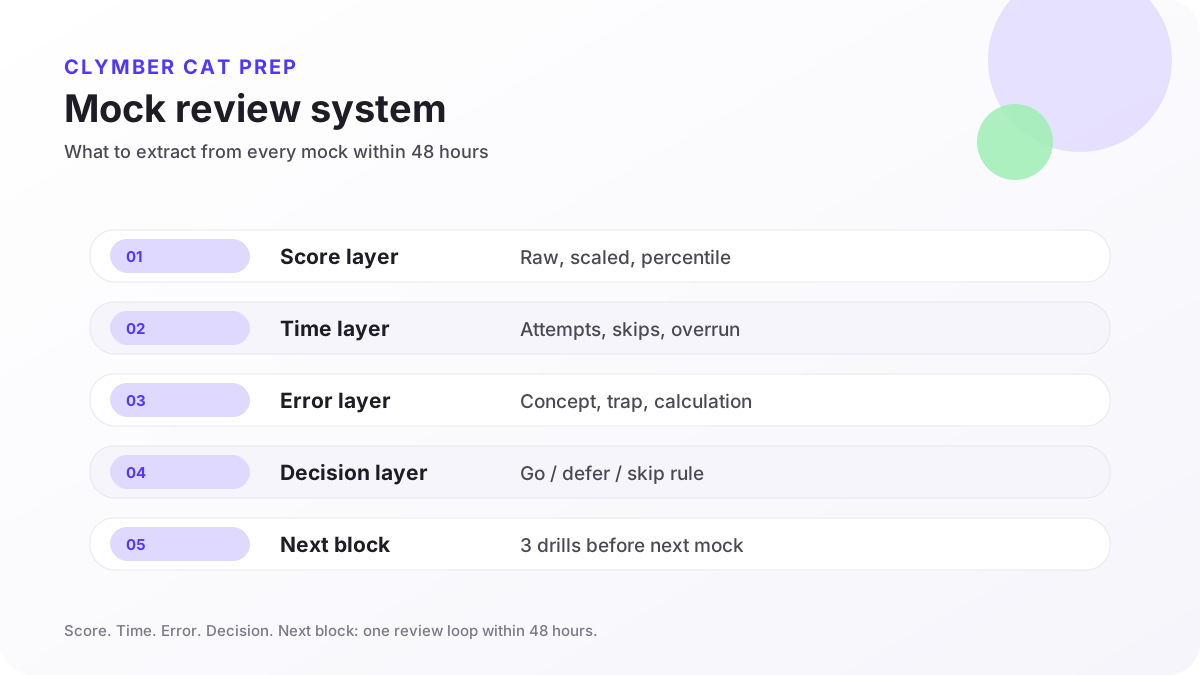
Use 15-18 hours per week if health and schedule allow it. Take 1 full mock per week, then spend 2-3 days repairing the top 3 causes. Skip low-frequency topics that are consuming time without improving net score.
3-month plan: 13-week sprint protocol
A 3-month plan is a repair operation, not a syllabus operation. The 13 weeks split into a 3-week stabilisation, a 7-week peak, and a 3-week taper. Weekly mocks begin in week 4 and continue through week 12.
| Week | Task focus | Mock | Notes |
|---|---|---|---|
| 1 | Diagnostic mock + error log setup | 1 full mock | Identify top 3 error causes per section |
| 2 | QA arithmetic and algebra refresh | None | 80-100 questions, untimed |
| 3 | RC + DILR set selection drill | 1 mock | Practice skip-decisions under timer |
| 4 | Weekly-mock rhythm begins | 1 mock + 2 sectionals | Mock on Sunday, sectionals mid-week |
| 5 | VARC inference + DILR caselets | 1 mock + 2 sectionals | Same Sunday-mock rhythm |
| 6 | QA geometry + VA grammar | 1 mock + 2 sectionals | Same rhythm |
| 7 | Mid-sprint full diagnostic week | 2 mocks (Wed + Sun) | Compare against week-1 baseline |
| 8 | Repair-heavy week — no new topics | 1 mock + 3 sectionals | Drill the error log only |
| 9 | DILR mixed sets + RC density | 1 mock + 2 sectionals | High-difficulty RC focus |
| 10 | QA modern math + VA mixed | 1 mock + 2 sectionals | Same rhythm |
| 11 | Full rehearsal week | 2 mocks (Wed + Sun) | Same time-of-day as exam |
| 12 | Last full mock + repair only | 1 mock | No new content from this week |
| 13 | Taper week | None | Light review, sleep, 1 sectional 3 days before |
What NOT to do in a 3-month plan:
- Do not attempt full syllabus coverage — pick the 60% of topics that carry 80% of marks and ignore the rest 4.
- Do not take more than 2 mocks per week — review depth collapses past that point.
- Do not change strategy after a single bad mock — wait for the average of 3 consecutive mocks before adjusting.
- Do not skip the taper week — exam-day score correlates more with sleep in the final 7 days than with any extra practice session 3.
Sample week templates
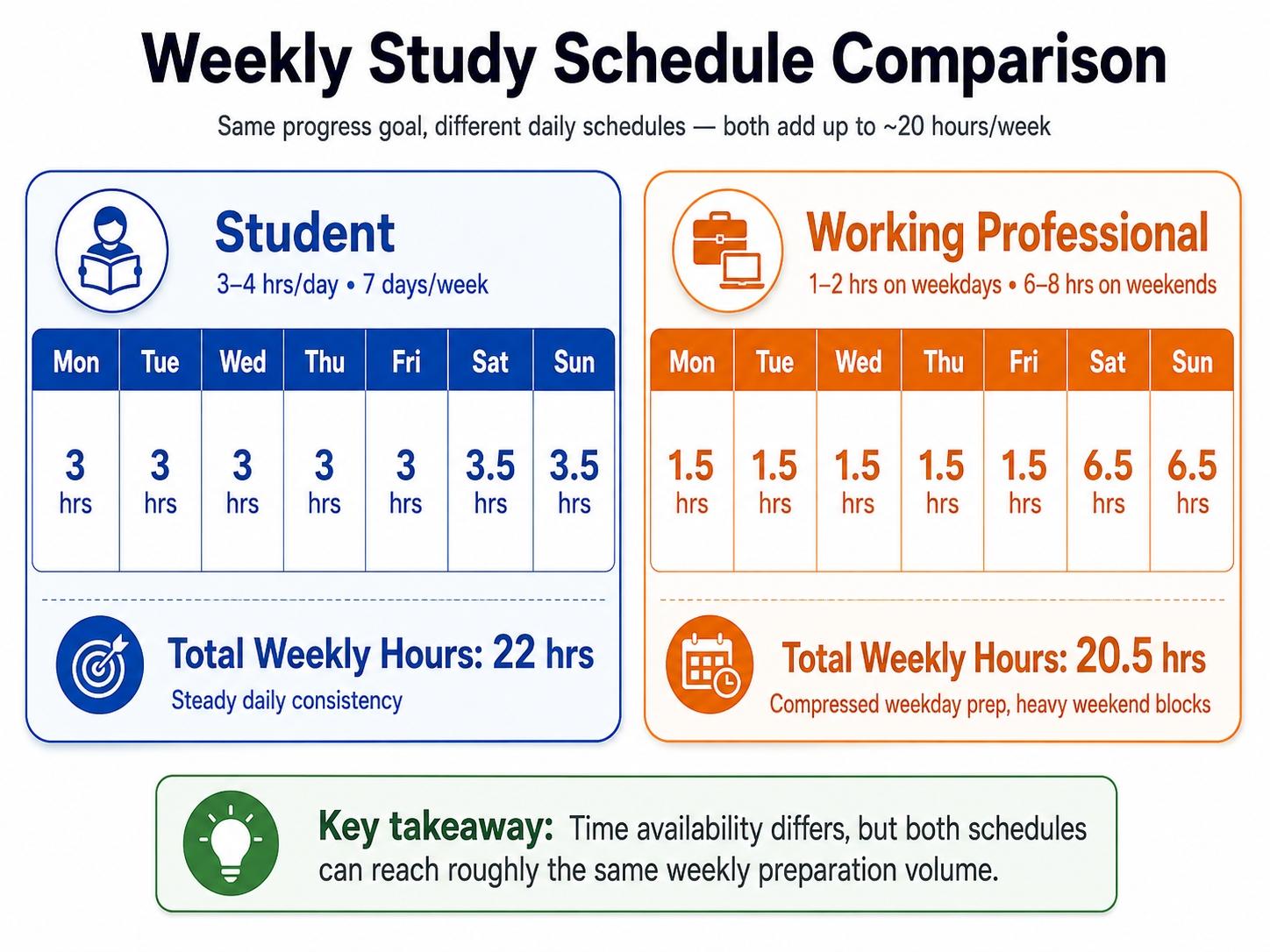
Three real-life weekly templates follow. Each totals different hours because lives differ. The grid is Monday through Sunday; sessions are stacked so morning, afternoon, and evening blocks add up to the day's total. A protected sleep window is non-negotiable — performance under 3-hour exam pressure correlates strongly with cumulative sleep across the prior 7 days 3.
Full-time student — 32-hour week
A full-time student has the most flexible calendar but the largest discipline gap. The template assumes two long sessions on weekdays and one long block on each weekend day.
| Day | Morning (90 min) | Afternoon (90 min) | Evening (60 min) | Daily total |
|---|---|---|---|---|
| Mon | QA topic block | RC 2 passages | Error-log review | 4 h |
| Tue | DILR set practice | VA drill | Vocabulary | 3.5 h |
| Wed | QA topic block | Sectional (40 min) + review | Light reading | 4 h |
| Thu | RC 2 passages | DILR set practice | Error-log review | 4 h |
| Fri | QA topic block | VA drill | Rest or vocabulary | 3 h |
| Sat | Full mock (180 min) | Mock review part 1 | Mock review part 2 | 6 h |
| Sun | Mock review part 3 | DILR mixed sets | Weekly retro + plan | 4.5 h |
Total: ~32 hours. Protected sleep window: 23:00 to 07:00. Saturday mocks should start at 09:00 to mirror the typical CAT Slot 1 timing 2. Sunday should never be a second full-mock day — the diminishing return on a second weekend mock without 48-hour spacing is well-documented 3.
Working professional — 14-hour week
A working professional has the least flexible calendar and the highest fatigue. The template assumes 90 minutes on 4 weekdays and longer weekend blocks.
| Day | Morning (45 min) | Lunch (30 min) | Evening (75 min) | Daily total |
|---|---|---|---|---|
| Mon | RC 1 passage | Vocabulary | QA topic block | 2.5 h |
| Tue | Rest (commute audio only) | — | DILR set practice | 1.25 h |
| Wed | RC 1 passage | Vocabulary | QA topic block | 2.5 h |
| Thu | Rest | — | Error-log review | 1.25 h |
| Fri | Rest | — | Light VA drill | 1.25 h |
| Sat | Full mock (180 min) | Lunch | Mock review part 1 | 4 h |
| Sun | Mock review part 2 | DILR mixed sets | Weekly retro + plan | 3 h |
Total: ~14 hours. Protected sleep window: 23:30 to 06:30. The Tuesday and Thursday rest evenings are deliberate — back-to-back high-cognitive-load evenings after a workday lower retention more than they raise coverage. The Saturday mock is the anchor; the rest of the week serves it.
Final-year student — 24-hour week
A final-year undergrad has a partly flexible calendar (lectures, project work) and moderate fatigue. The template assumes 3 weekday evenings of focused work and full weekend blocks.
| Day | Morning (45 min) | Lecture-gap (45 min) | Evening (90 min) | Daily total |
|---|---|---|---|---|
| Mon | RC 1 passage | Vocabulary | QA topic block | 3 h |
| Tue | DILR set practice | Light VA drill | Error-log review | 3 h |
| Wed | RC 1 passage | Vocabulary | QA topic block | 3 h |
| Thu | Project / coursework | — | Sectional (40 min) + review | 1.5 h |
| Fri | Project / coursework | — | Rest or vocabulary | 0.75 h |
| Sat | Full mock (180 min) | Mock review part 1 | DILR mixed sets | 5.5 h |
| Sun | Mock review part 2 | RC 2 passages | Weekly retro + plan | 4.5 h |
Total: ~24 hours. Protected sleep window: 23:00 to 07:00. Project and coursework get priority on Thursday and Friday — protecting the degree is part of protecting the CAT plan, because a stressed semester wrecks October-November availability when mock cadence peaks. Weekend blocks anchor the plan.
Every timeline needs the same 4 weekly outputs
The four outputs are: questions solved, passages reviewed, DILR sets classified, and mock errors repaired. A plan with no output log is not a plan; it is a calendar.
| Output | Minimum weekly proof | Why it matters |
|---|---|---|
| Questions solved | 80-150 | Builds QA fluency |
| Passages reviewed | 6-10 | Builds VARC evidence |
| DILR sets classified | 8-12 | Builds selection |
| Errors repaired | Top 3 causes | Builds score |
What kills a plan — 6 patterns to avoid
The most common reasons CAT plans collapse are not lack of hours. They are pattern failures. The six listed below recur across every cohort and every runway length.
- No diagnostic mock in week 1. Without a baseline score, every later mock measures noise instead of progress. The diagnostic feels premature; it is not. Take it cold, learn what the gap actually is, and let every subsequent number be a comparison.
- No error log. Solving 1,000 questions without logging which ones were wrong and why produces familiarity, not improvement. An error log is a 4-column spreadsheet: question source, error type, root cause, repair drill. Nothing more, nothing less.
- Content-binge without practice. Watching 40 hours of QA video lectures in a month and solving 30 questions is the most common content-binge failure mode. The ratio should invert — 40 hours of practice for every 10 hours of lectures, not the reverse.
- Mock without review. A 3-hour mock with no review is a 3-hour stress test. The 4-6 hours of structured review afterwards are where the score moves. Pair every mock with a review block on the calendar before you take the mock — not after.
- Skipping VARC for QA comfort. Engineers, in particular, default to QA practice because it gives quick feedback. VARC requires slower, less satisfying work but carries equal weight in the composite percentile 5. A QA-heavy week is the most common form of avoidance.
- No rest week. Continuous 16-week pushes without a rest week produce the late-October collapse pattern: a mock score drop that looks like a skill regression but is actually fatigue. Build one rest week every 6-8 weeks and treat it as part of the plan, not a deviation.
FAQs
Can I prepare for CAT in 3 months?
Yes for some profiles, but the plan must be mock-led and selective. Avoid promises about percentile outcomes.
How many hours per week are enough for CAT?
It depends on starting point. Use 8-10 hours for a long runway and 15-18 hours for late-stage repair only if sustainable.
When should I start taking mocks?
Start earlier than comfort suggests. The first mock is diagnostic, not a verdict.
Is 6 months enough for a 99 percentile?
For repeat candidates with a prior 90+ percentile score, 6 months is usually enough 6. For first-time candidates starting from basics, 6 months can take you to a competitive percentile band but a 99 percentile target requires either above-average starting fluency or above-average weekly hours. Do not anchor to a percentile number; anchor to a weekly-output number and let the percentile follow.
When should I start mocks?
Earlier than feels comfortable. For a 12-month runway, take the first diagnostic mock in month 3. For a 6-month runway, take the first diagnostic in week 1. For a 3-month sprint, take the first diagnostic on day 1. The diagnostic mock is calibration, not assessment — its job is to make every later mock measurable, not to predict outcome.
How many hours per day for CAT 2026?
There is no universal number — there is a weekly number that matches your runway. A 12-month plan needs 8-10 hours per week, which averages to 1-1.5 hours on weekdays and 3-4 hours each weekend day. A 6-month plan needs 12-15 hours per week. A 3-month sprint needs 15-18 hours per week if your health and work allow it. Daily averaging hides the more useful truth: weekend blocks carry most plans, weekday consistency keeps the muscle warm.
Can I prepare for CAT while doing a job?
Yes — see the "Working professional — 14-hour week" template above. The two things that determine success are the Saturday mock and the lunch-break consistency. A working professional cannot match a full-time student on volume; the trade is depth of review per hour. Pick a 9-month or 12-month runway, protect 4-5 weekday evenings as either work-only or study-only (never split), and treat the Saturday mock as the anchor that the rest of the week serves.
Conclusion
Tonight, choose one of the 4 timeline bands and write your weekly hours beside it. Then schedule the first 2 sectionals and 1 full mock before changing any booklist.
Related reading
- CAT exam overview
- QA strategy
- DILR strategy
- VARC strategy
- CAT mock test playbook
- Situational CAT preparation guide
- Self-study vs coaching for CAT
- CAT percentile explained
- Foundation plan
- Mentor Pro plan
References
- Indian Institutes of Management, "CAT official website," 2025. [Online]. Available: https://iimcat.ac.in/. Accessed: Jun. 15, 2026. ↩
- Times of India Education, "CAT 2025 exam pattern and strategy reporting," 2025. [Online]. Available: https://timesofindia.indiatimes.com/education/news. Accessed: Jun. 15, 2026. ↩
- Times of India Education, "CAT 2025 result reporting and candidate pool," 2025. [Online]. Available: https://timesofindia.indiatimes.com/education/news. Accessed: Jun. 15, 2026. ↩
- 2IIM, "CAT previous-year question papers," 2025. [Online]. Available: https://online.2iim.com/CAT-question-paper/. Accessed: Jun. 15, 2026. ↩
- 2IIM, "CAT score calculator and score-vs-percentile estimates," 2025. [Online]. Available: https://online.2iim.com/CAT-question-paper/. Accessed: Jun. 15, 2026. ↩
- Cracku, "CAT score calculator," 2025. [Online]. Available: https://cracku.in/cat-score-calculator/. Accessed: Jun. 15, 2026. ↩
- Career Launcher, "CAT marks vs percentile," 2025. [Online]. Available: https://www.careerlauncher.com/cat-mba/cat-marks-vs-percentile/. Accessed: Jun. 15, 2026. ↩
- MBAUniverse, "CAT score vs percentile analysis," 2025. [Online]. Available: https://www.mbauniverse.com/articles/cat-score-vs-percentile. Accessed: Jun. 15, 2026. ↩
- InsideIIM, "CAT preparation and admission analysis," 2025. [Online]. Available: https://insideiim.com/. Accessed: Jun. 15, 2026. ↩
- IMS India, "CAT analysis and preparation resources," 2025. [Online]. Available: https://www.imsindia.com/blog/cat/. Accessed: Jun. 15, 2026. ↩
- Career Launcher, "CAT preparation resources," 2025. [Online]. Available: https://www.careerlauncher.com/cat-mba/. Accessed: Jun. 15, 2026. ↩
- National Institutional Ranking Framework, Ministry of Education, "India Rankings 2025: Management," 2025. [Online]. Available: https://www.nirfindia.org/Rankings/2025/ManagementRanking.html. Accessed: Jun. 15, 2026. ↩
- Cracku, "CAT preparation 6-month and crash-course structure," 2026. [Online]. Available: https://cracku.in/. Accessed: Jun. 15, 2026. ↩
- InsideIIM, "Aspirant journeys and percentile-band guidance," 2026. [Online]. Available: https://insideiim.com/. Accessed: Jun. 15, 2026. ↩
- IMS India, "CAT 2026 registration and 7-month preparation planning," 2026. [Online]. Available: https://www.imsindia.com/blog/cat/. Accessed: Jun. 15, 2026. ↩
- Indian Institutes of Management, "CAT 2026 notification and exam-day convention," 2026. [Online]. Available: https://iimcat.ac.in/. Accessed: Jun. 15, 2026. ↩