Topic Guide
The 6-month CAT plan: what fits, what does not
A 6-month plan works only if you cut. Most students try to cover everything at half-depth, then discover in month 4 that no section is stable. The better route is deliberate: cut two low-return QA topics for now, limit one LR pattern, and spend the saved time on core accuracy and mock review.
The week-1 cut list
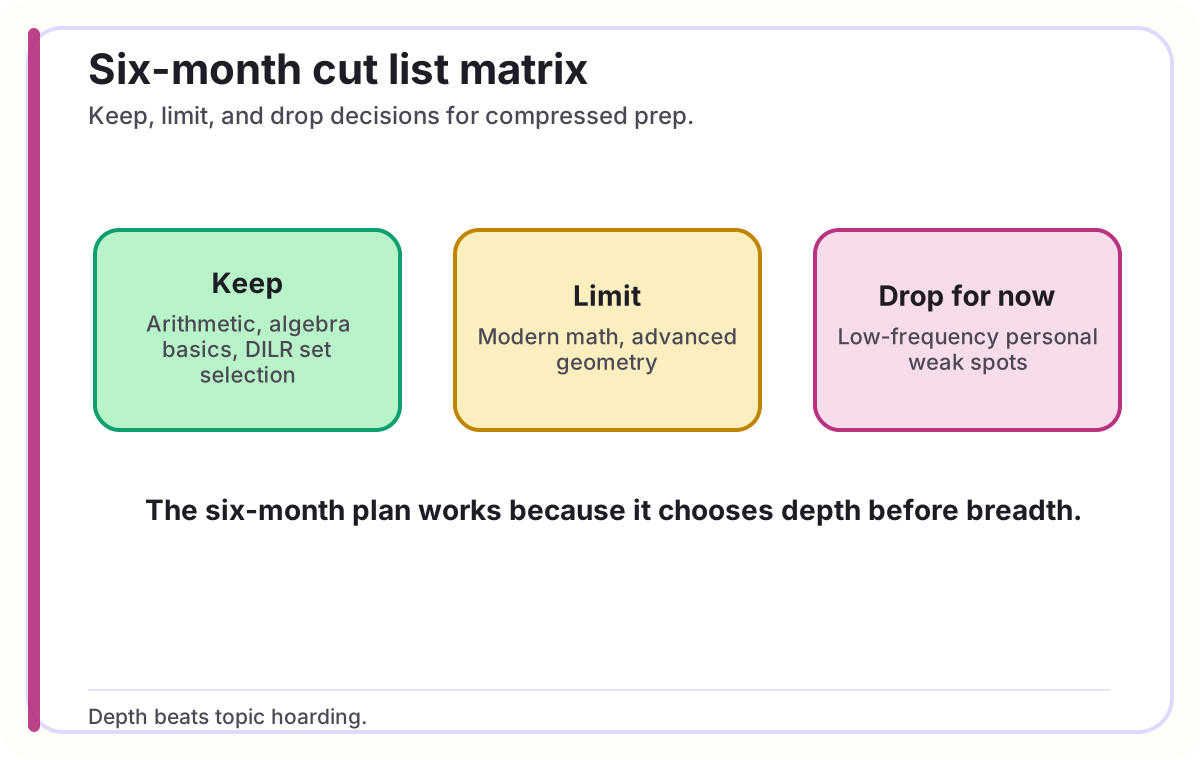
The cut list is not a surrender. It is a resource decision. Keep arithmetic, algebra basics, DILR set selection, and VARC reading. Limit advanced modern math and rare geometry if they are not already strong. Postpone personal low-frequency weak spots until core accuracy is stable.
The cut list should be written in week 1, not after the first bad mock.
Treat the week-1 cut list as a capacity decision, not a motivation decision. The official CAT site controls dates and registration facts; the plan controls training load 1. Write the planned hours, completed hours, and review hours in the same row every Sunday. If one of those three numbers is missing, the next week will repeat the same mistake with a cleaner calendar but weaker evidence.
The review routine should be narrower than the study routine. Pick one VARC behaviour, one DILR behaviour, and one QA behaviour to observe during the week. Examples: re-reading too often, abandoning DILR sets too late, or starting QA without a skip threshold. The plan becomes useful only when it changes a decision inside a timed session, not when it adds another topic name.
Use the mentor or peer check as an audit of evidence. Bring three items: last test score, two recurring error tags, and the hours actually completed. Do not ask whether the plan looks strong. Ask which one action should change before the next test. That keeps the week-1 cut list tied to one correction and one measurable follow-up.
The operating rhythm is weekly, even when the article is monthly. Convert the week-1 cut list into seven-day tasks: reading blocks, problem blocks, sectional review, and one protected recovery slot. A plan that cannot survive one normal week of college, office, travel, or family load will not survive the full season.
Months 1-2 - concept core
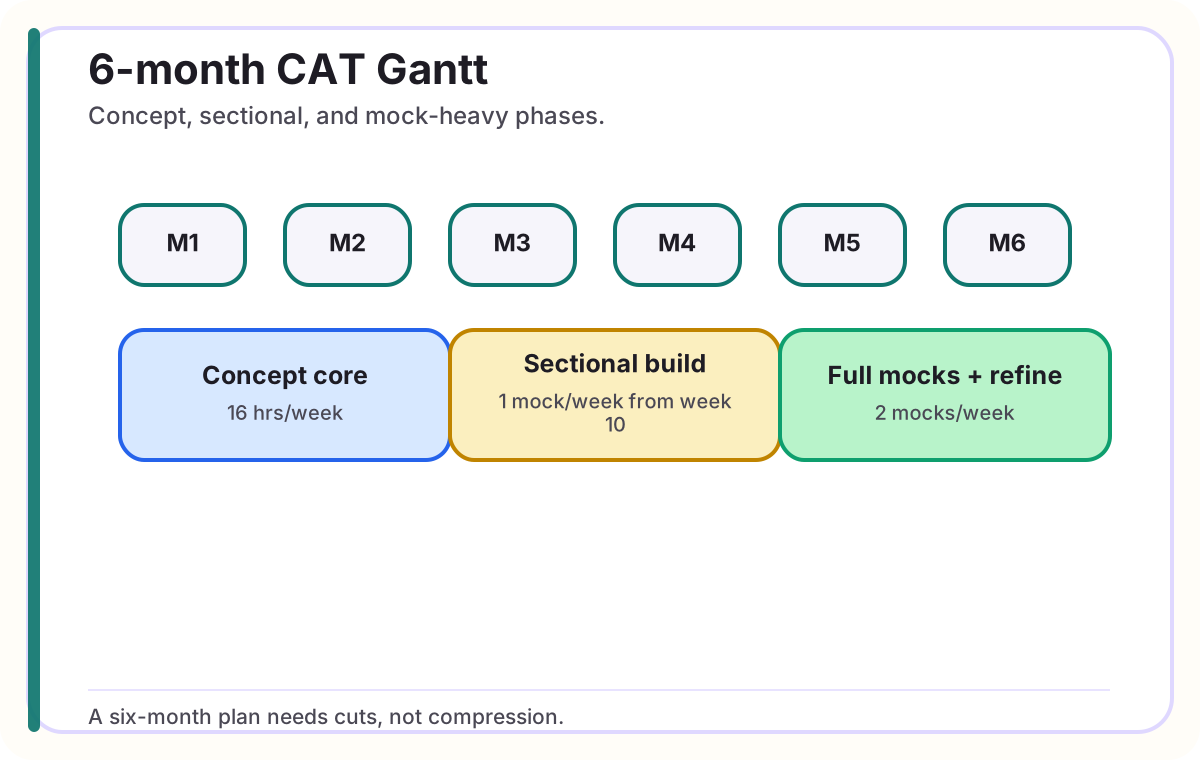
In months 1 and 2, focus on concept coverage and short drills. Use past papers for benchmark examples, but do not let full mocks consume the week [2], [3].
The target is a clean notebook of repeatable methods, not broad exposure.
Treat months 1-2 - concept core as a capacity decision, not a motivation decision. The official CAT site controls dates and registration facts; the plan controls training load 1. Write the planned hours, completed hours, and review hours in the same row every Sunday. If one of those three numbers is missing, the next week will repeat the same mistake with a cleaner calendar but weaker evidence.
The review routine should be narrower than the study routine. Pick one VARC behaviour, one DILR behaviour, and one QA behaviour to observe during the week. Examples: re-reading too often, abandoning DILR sets too late, or starting QA without a skip threshold. The plan becomes useful only when it changes a decision inside a timed session, not when it adds another topic name.
Use the mentor or peer check as an audit of evidence. Bring three items: last test score, two recurring error tags, and the hours actually completed. Do not ask whether the plan looks strong. Ask which one action should change before the next test. That keeps months 1-2 - concept core tied to one correction and one measurable follow-up.
The operating rhythm is weekly, even when the article is monthly. Convert months 1-2 - concept core into seven-day tasks: reading blocks, problem blocks, sectional review, and one protected recovery slot. A plan that cannot survive one normal week of college, office, travel, or family load will not survive the full season.
Months 3-4 - sectionals
Shift toward timed sectionals and mixed sets. Add one full mock per week only when you can review it. The official CAT structure and marking scheme should be refreshed annually 1, [6], [7].
Keep one repair drill after every mock: the weakest section gets the next day.
Treat months 3-4 - sectionals as a capacity decision, not a motivation decision. The official CAT site controls dates and registration facts; the plan controls training load 1. Write the planned hours, completed hours, and review hours in the same row every Sunday. If one of those three numbers is missing, the next week will repeat the same mistake with a cleaner calendar but weaker evidence.
The review routine should be narrower than the study routine. Pick one VARC behaviour, one DILR behaviour, and one QA behaviour to observe during the week. Examples: re-reading too often, abandoning DILR sets too late, or starting QA without a skip threshold. The plan becomes useful only when it changes a decision inside a timed session, not when it adds another topic name.
Use the mentor or peer check as an audit of evidence. Bring three items: last test score, two recurring error tags, and the hours actually completed. Do not ask whether the plan looks strong. Ask which one action should change before the next test. That keeps months 3-4 - sectionals tied to one correction and one measurable follow-up.
The operating rhythm is weekly, even when the article is monthly. Convert months 3-4 - sectionals into seven-day tasks: reading blocks, problem blocks, sectional review, and one protected recovery slot. A plan that cannot survive one normal week of college, office, travel, or family load will not survive the full season.
Months 5-6 - full-length and refine
Two mocks per week can work near the end of a 6-month plan. More than that creates review debt. The plan should produce fewer unsolved doubts, not more score screenshots.
A mock is complete only when the top 10 errors are categorised.
Treat months 5-6 - full-length and refine as a capacity decision, not a motivation decision. The official CAT site controls dates and registration facts; the plan controls training load 1. Write the planned hours, completed hours, and review hours in the same row every Sunday. If one of those three numbers is missing, the next week will repeat the same mistake with a cleaner calendar but weaker evidence.
The review routine should be narrower than the study routine. Pick one VARC behaviour, one DILR behaviour, and one QA behaviour to observe during the week. Examples: re-reading too often, abandoning DILR sets too late, or starting QA without a skip threshold. The plan becomes useful only when it changes a decision inside a timed session, not when it adds another topic name.
Use the mentor or peer check as an audit of evidence. Bring three items: last test score, two recurring error tags, and the hours actually completed. Do not ask whether the plan looks strong. Ask which one action should change before the next test. That keeps months 5-6 - full-length and refine tied to one correction and one measurable follow-up.
What does not fit
Syllabus lists help you see the territory [4], [5]. They do not require equal time for every item. A topic that appears rarely and costs 10 hours to stabilise may be a poor trade-off compared with arithmetic or DILR set selection.
Use opportunity cost as the decision rule.
Treat what does not fit as a capacity decision, not a motivation decision. The official CAT site controls dates and registration facts; the plan controls training load 1. Write the planned hours, completed hours, and review hours in the same row every Sunday. If one of those three numbers is missing, the next week will repeat the same mistake with a cleaner calendar but weaker evidence.
The review routine should be narrower than the study routine. Pick one VARC behaviour, one DILR behaviour, and one QA behaviour to observe during the week. Examples: re-reading too often, abandoning DILR sets too late, or starting QA without a skip threshold. The plan becomes useful only when it changes a decision inside a timed session, not when it adds another topic name.
Use the mentor or peer check as an audit of evidence. Bring three items: last test score, two recurring error tags, and the hours actually completed. Do not ask whether the plan looks strong. Ask which one action should change before the next test. That keeps what does not fit tied to one correction and one measurable follow-up.
What to do this week
Write the keep, limit, and postpone list. Share it with your mentor or accountability partner. Then build only the next 14 days of the plan.
Your target is one written cut list before Friday.
Treat what to do this week as a capacity decision, not a motivation decision. The official CAT site controls dates and registration facts; the plan controls training load 1. Write the planned hours, completed hours, and review hours in the same row every Sunday. If one of those three numbers is missing, the next week will repeat the same mistake with a cleaner calendar but weaker evidence.
The review routine should be narrower than the study routine. Pick one VARC behaviour, one DILR behaviour, and one QA behaviour to observe during the week. Examples: re-reading too often, abandoning DILR sets too late, or starting QA without a skip threshold. The plan becomes useful only when it changes a decision inside a timed session, not when it adds another topic name.
Use the mentor or peer check as an audit of evidence. Bring three items: last test score, two recurring error tags, and the hours actually completed. Do not ask whether the plan looks strong. Ask which one action should change before the next test. That keeps what to do this week tied to one correction and one measurable follow-up.
FAQs
Can I prepare for CAT in 6 months?
Yes, if you already have a usable academic base and are willing to cut low-return topics early.
How many hours per week does a 6-month plan need?
Plan around 16 focused hours per week. Fewer hours can work only with stronger starting accuracy.
When should mocks start in a 6-month plan?
Use sectionals in the first 2 months and introduce full mocks around week 10.
What should I cut in a 6-month CAT plan?
Cut or limit low-frequency topics that are personally expensive. Keep arithmetic, algebra basics, VARC reading, and DILR set selection.
Is two mocks per week too much?
Two mocks per week is acceptable in the final phase only if every mock is reviewed.
Conclusion
Choose the next 7 days, not the full season. Put the hours or mocks on the calendar, then review what actually happened before you expand the plan.
Related reading
References
- Indian Institutes of Management, "Common Admission Test official website," 2025. [Online]. Available: https://iimcat.ac.in/ [2] The Economic Times, "CAT 2025 Notification Released: Registration begins August 1 at iimcat.ac.in," 2025. [Online]. Available: https://economictimes.indiatimes.com/news/new-updates/cat-2025-notification-released-at-iimcat-ac-in-exam-on-november-30-registrations-begin-august-1-at-iimcat-ac-in/articleshow/122932378.cms [3] 2IIM, "CAT previous year question papers," 2025. [Online]. Available: https://online.2iim.com/CAT-question-paper/ [4] Cracku, "CAT previous papers," 2025. [Online]. Available: https://cracku.in/cat-previous-papers [5] IMS India, "CAT syllabus and preparation guide," 2025. [Online]. Available: https://www.imsindia.com/blog/cat/cat-syllabus/ [6] MBAUniverse, "CAT syllabus and exam pattern," 2025. [Online]. Available: https://www.mbauniverse.com/articles/cat-syllabus [7] Career Launcher, "CAT exam pattern," 2025. [Online]. Available: https://www.careerlauncher.com/cat-mba/exam-pattern/ [8] Shiksha, "CAT exam pattern," 2025. [Online]. Available: https://www.shiksha.com/mba/cat-exam-pattern ↩