Topic Guide
Algebra for CAT: quadratics, functions, progressions
Algebra looks like manipulation, but CAT usually rewards pattern recognition first. The same six forms recur: quadratics, inequalities, functions, graph shifts, progressions, and log-exponent conversions. If you name the form in 20 seconds, the rest of the problem has a route.
The 6 recurring patterns
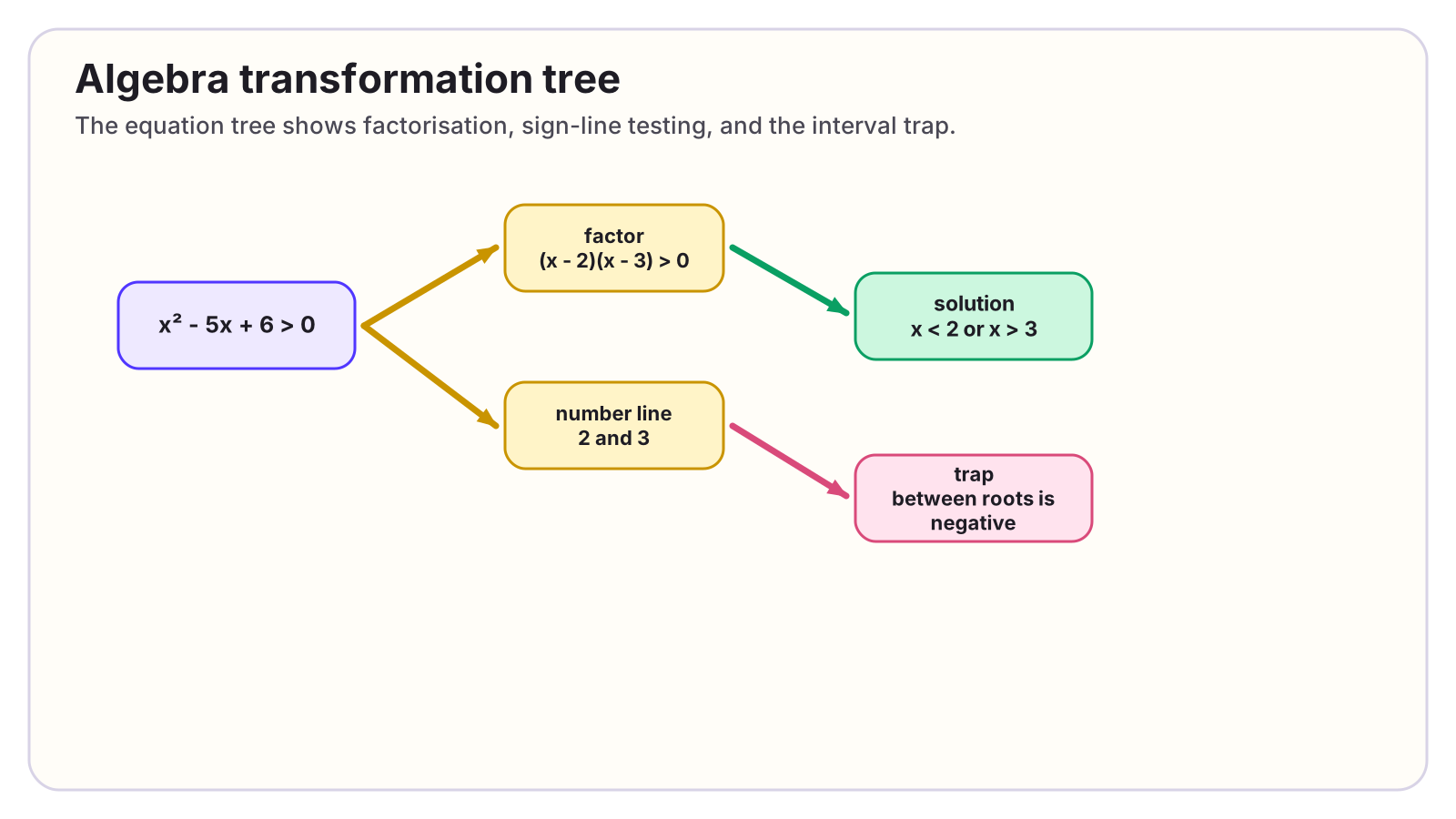
Use six buckets: quadratic form, inequality ranges, function input-output, graph shift, arithmetic or geometric progressions, and logarithm-exponent conversion. MBAUniverse estimates algebra at about 34 percent of QA across 2021-2025, making it the second large QA block after arithmetic 3.
Write the bucket at the top of your solution. The label tells you which tool is legal.
Week-by-week algebra plan
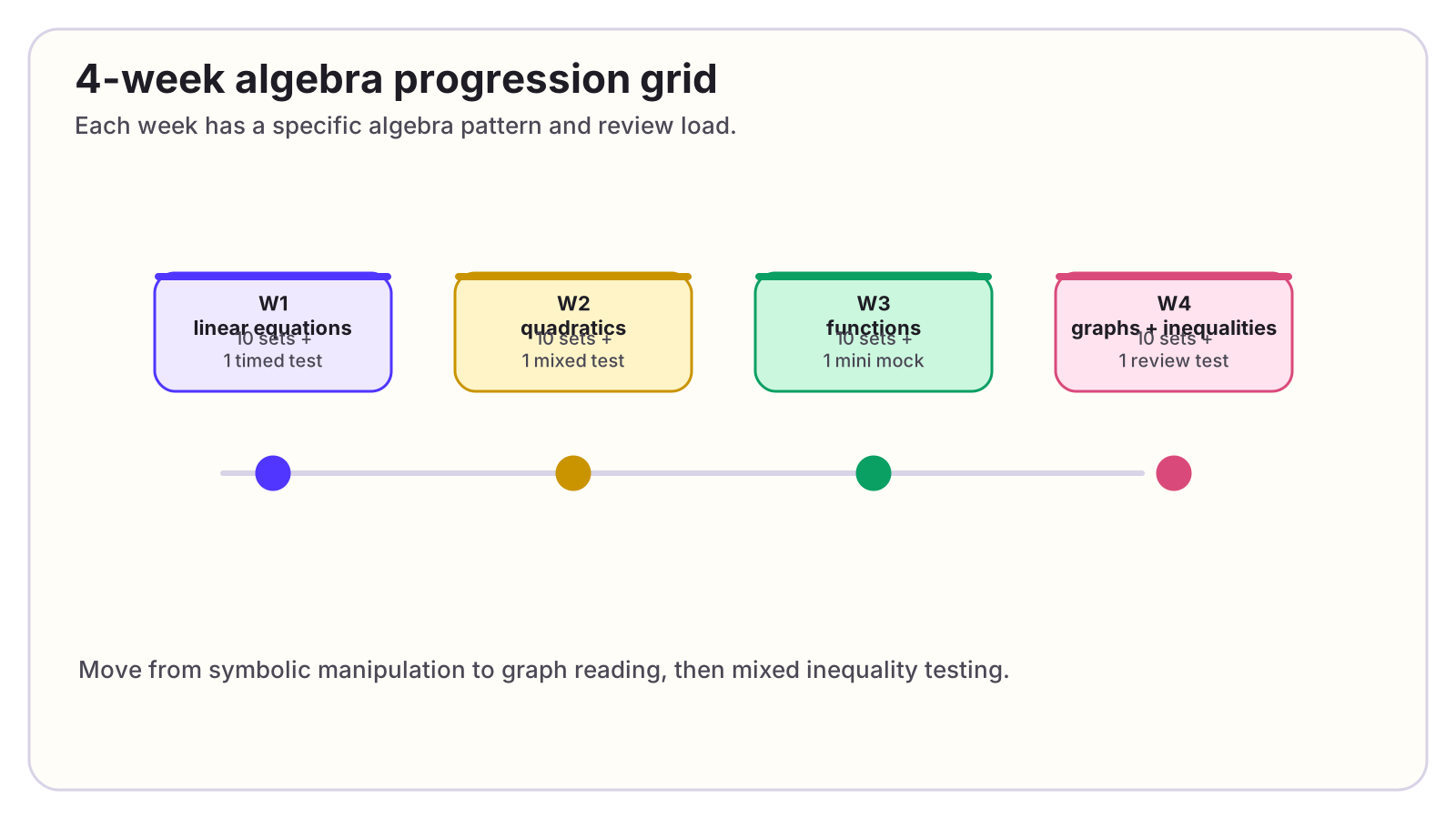
Week 1: quadratics and signs. Week 2: inequalities and ranges. Week 3: functions and graphs. Week 4: progressions, logs, and mixed drills. NCERT textbooks can refresh the fundamentals when a manipulation step is weak 6.
Do 10 pattern-recognition questions before longer problem solving each week.
Quadratics - factor, sign, root
After factoring, mark roots on a number line and test sign intervals. If the problem asks for positive solutions, integer values, or a range, roots alone are incomplete. A clean sign chart often prevents overcounting solutions.
2IIM’s past-paper database should be used after the concept pass so you see CAT-level disguises rather than textbook sequencing 2.
Functions and graphs - the 60-second shortcut
For function composition, write the inner function first. For graphs, ask which transformation changed the base shape: shift, stretch, reflection, or domain restriction. If the function is defined piecewise, locate the interval before substituting.
IMS places functions and algebra within the QA topic family and notes that QA includes mathematics from school-level foundations 5. Recognition is the CAT layer on top of those foundations.
Common algebra traps
Four traps recur: dividing by a possible zero, squaring both sides without checking roots, ignoring inequality reversal on multiplying by a negative, and treating logs without domain checks. Write “domain?” in the margin for every functions, roots, or logarithms problem.
The official CAT site remains the current-year reference for pattern and registration updates 1. Your algebra log should not depend on a predicted topic count.
Practice routine - 10 problems per pattern
Pick one algebra pattern and solve 10 problems this week with a 100-second cap per problem. Afterward, review errors by bucket: form not recognised, manipulation slip, domain miss, or arithmetic slip. Dunlosky et al. and Roediger and Karpicke support practice testing with corrective review 7, 8.
Only after 10 narrow questions should you add mixed sets.
FAQs
Is algebra important for CAT QA?
Yes. Recent analyses place algebra among the largest QA areas, often close to arithmetic in weight.
Which algebra topics should I study for CAT?
Prioritise quadratics, inequalities, functions and graphs, progressions, logarithms, and exponents.
How long should the first algebra pass take?
Use a 4-week pass: quadratics, inequalities, functions, then progressions and logs.
What is the biggest algebra trap?
Domain errors: dividing by zero, ignoring log restrictions, or accepting roots introduced by squaring.
How should I practise algebra?
Solve 10 narrow problems per pattern with a 100-second cap, then review the failure bucket before mixing topics.
Conclusion
Choose one algebra pattern and solve 10 problems with a 100-second cap. Review the failures by form recognition, manipulation, domain, or arithmetic.
Related reading
References
- Indian Institutes of Management, "CAT official website," 2026. [Online]. Available: https://iimcat.ac.in/. Accessed: Jun. 14, 2026. ↩
- 2IIM, "CAT previous year question papers (2017-2025) with solutions," 2026. [Online]. Available: https://online.2iim.com/CAT-question-paper/. Accessed: Jun. 14, 2026. ↩
- MBAUniverse, "CAT 2026 syllabus: section-wise topics and 5-year weightage analysis," 2026. [Online]. Available: https://www.mbauniverse.com/cat/syllabus. Accessed: Jun. 14, 2026. ↩
- Cracku, "CAT exam syllabus 2025," 2026. [Online]. Available: https://cracku.in/cat-exam-syllabus/. Accessed: Jun. 14, 2026. ↩
- IMS India, "CAT syllabus 2026: sections, topics, weightage, and exam pattern," 2026. [Online]. Available: https://www.imsindia.com/blog/cat/cat-syllabus/. Accessed: Jun. 14, 2026. ↩
- National Council of Educational Research and Training, "Textbooks PDF (I-XII)," 2026. [Online]. Available: https://ncert.nic.in/textbook.php. Accessed: Jun. 14, 2026. ↩
- J. Dunlosky, K. A. Rawson, E. J. Marsh, M. J. Nathan, and D. T. Willingham, "Improving students’ learning with effective learning techniques: Promising directions from cognitive and educational psychology," Psychological Science in the Public Interest, vol. 14, no. 1, pp. 4-58, 2013. [Online]. Available: https://journals.sagepub.com/doi/10.1177/1529100612453266. Accessed: Jun. 14, 2026. ↩
- H. L. Roediger III and J. D. Karpicke, "Test-enhanced learning: Taking memory tests improves long-term retention," Psychological Science, vol. 17, no. 3, pp. 249-255, 2006. [Online]. Available: https://doi.org/10.1111/j.1467-9280.2006.01693.x. Accessed: Jun. 14, 2026. ↩