Topic Guide
Geometry for CAT: the 5 figures that cover most items
CAT geometry is built on a small number of figures, not a huge pile of theorems. If you can classify the diagram as triangle, circle, quadrilateral, coordinate, or solid, the theorem list becomes shorter. The student who labels the figure first solves with less noise.
The 5 figures
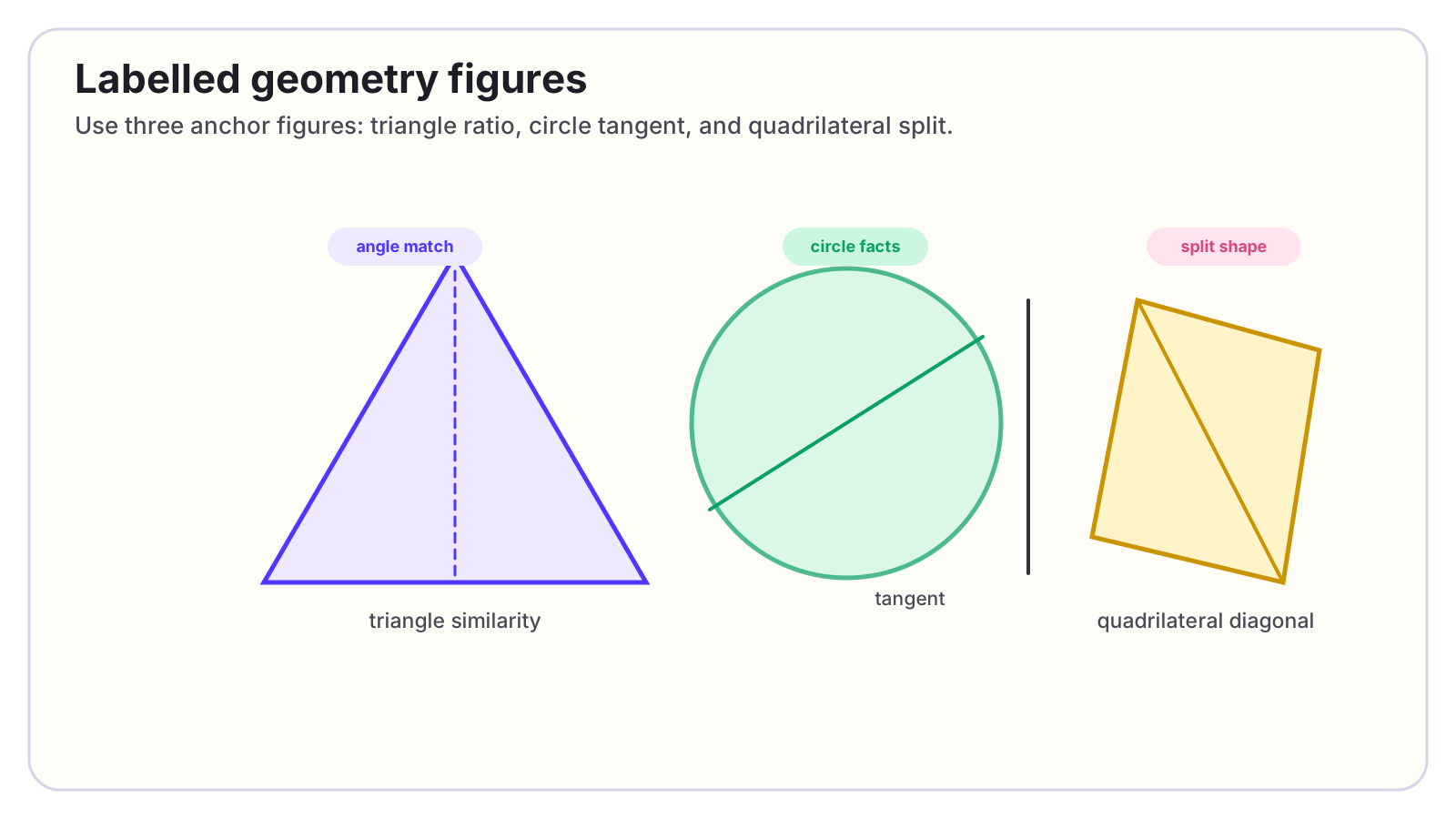
Use five families: triangle, circle, quadrilateral, coordinate plane, and solid. MBAUniverse’s 2021-2025 topic analysis estimates geometry and mensuration at about 15 percent of QA questions 3. That is smaller than arithmetic, but geometry often has high accuracy potential after diagram discipline.
Before applying any theorem, name the figure family. This prevents random formula hunting.
The 8 essential theorems
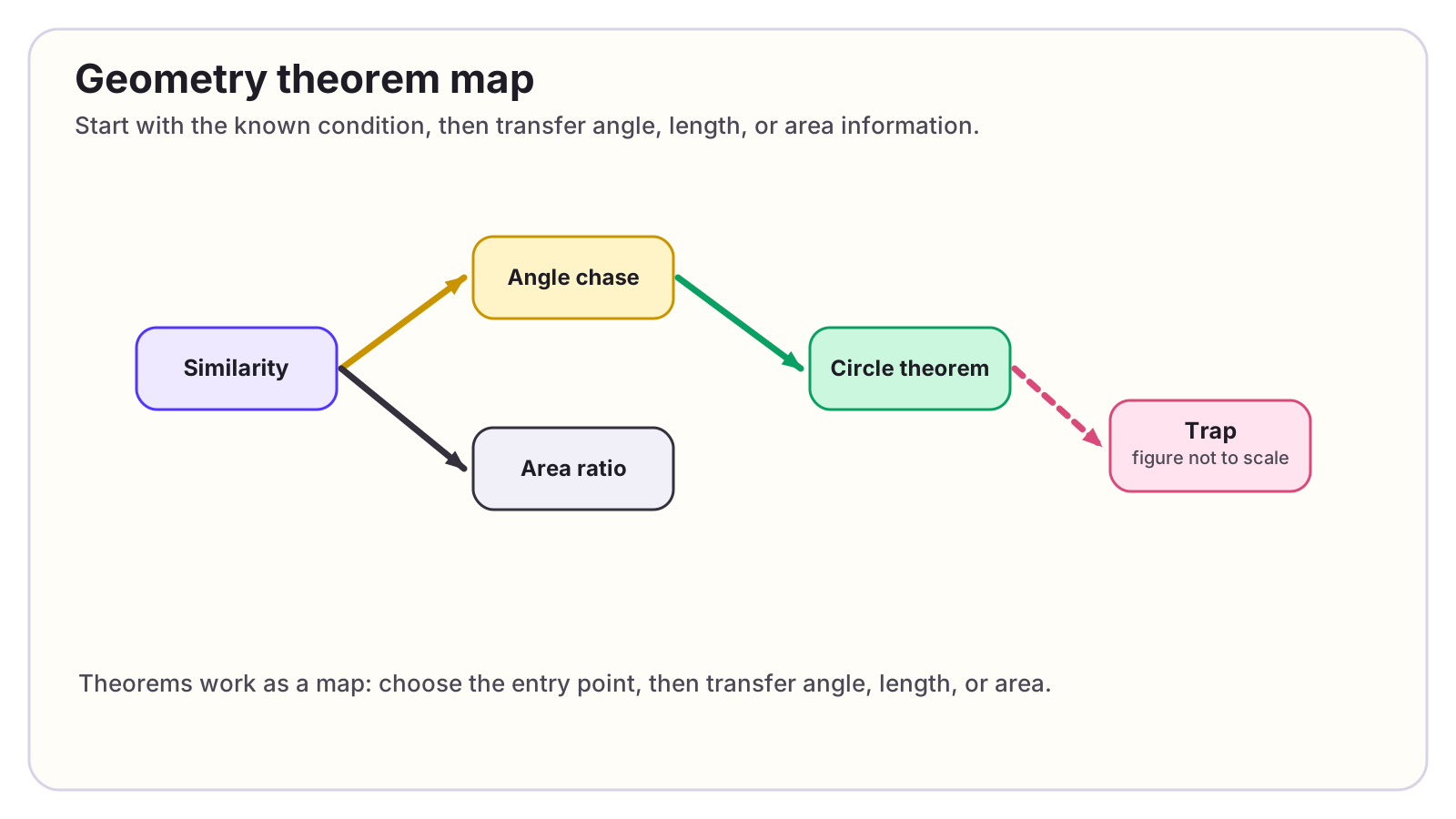
Prioritise similarity, Pythagoras, angle sum, area ratios, tangent-radius perpendicularity, angles in the same segment, cyclic quadrilateral angles, and coordinate distance or slope. NCERT textbooks are a reliable fundamentals base for these school-level theorem families 6.
The goal is not theorem volume. The goal is theorem recognition under a sparse diagram.
Triangles - similarity before calculation
Look for parallel lines, equal angles, shared height, and side ratios. If two triangles are similar, area scales by the square of side ratio. If heights are shared, area ratio equals base ratio. Write the ratio before writing numbers.
2IIM’s past-paper archive helps because it exposes how CAT disguises the same theorem in different diagrams 2.
Circles - tangent, chord, angle
A radius to a tangent is perpendicular. Angles in the same segment are equal. The angle between tangent and chord links to the alternate segment. If a circle problem has too many lines, redraw only the chord, tangent, and centre.
IMS notes that QA draws from school-level mathematics, with arithmetic and algebra dominant but geometry still tested 5. Keep geometry review precise rather than sprawling.
Figure misreads
CAT diagrams are often not to scale. Avoid assumptions such as “looks equal,” “almost right angle,” or “center seems midway.” Mark only stated facts and theorem-derived facts. If a diagram suggests a property but the text does not give it, treat it as unproved.
This is especially important in coordinate geometry where a drawing can distort slope and distance.
Practice protocol - 30 problems per week
Solve 30 geometry problems per week for four weeks. For every miss, redraw the figure and label the theorem that should have appeared. Dunlosky et al. and Roediger and Karpicke support practice testing and active correction 7, 8.
Your target is not to memorise another theorem. It is to recognise the right one 20 seconds earlier.
FAQs
How important is geometry in CAT QA?
Recent analyses estimate geometry and mensuration at a moderate share of QA, below arithmetic and algebra but still worth systematic preparation.
Which geometry topics matter most for CAT?
Triangles, circles, quadrilaterals, coordinate geometry, and solids are the five figure families to prioritise.
How many theorems should I know?
Start with eight theorem families: similarity, Pythagoras, angle sum, area ratios, tangent-radius, same-segment angles, cyclic quadrilaterals, and distance-slope.
Should I trust CAT geometry diagrams?
No. Treat diagrams as sketches unless the question states a property.
How should I review geometry mistakes?
Redraw the figure and label the theorem you missed. Track repeated figure families.
Conclusion
Pick the geometry figure family where your accuracy is lowest and solve 15 problems on it this week. Redraw every miss and name the theorem that should have appeared.
Related reading
References
- Indian Institutes of Management, "CAT official website," 2026. [Online]. Available: https://iimcat.ac.in/. Accessed: Jun. 14, 2026. ↩
- 2IIM, "CAT previous year question papers (2017-2025) with solutions," 2026. [Online]. Available: https://online.2iim.com/CAT-question-paper/. Accessed: Jun. 14, 2026. ↩
- MBAUniverse, "CAT 2026 syllabus: section-wise topics and 5-year weightage analysis," 2026. [Online]. Available: https://www.mbauniverse.com/cat/syllabus. Accessed: Jun. 14, 2026. ↩
- Cracku, "CAT exam syllabus 2025," 2026. [Online]. Available: https://cracku.in/cat-exam-syllabus/. Accessed: Jun. 14, 2026. ↩
- IMS India, "CAT syllabus 2026: sections, topics, weightage, and exam pattern," 2026. [Online]. Available: https://www.imsindia.com/blog/cat/cat-syllabus/. Accessed: Jun. 14, 2026. ↩
- National Council of Educational Research and Training, "Textbooks PDF (I-XII)," 2026. [Online]. Available: https://ncert.nic.in/textbook.php. Accessed: Jun. 14, 2026. ↩
- J. Dunlosky, K. A. Rawson, E. J. Marsh, M. J. Nathan, and D. T. Willingham, "Improving students’ learning with effective learning techniques: Promising directions from cognitive and educational psychology," Psychological Science in the Public Interest, vol. 14, no. 1, pp. 4-58, 2013. [Online]. Available: https://journals.sagepub.com/doi/10.1177/1529100612453266. Accessed: Jun. 14, 2026. ↩
- H. L. Roediger III and J. D. Karpicke, "Test-enhanced learning: Taking memory tests improves long-term retention," Psychological Science, vol. 17, no. 3, pp. 249-255, 2006. [Online]. Available: https://doi.org/10.1111/j.1467-9280.2006.01693.x. Accessed: Jun. 14, 2026. ↩