Topic Guide
Sectional cutoff in CAT: what each IIM requires
There is no single CAT sectional cutoff. The number changes by institute, category, and stage. A candidate can clear the total percentile gate and still miss the shortlist because one section falls below the institute minimum. Read the sectional gate first, then read the overall percentile.
What a sectional cutoff means
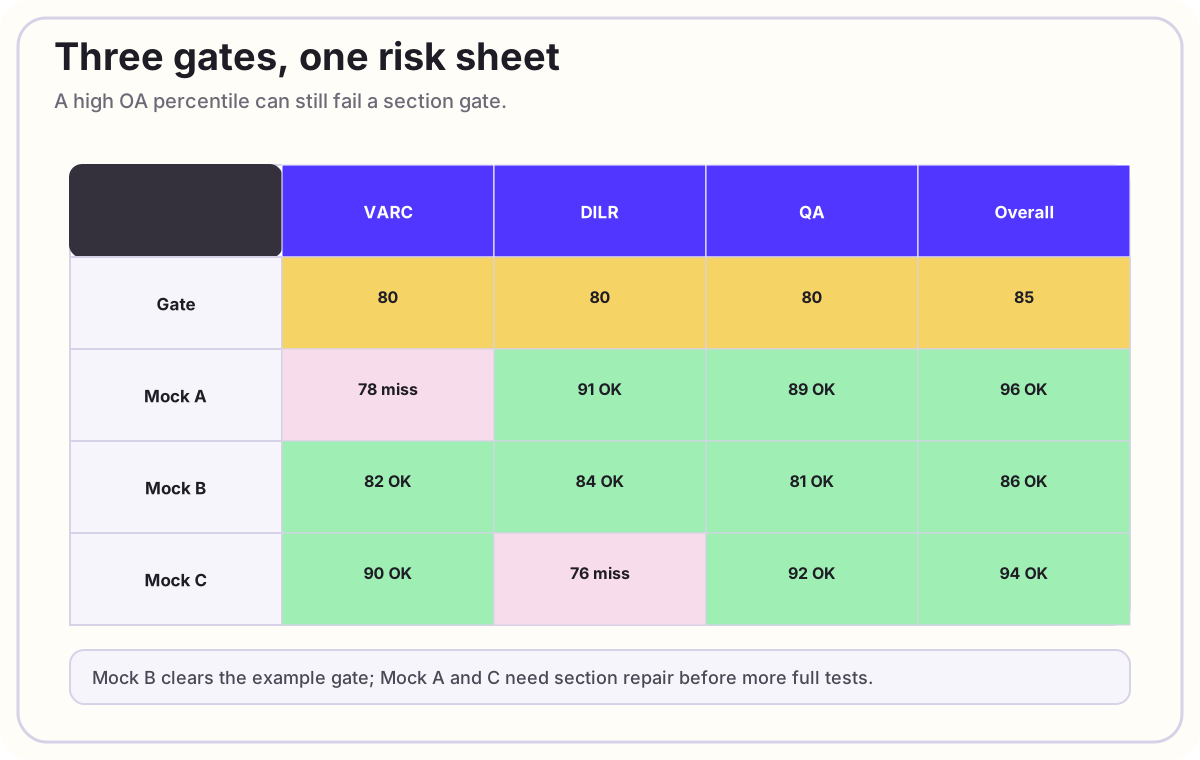
CAT has three scored sections: VARC, DILR, and QA. A sectional cutoff asks whether each section crosses the minimum published by the institute. The rule exists because IIMs do not want a one-section spike to hide a weak floor in another section.
For planning, treat the sectional cutoff as a hard gate. A 99 overall percentile with a weak DILR percentile is less useful for an IIM that requires a DILR gate than a lower overall score with clean section balance.
How to read the old-IIM table
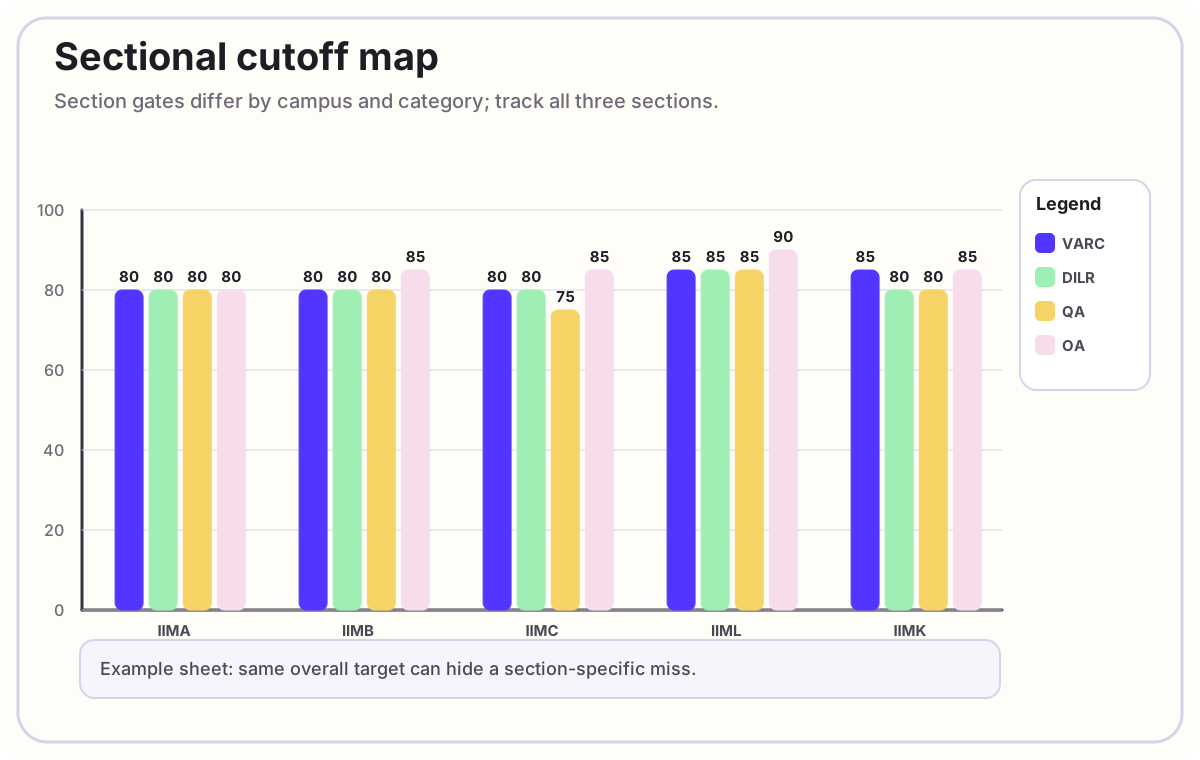
The old-IIM policy pages publish category-wise section and aggregate gates. In practice, a shortlist sheet should have one row per institute and four columns: VARC, DILR, QA, and overall. Students often track only overall percentile because it is the number shown most visibly in mock dashboards. That is the wrong dashboard for institute selection.
The safe working band for General-category aspirants is to keep each section near the strongest old-IIM gate, then set the total percentile target separately. For reserved-category and PwD candidates, use the institute PDF rather than a coaching table, because the gate varies by category.
Why the total percentile can mislead
A total percentile combines the whole paper. It can be high because one section was excellent. The sectional gate asks a different question: was the candidate above the minimum in all three sections. That is why sectional-vs-overall tracking needs two rows on your mock sheet.
A practical tracker uses green for sections at least 5 percentile points above target, amber for within 5 points, and red for below target. Red in one section deserves a section-specific drill before the next full-length mock.
The weekly tracking rule
After each mock, record four numbers: VARC percentile, DILR percentile, QA percentile, and overall percentile. Then compare them to the strictest gate among your target institutes. This turns a vague weakness into a visible gate.
One stable rule works: if the same section misses the target gate twice in three mocks, pause mixed practice for 3 days and run focused repair on that section.
When to update the table
Do not preserve a cutoff table without a date. Admission policies change by batch and institute. The article should carry a fact-check date, and engineering should make the admissions-cycle year visible near the table.
For a student, the method is simpler: check the official institute page when the new CAT cycle opens, then lock the numbers into your shortlist sheet for that cycle.
The 5-point buffer rule
The published gate is a minimum, not a target. A student who needs 80 in DILR should plan for 85 on the working sheet, because mock percentiles move with paper difficulty, set selection, and peer performance. That 5-point buffer is not a claim from an institute policy; it is a planning margin built from the difference between eligibility and reliable performance. The institute pages define the gate, and the buffer belongs to the student's weekly review process 1, [2], [3].
Use one row for the institute minimum and one row for your working target. If the official row says 80, the working row says 85. If the same section lands under the working row in two of the next three mocks, the repair action is section-specific practice, not another full-length mock. This converts a policy number into a 3-mock operating rule.
The shortlist-sheet layout
A usable shortlist sheet has columns for institute, category, VARC, DILR, QA, overall, source URL, and source date. The source columns matter because admission PDFs and web pages change across cycles. A coaching-site summary can be useful for orientation, but the official institute page should be the table you use for final planning 1, [2], [3], [4], [5].
Once the table exists, sort it by the section where you are weakest. A candidate weak in DILR should not read the overall column first. A candidate weak in VARC should compare IIM Lucknow and IIM Kozhikode separately because the VARC gate may carry the highest risk in that profile. The sheet is useful because it turns a general anxiety into one visible red cell.
FAQs
What is CAT sectional cutoff?
CAT sectional cutoff is the article's main operating idea. Read it as a decision rule with a number attached, not as a loose definition.
Which source should I trust first?
Use official CAT or institute pages for policy claims, then use coaching analyses for paper-pattern interpretation and academic studies for learning-strategy claims.
How often should this article be refreshed?
Refresh it once every CAT admission cycle, and sooner if an official institute policy page publishes a new PDF.
What is the practical next step?
Write the main number from this article into your mock sheet or shortlist sheet today, then check it after the next mock.
How does this link to Clymber preparation?
It turns a vague CAT-prep question into one measurable decision that can be reviewed by a student or mentor within 7 days.
Conclusion
Use this article as a working sheet, not only as a reading page. Record the main number for your target case, apply it to the next mock or shortlist decision, and review the result within 7 days.
Related reading
- /blog/sectional-vs-overall-percentile-cat
- /blog/iim-cutoffs-explained
- /glossary
- /blog/cat-percentile-explained
- /iim-cutoffs
References
- IIM Ahmedabad, "MBA admissions criteria for Indian candidates." Available: https://www.iima.ac.in/academics/mba/admissions/indians. Accessed: 15-Jun-2026. [2] IIM Bangalore, "PGP and PGP-BA admission process for 2026-28." Available: https://www.iimb.ac.in/sites/default/files/inline-files/PGP%20and%20PGP%20BA%20Admission%20process%20for%202026-28.pdf. Accessed: 15-Jun-2026. [3] IIM Calcutta, "MBA admissions and selection criteria." Available: https://www.iimcal.ac.in/programs/pgp/admission. Accessed: 15-Jun-2026. [4] IIM Lucknow, "Admission policy for MBA, MBA-ABM and MBA-SM 2026-28." Available: https://www.iiml.ac.in/sites/default/files/upload/admission_2026-28/AdmissionPolicy_2026-28.pdf. Accessed: 15-Jun-2026. [5] IIM Kozhikode, "PGP admissions and selection policy." Available: https://iimk.ac.in/academic-programmes/pgp/admission. Accessed: 15-Jun-2026. [6] IIM CAT, "CAT official website." Available: https://iimcat.ac.in. Accessed: 15-Jun-2026. [7] MBAUniverse, "CAT exam pattern and syllabus guide." Available: https://www.mbauniverse.com/cat/exam-pattern. Accessed: 15-Jun-2026. [8] Times of India, "IIM Trichy joins Joint Admission Process 2026." Available: https://timesofindia.indiatimes.com/education/news/iim-trichy-joins-joint-admission-process-2026-for-mba-pgpm-admissions/articleshow/124348236.cms. Accessed: 15-Jun-2026. ↩