Topic Guide
DI calculation shortcuts for CAT: 5 moves that save time
Faster DI calculation is not the result of more arithmetic. It comes from refusing arithmetic when a bounded approximation answers the question. Five moves handle most CAT DI calculations. The key is knowing when the approximation is safe and when the options demand exact work.
The 5 moves at a glance
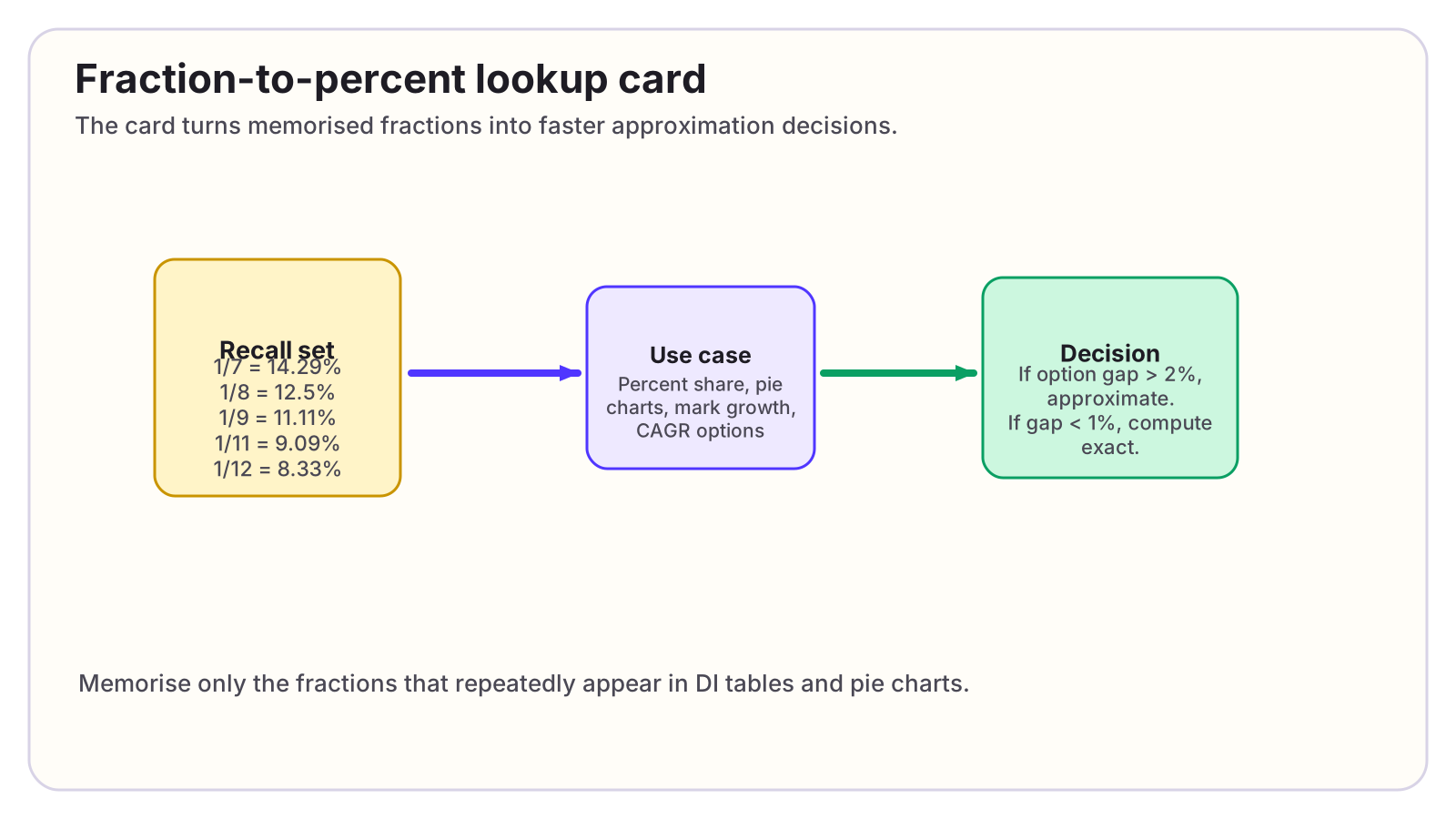
Five moves cover most CAT DI calculation work: fraction-to-percent recall, round-then-adjust, ratio bounding, proxy values, and order-of-magnitude sanity checks. DILR is a 40-minute section in the expected current pattern, so every calculation must earn its place 3, 5.
Use exact arithmetic only when the options are tight or the question asks for an exact integer.
Move 1 - fraction-to-percent recall
Know these cold: 1/2 = 50, 1/3 = 33.33, 1/4 = 25, 1/5 = 20, 1/6 = 16.67, 1/7 about 14.29, 1/8 = 12.5, 1/9 about 11.11. That small table handles growth rates, shares, margins, and efficiency comparisons.
Cracku’s syllabus page confirms DI as a core section area within CAT’s DILR structure 4. The exam rewards reliable approximations because DI sets often test comparison, not perfect calculation.
Move 2 - round, then account for error
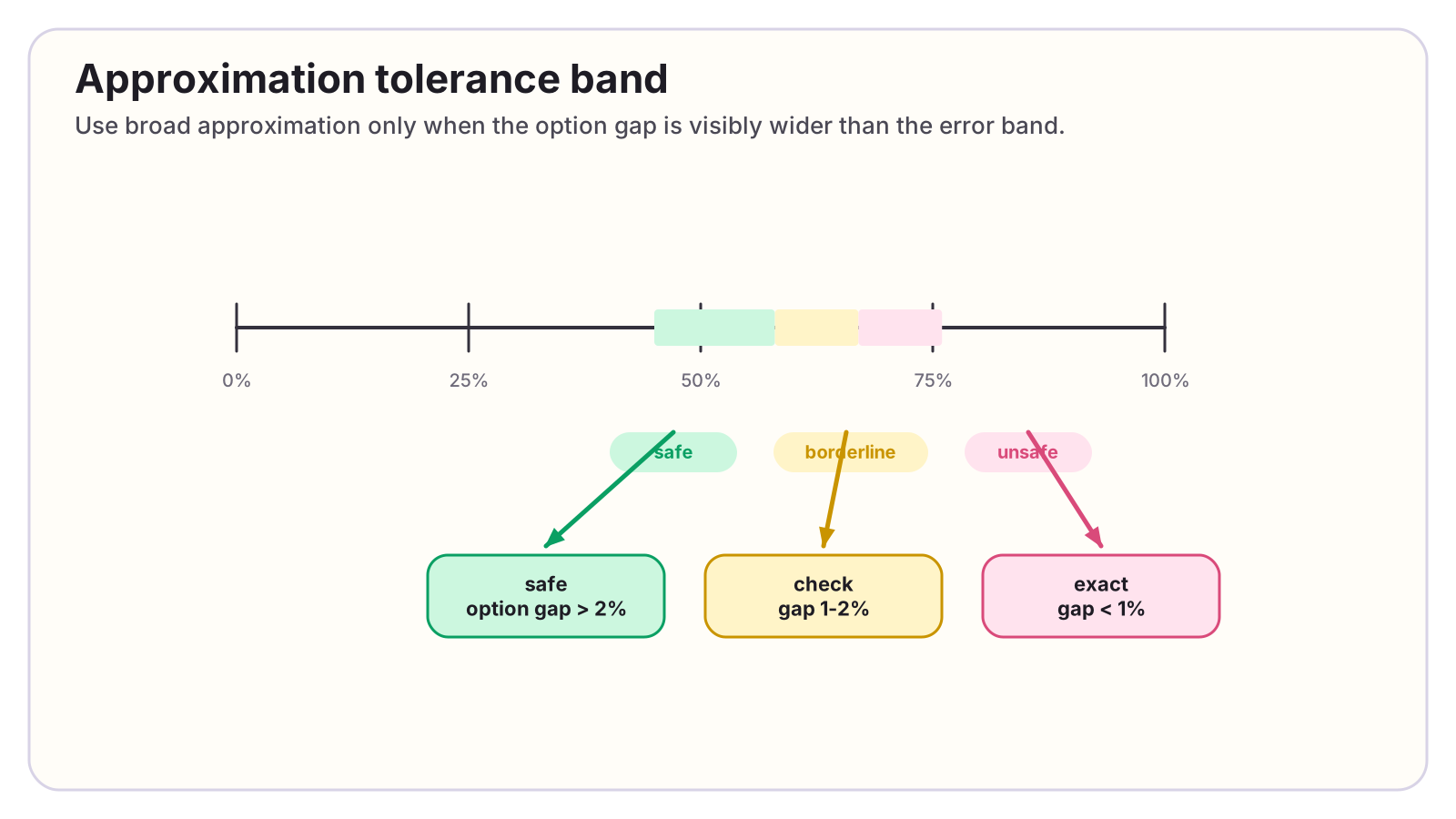
Round 498 to 500 only if you remember the result is slightly high. Round 19.8 percent to 20 percent only if a 1 percent relative error cannot change the option. If options are 24.8 and 25.1, stop approximating and compute exactly.
IMS lists +3 and -1 marking and TITA mechanics in its pattern overview, so careless errors have direct score cost 5. Rounding must be controlled, not casual.
Move 3 - ratio bounding
If a ratio is between 1.24 and 1.27, and the options are 1.1, 1.2, 1.25, and 1.5, the bound is enough. Bounding is especially strong when the data table has rounded values or when the question asks “closest to.”
Use two bounds: a lower safe value and an upper safe value. If only one option lives inside, stop.
Move 4 - proxy values and sanity checks
Use 72 as a proxy for 6 dozen, 360 for full circle percentages, 1000 for per-thousand scaling, and 365 for days only when precision matters. Then run a sanity check: does the answer’s magnitude fit the table?
2IIM’s past-paper archive is useful for training this because real DI sets mix ratios, percentages, and tables 2. Solve one old set twice: once exact, once with approximations, then compare answers.
Practice routine - one set, two passes
Take one DI set this week. Attempt it once under time using the five moves. Then re-solve exactly without time pressure and record where approximation stayed safe or failed. Dunlosky et al. and Roediger and Karpicke support practice with retrieval and review rather than passive rereading 6, 7.
Your target is a 30 percent time reduction only when accuracy stays unchanged.
FAQs
What are DI calculation shortcuts for CAT?
They are controlled approximation methods: fraction recall, round-adjust, ratio bounds, proxies, and sanity checks.
When should I avoid approximation in DI?
Avoid it when options are close, the answer is a TITA integer, or the question asks for exact value.
Which fractions should I memorise for DI?
Start with 1/2 through 1/9, especially 1/6, 1/7, 1/8, and 1/9.
How do I know if rounding is safe?
Track the direction of error and compare it with option spacing. Wide spacing allows approximation; tight spacing needs exact work.
How should I practise DI calculation?
Solve one set twice: first under time with approximation, then exactly. Compare the time and error log.
Conclusion
Take one DI set and solve it twice: one timed approximation pass and one exact review pass. Keep only the shortcuts that preserved accuracy.
Related reading
References
- Indian Institutes of Management, "CAT official website," 2026. [Online]. Available: https://iimcat.ac.in/. Accessed: Jun. 14, 2026. ↩
- 2IIM, "CAT previous year question papers (2017-2025) with solutions," 2026. [Online]. Available: https://online.2iim.com/CAT-question-paper/. Accessed: Jun. 14, 2026. ↩
- MBAUniverse, "CAT 2026 syllabus: section-wise topics and 5-year weightage analysis," 2026. [Online]. Available: https://www.mbauniverse.com/cat/syllabus. Accessed: Jun. 14, 2026. ↩
- Cracku, "CAT exam syllabus 2025," 2026. [Online]. Available: https://cracku.in/cat-exam-syllabus/. Accessed: Jun. 14, 2026. ↩
- IMS India, "CAT syllabus 2026: sections, topics, weightage, and exam pattern," 2026. [Online]. Available: https://www.imsindia.com/blog/cat/cat-syllabus/. Accessed: Jun. 14, 2026. ↩
- J. Dunlosky, K. A. Rawson, E. J. Marsh, M. J. Nathan, and D. T. Willingham, "Improving students’ learning with effective learning techniques: Promising directions from cognitive and educational psychology," Psychological Science in the Public Interest, vol. 14, no. 1, pp. 4-58, 2013. [Online]. Available: https://journals.sagepub.com/doi/10.1177/1529100612453266. Accessed: Jun. 14, 2026. ↩
- H. L. Roediger III and J. D. Karpicke, "Test-enhanced learning: Taking memory tests improves long-term retention," Psychological Science, vol. 17, no. 3, pp. 249-255, 2006. [Online]. Available: https://doi.org/10.1111/j.1467-9280.2006.01693.x. Accessed: Jun. 14, 2026. ↩
- Encyclopaedia Britannica, "Venn diagram," 2026. [Online]. Available: https://www.britannica.com/science/Venn-diagram. Accessed: Jun. 14, 2026. ↩