Topic Guide
Games and tournaments LR for CAT: the bracket discipline
Tournament LR rewards the student who draws the bracket before solving anything. Most errors begin when fixtures, outcomes, and tie-breaks are written in the same messy space. A bracket-first approach separates the structure from the arithmetic. That gives ranking questions less room to mislead you.
The bracket template - 90 seconds to make the set visible
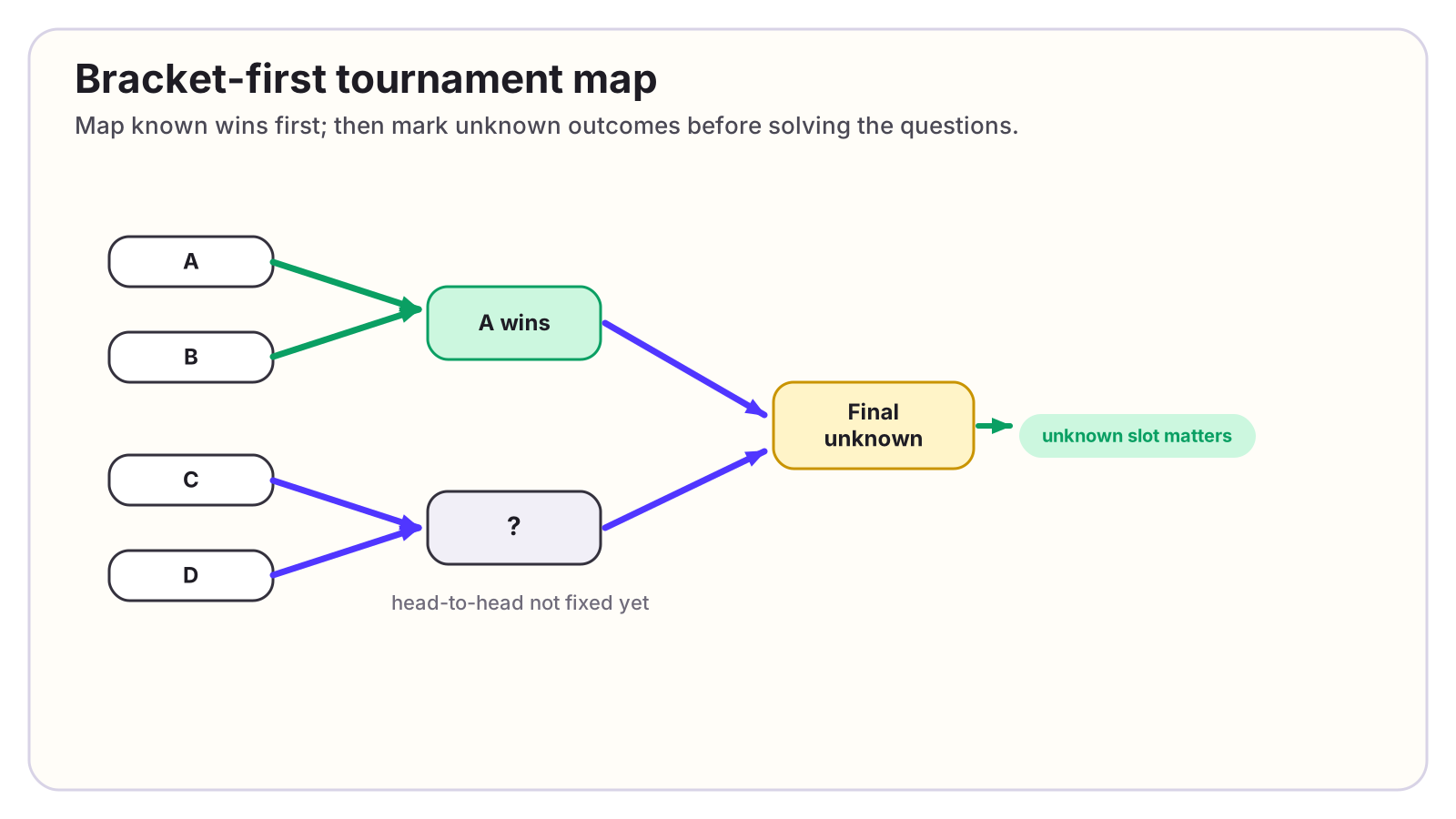
Many students read match results as prose. Draw first. Put teams in a bracket or round-robin table, reserve a side box for tie-breaks, and leave a final ranking row. 2IIM’s paper bank is the best place to practise because tournament sets appear as full caselets, not as isolated puzzles 2.
CAT DILR has no stable syllabus list, but MBAUniverse and IMS both include puzzles, scheduling, tables, and analytical reasoning under the section’s scope 3, 5. A bracket is the visual language for that family.
Fixtures before outcomes
First record who plays whom. Then add win, loss, score, or points. If you enter outcomes while still discovering fixtures, the grid becomes cluttered. For round-robin sets, use a square matrix. For knockout sets, use a bracket. For league-plus-knockout sets, use both.
The official CAT site is the annual source for section format 1, while coaching analyses should be used for topic trends rather than official rules. Keep that distinction clear in the article and in your own prep.
Tie-breaks and head-to-heads
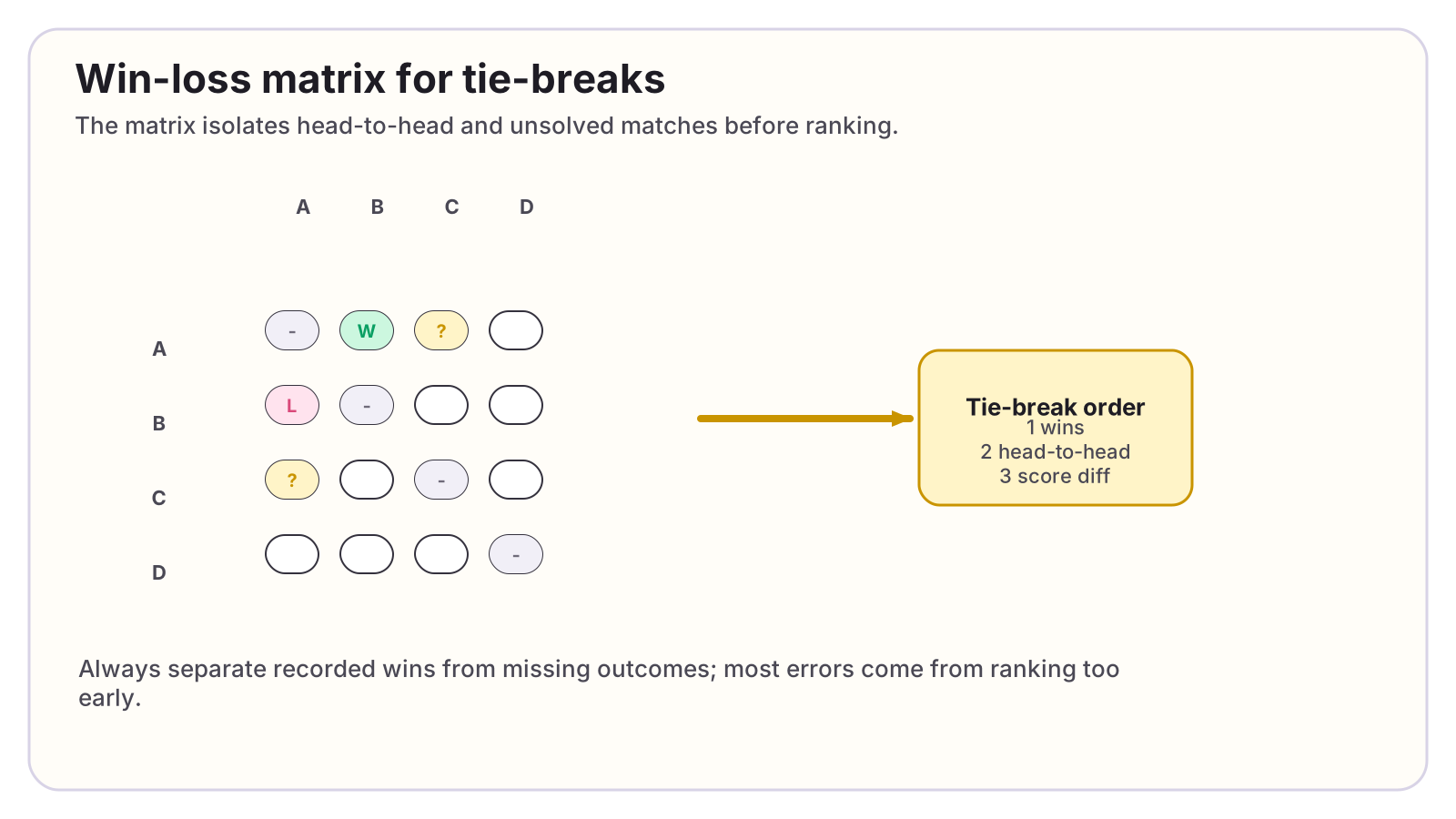
Write the tie-break hierarchy in a separate log: points, head-to-head, score margin, goals for, goals against, or another set-specific rule. Do not rely on memory. Tournament LR sets often hide one ranking switch inside this hierarchy.
Cracku’s syllabus page lists DILR as a section testing data interpretation and logical reasoning capability 4. In tournament sets, the data is usually clean; the reasoning is in the tie-break order.
The bracket-to-question map
Rank questions ask who finishes where. Missing-result questions ask what score or outcome must have occurred. Possibility questions ask which statement can or cannot be true. Mark each question type before solving because it tells you whether to complete the full table or test a branch.
A rank question may need all results. A possibility question may need only one contradiction.
Worked example - 4-team mini league
For teams A, B, C, and D, draw a 4 by 4 matrix and leave the diagonal blank. Add one cell per match. If a clue says A beat B by 2 and C drew D, record outcome and margin separately. If final points are given, reconcile wins and draws before reading questions.
Practice testing helps because you recall the structure under constraint rather than admiring a solved table 7.
Practice routine - 10-minute cap
Find one tournament or scheduling set this week. Spend 90 seconds drawing, 90 seconds entering obvious results, and 7 minutes solving. Then review the tie-break log. Dunlosky et al. support distributed practice, so return to one failed tournament set after 3 days rather than moving on permanently 6.
Your goal is not a perfect bracket. It is a readable bracket under time.
FAQs
How do I solve games and tournaments LR sets?
Draw fixtures first, then outcomes, then tie-breaks. A bracket or round-robin matrix should exist before you answer questions.
What is the biggest mistake in tournament LR?
Mixing fixtures, outcomes, and tie-breaks in one messy table. Separate them from the start.
How much time should I spend drawing the bracket?
Use 90 seconds. A clear bracket usually saves more time than it costs.
Are tournament sets common in CAT?
They are one family under DILR puzzles and scheduling. Use past-paper databases to practise them in full-set form.
How do I review a tournament set?
Check whether the first error came from fixture mapping, outcome recording, tie-break order, or branch testing.
Conclusion
Find one tournament LR set this week. Draw the bracket or matrix before solving, log tie-breaks separately, and cap the attempt at 10 minutes.
Related reading
References
- Indian Institutes of Management, "CAT official website," 2026. [Online]. Available: https://iimcat.ac.in/. Accessed: Jun. 14, 2026. ↩
- 2IIM, "CAT previous year question papers (2017-2025) with solutions," 2026. [Online]. Available: https://online.2iim.com/CAT-question-paper/. Accessed: Jun. 14, 2026. ↩
- MBAUniverse, "CAT 2026 syllabus: section-wise topics and 5-year weightage analysis," 2026. [Online]. Available: https://www.mbauniverse.com/cat/syllabus. Accessed: Jun. 14, 2026. ↩
- Cracku, "CAT exam syllabus 2025," 2026. [Online]. Available: https://cracku.in/cat-exam-syllabus/. Accessed: Jun. 14, 2026. ↩
- IMS India, "CAT syllabus 2026: sections, topics, weightage, and exam pattern," 2026. [Online]. Available: https://www.imsindia.com/blog/cat/cat-syllabus/. Accessed: Jun. 14, 2026. ↩
- J. Dunlosky, K. A. Rawson, E. J. Marsh, M. J. Nathan, and D. T. Willingham, "Improving students’ learning with effective learning techniques: Promising directions from cognitive and educational psychology," Psychological Science in the Public Interest, vol. 14, no. 1, pp. 4-58, 2013. [Online]. Available: https://journals.sagepub.com/doi/10.1177/1529100612453266. Accessed: Jun. 14, 2026. ↩
- H. L. Roediger III and J. D. Karpicke, "Test-enhanced learning: Taking memory tests improves long-term retention," Psychological Science, vol. 17, no. 3, pp. 249-255, 2006. [Online]. Available: https://doi.org/10.1111/j.1467-9280.2006.01693.x. Accessed: Jun. 14, 2026. ↩
- Encyclopaedia Britannica, "Venn diagram," 2026. [Online]. Available: https://www.britannica.com/science/Venn-diagram. Accessed: Jun. 14, 2026. ↩