Topic Guide
LR arrangements for CAT: linear, circular, hybrid
Arrangement sets do not become hard at the question stage. They become hard when the grid is missing and positions live in memory. The grid-first method moves that memory onto paper within 60 seconds. After that, the set becomes clue ordering rather than mental juggling.
The grid-first technique - 60 seconds before clue 3
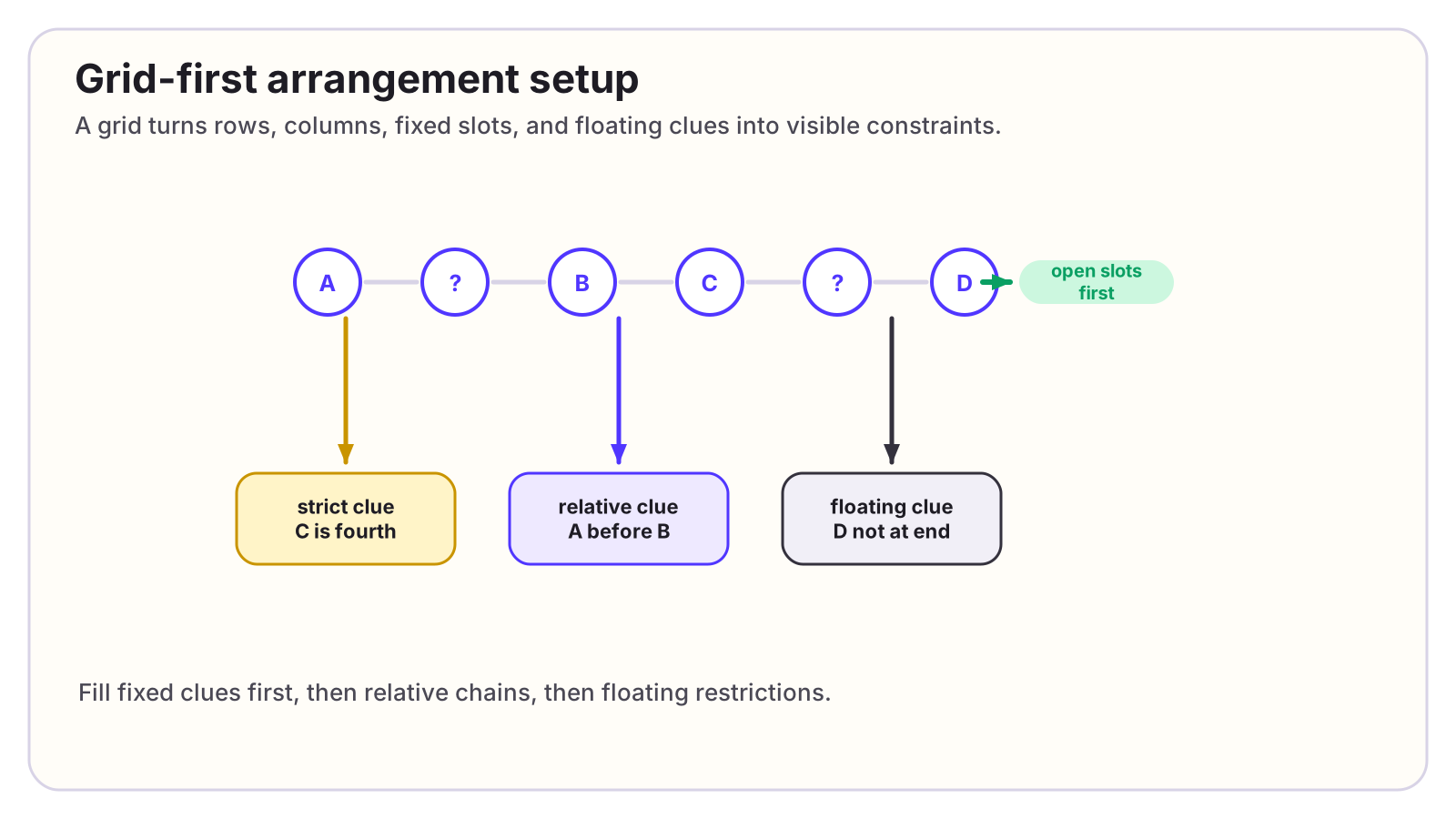
Arrangement sets punish students who hold positions in their head. In the first 60 seconds, draw rows for positions, entities, variables, and constraints. 2IIM’s previous-paper archive lets you pull real LR sets across years for this drill 2. MBAUniverse and IMS both list arrangements, puzzles, blood relations, syllogisms, and Venn diagrams under logical reasoning coverage 3, 5.
The grid is not decoration. It is your working memory on paper.
Strict clues before loose clues
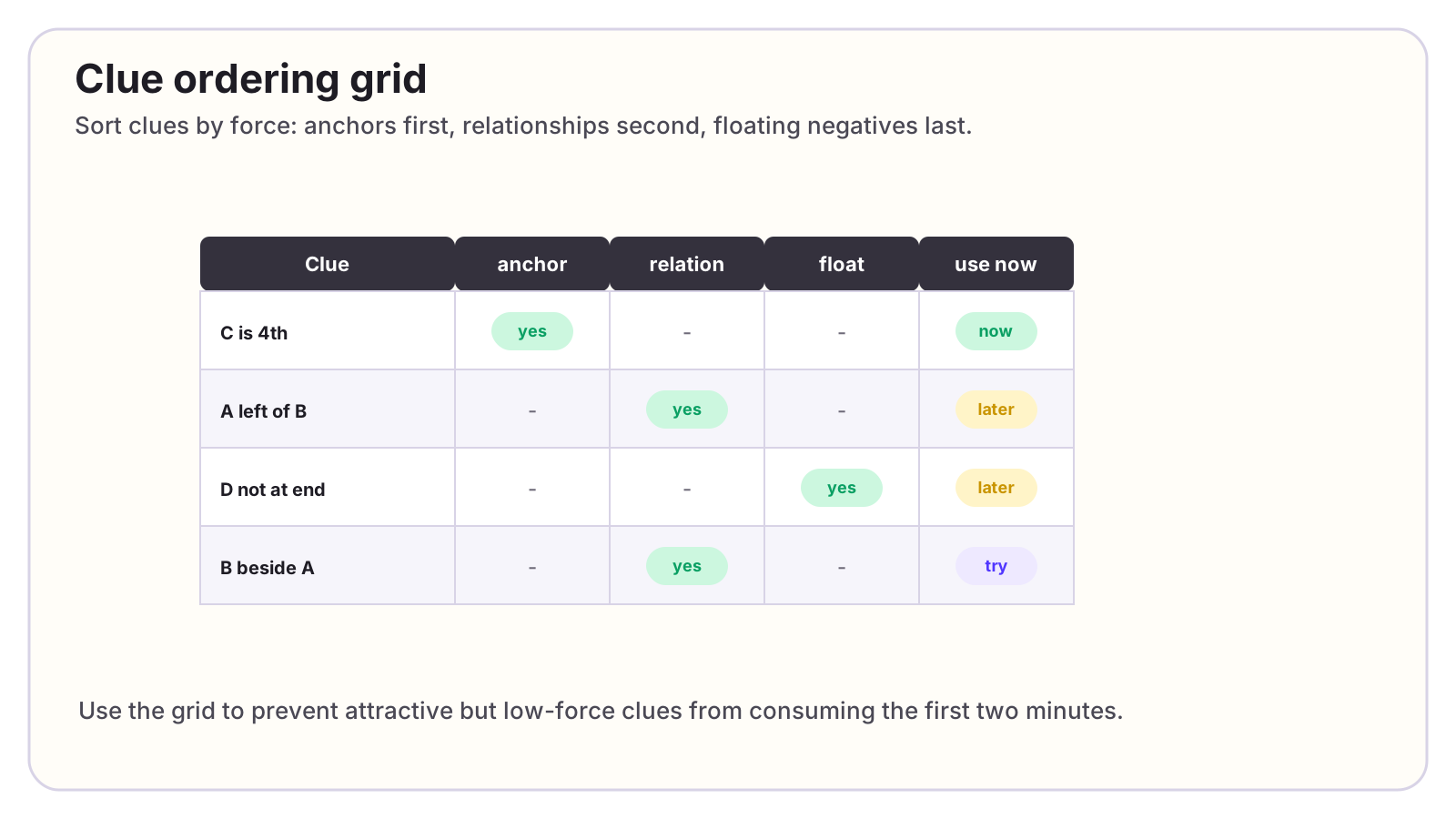
A strict clue fixes a position, distance, adjacency, or exact count. A loose clue only says before, after, or not together. Read all clues once, then number them by force. Start with fixed-position and exact-number clues, then use relative clues to connect names.
Cracku’s syllabus overview confirms DILR as one of the three CAT sections, while the official CAT site remains the annual format authority 1, 4. The method works because the logical structure is stable even when the set theme changes.
Linear, circular, and hybrid sets
Linear arrangements need left-right position rows. Circular arrangements need reference points: clockwise, opposite, immediate neighbour. Hybrid sets add a second variable such as colour, city, floor, day, or profession. For hybrid sets, add a row rather than rewriting the whole diagram.
The common error is to treat a hybrid set as a new topic. It is usually a linear or circular arrangement with one extra variable.
The four failure modes
Setup errors happen before solving starts. Clue-order errors happen when a loose clue is used too early. Variable-tracking errors happen when a second row is not updated. Contradiction errors happen when a branch fails but remains on the page.
Dunlosky et al. support distributed practice and practice testing, which is exactly how arrangement review should run 6. Review one failed set by identifying which of the four failure modes appeared first.
Worked example - a 6-person line
For six people in a line, draw positions 1-6, then add a second row for candidates. If the first strict clue says C is third, write C under 3 immediately. If A sits immediately left of D, place the AD block in available adjacent cells. If B is not at an end, cross B from positions 1 and 6.
After the grid is stable, answer questions. Do not answer while the grid is half-built.
Practice plan - one set, one autopsy
Attempt one arrangement set under 11 minutes. Then spend 11 minutes reviewing. Mark the first clue you should have used, the first branch that failed, and the row that carried the error. Roediger and Karpicke’s retrieval-practice work supports this attempt-first habit 7.
A clean arrangement set is not one you solved eventually. It is one whose grid stayed readable until the final question.
FAQs
How do I start LR arrangements for CAT?
Draw the grid before solving: positions, entities, variables, constraints. Then number clues by force.
What is a strict clue in arrangements?
A strict clue fixes a position, adjacency, distance, or exact count. It removes more possibilities than a loose clue.
Are circular arrangements different from linear arrangements?
The reference changes, but the method remains grid-first. Mark clockwise direction, opposite pairs, and neighbours clearly.
How much time should one arrangement set take?
Use an 11-minute cap for a standard set in practice. Review for another 11 minutes.
How do I review arrangement mistakes?
Tag the first failure as setup, clue order, variable tracking, or contradiction handling.
Conclusion
Solve one arrangement set under 11 minutes and review it for another 11. Circle the first clue you should have used and the first branch that broke.
Related reading
References
- Indian Institutes of Management, "CAT official website," 2026. [Online]. Available: https://iimcat.ac.in/. Accessed: Jun. 14, 2026. ↩
- 2IIM, "CAT previous year question papers (2017-2025) with solutions," 2026. [Online]. Available: https://online.2iim.com/CAT-question-paper/. Accessed: Jun. 14, 2026. ↩
- MBAUniverse, "CAT 2026 syllabus: section-wise topics and 5-year weightage analysis," 2026. [Online]. Available: https://www.mbauniverse.com/cat/syllabus. Accessed: Jun. 14, 2026. ↩
- Cracku, "CAT exam syllabus 2025," 2026. [Online]. Available: https://cracku.in/cat-exam-syllabus/. Accessed: Jun. 14, 2026. ↩
- IMS India, "CAT syllabus 2026: sections, topics, weightage, and exam pattern," 2026. [Online]. Available: https://www.imsindia.com/blog/cat/cat-syllabus/. Accessed: Jun. 14, 2026. ↩
- J. Dunlosky, K. A. Rawson, E. J. Marsh, M. J. Nathan, and D. T. Willingham, "Improving students’ learning with effective learning techniques: Promising directions from cognitive and educational psychology," Psychological Science in the Public Interest, vol. 14, no. 1, pp. 4-58, 2013. [Online]. Available: https://journals.sagepub.com/doi/10.1177/1529100612453266. Accessed: Jun. 14, 2026. ↩
- H. L. Roediger III and J. D. Karpicke, "Test-enhanced learning: Taking memory tests improves long-term retention," Psychological Science, vol. 17, no. 3, pp. 249-255, 2006. [Online]. Available: https://doi.org/10.1111/j.1467-9280.2006.01693.x. Accessed: Jun. 14, 2026. ↩
- Encyclopaedia Britannica, "Venn diagram," 2026. [Online]. Available: https://www.britannica.com/science/Venn-diagram. Accessed: Jun. 14, 2026. ↩