Topic Guide
Diversity factor in IIM admissions: what it actually does
Diversity factor is an explicit component in some IIM composite-score models. It may account for academic background, gender, or other profile dimensions depending on institute policy. It is real, but it is not a substitute for the CAT gate. Treat it as a margin-shifter in the scorecard.
Definition
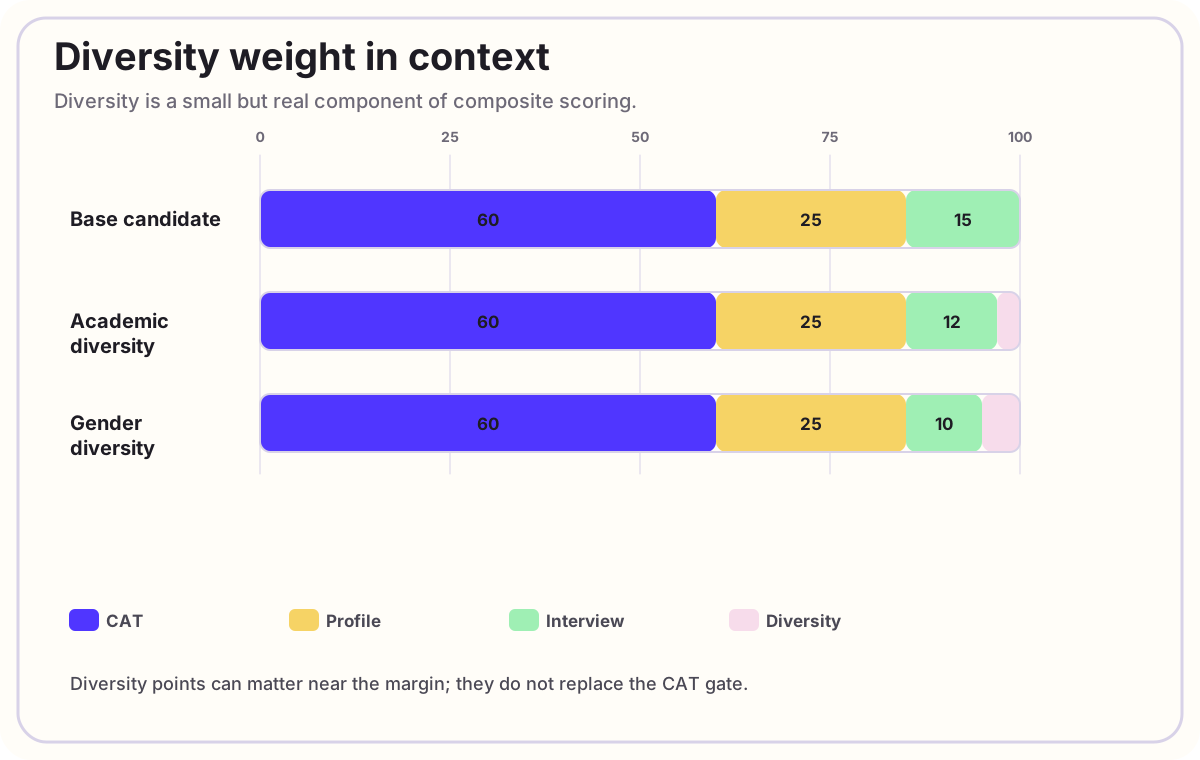
An institute can assign diversity points to improve classroom mix across academic streams or gender representation. The policy specifies the conditions and the weight. A candidate does not need to guess whether the factor exists; the admission document should say so.
The practical mistake is calling it bonus marks. It is not separate from the scorecard. It is one row inside the scorecard.
Where it matters most
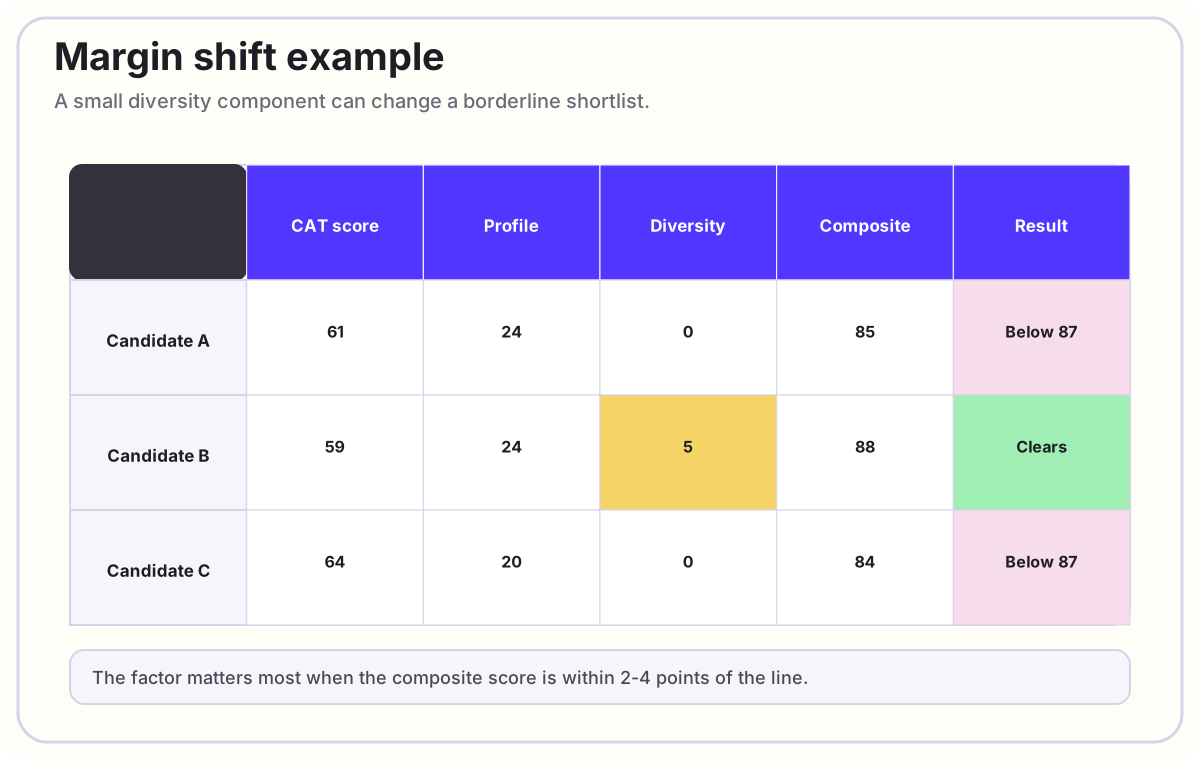
A small diversity weight can move a candidate near a boundary. It will not compensate for missing the sectional gate. It also cannot turn an unfavourable interview into a strong conversion by itself.
Use the factor to read fit across IIMs. A non-engineering or women applicant may be more competitive at an institute whose scorecard explicitly recognises that dimension.
How to compare institutes
A shortlist sheet should include CAT weight, profile weight, interview weight, and diversity weight. Looking at diversity alone creates a distorted picture. Looking at the full scorecard tells the candidate whether the institute rewards the profile they actually have.
The comparison is especially useful for candidates with uneven academic records. A profile-friendly institute may be a better target than a CAT-heavy institute at the same percentile.
What it does not do
Every candidate still needs to clear the eligibility gates. A diversity factor works after the basic gates are satisfied. If the student misses QA or VARC by the institute minimum, the composite advantage may never enter the calculation.
So the preparation strategy remains the same: build section floors first, then optimise institute fit.
How to use it this week
List 5 target institutes. For each one, add whether it has academic diversity, gender diversity, both, or neither in the published scorecard. Then mark whether that factor helps your actual profile.
This takes 30 minutes and prevents several months of vague target selection.
Where diversity points enter the scorecard
IIMs that use diversity factors typically place them inside a shortlist or final-score formula alongside CAT, academics, work experience, writing, and interview components. The exact weight changes by institute and cycle, so the official admissions page should be checked before using any number in a shortlist sheet 1, [2], [3], [4], [5].
This matters because a diversity factor can shift close cases but cannot replace the main gates. Sectional cutoffs, overall percentile, and composite ranking still matter. The right student takeaway is neither dismissal nor overconfidence. It is to record the applicable component and then prepare for the scored stages.
A 100-point example
Consider two candidates on a 100-point shortlist scale. Candidate A has 62.4 before a diversity component. Candidate B has 61.1 before that component and receives 2.0 applicable diversity points. Candidate B moves to 63.1 and can cross Candidate A. That is a real shift, but it is still a boundary shift rather than a full replacement for CAT or interview performance.
The example also shows why claims about diversity points should be written carefully. A component can be decisive in a narrow band and irrelevant when the gap is large. The production copy should say that the shift can matter in close cases, and then point readers to the institute formula.
What to record in your shortlist sheet
The shortlist sheet should include institute, cycle, applicable category, diversity component, maximum points, and source date. Keep the language neutral. The purpose is admissions planning, not judgment. A candidate should know whether the component exists, how much it weighs, and whether the current cycle still uses it.
After recording it, return to the controllable columns: section targets, mock review, WAT-PI evidence, and application documents. Diversity can change the margin, but preparation still has to clear the main gates.
FAQs
What is IIM diversity factor?
IIM diversity factor is the article's main operating idea. Read it as a decision rule with a number attached, not as a loose definition.
Which source should I trust first?
Use official CAT or institute pages for policy claims, then use coaching analyses for paper-pattern interpretation and academic studies for learning-strategy claims.
How often should this article be refreshed?
Refresh it once every CAT admission cycle, and sooner if an official institute policy page publishes a new PDF.
What is the practical next step?
Write the main number from this article into your mock sheet or shortlist sheet today, then check it after the next mock.
How does this link to Clymber preparation?
It turns a vague CAT-prep question into one measurable decision that can be reviewed by a student or mentor within 7 days.
Conclusion
Use this article as a working sheet, not only as a reading page. Record the main number for your target case, apply it to the next mock or shortlist decision, and review the result within 7 days.
Related reading
References
- IIM Ahmedabad, "MBA admissions criteria for Indian candidates." Available: https://www.iima.ac.in/academics/mba/admissions/indians. Accessed: 15-Jun-2026. [2] IIM Bangalore, "PGP and PGP-BA admission process for 2026-28." Available: https://www.iimb.ac.in/sites/default/files/inline-files/PGP%20and%20PGP%20BA%20Admission%20process%20for%202026-28.pdf. Accessed: 15-Jun-2026. [3] IIM Lucknow, "Admission policy for MBA, MBA-ABM and MBA-SM 2026-28." Available: https://www.iiml.ac.in/sites/default/files/upload/admission_2026-28/AdmissionPolicy_2026-28.pdf. Accessed: 15-Jun-2026. [4] IIM Kozhikode, "PGP admissions and selection policy." Available: https://iimk.ac.in/academic-programmes/pgp/admission. Accessed: 15-Jun-2026. [5] NIRF, "India rankings management category." Available: https://www.nirfindia.org/Rankings/2025/ManagementRanking.html. Accessed: 15-Jun-2026. [6] IIM CAT, "CAT official website." Available: https://iimcat.ac.in. Accessed: 15-Jun-2026. [7] MBAUniverse, "CAT exam pattern and syllabus guide." Available: https://www.mbauniverse.com/cat/exam-pattern. Accessed: 15-Jun-2026. [8] Times of India, "IIM Trichy joins Joint Admission Process 2026." Available: https://timesofindia.indiatimes.com/education/news/iim-trichy-joins-joint-admission-process-2026-for-mba-pgpm-admissions/articleshow/124348236.cms. Accessed: 15-Jun-2026. ↩