Topic Guide
JAP and CAP in IIM admissions: what the common process means
JAP and CAP are admission-process terms, not extra exams. They describe how groups of IIMs coordinate interviews or admission steps. The shortlist criteria still belong to the individual institute. That distinction prevents a common mistake: treating a common interview process as a common selection score.
What JAP means
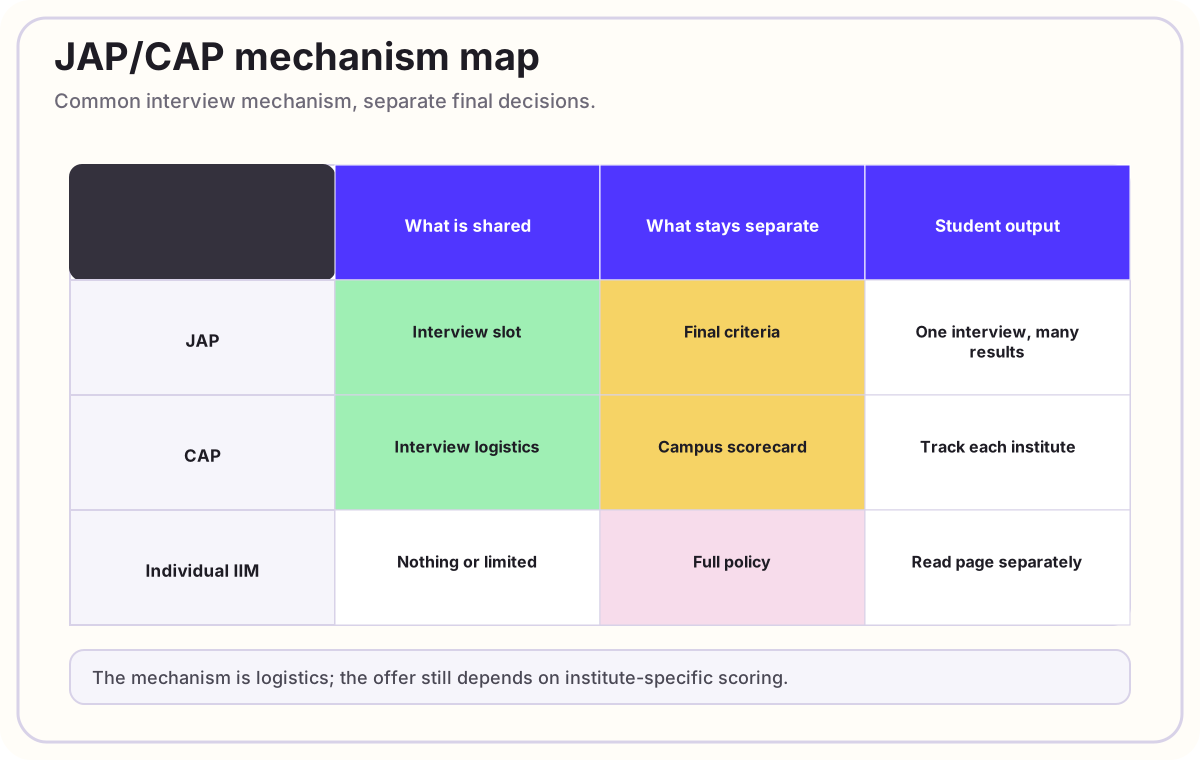
A joint process reduces duplicated interview logistics. It can make one interview window relevant to multiple institutes. But it does not mean each institute applies the same final conversion weights.
For students, the useful question is not only whether an IIM is in JAP. The useful question is which policy document decides the final score after the common process ends.
What CAP means
CAP works as a coordination layer. Participating institutes can use a common process while maintaining institute-level weights, cutoffs, and final offer rules. This explains why two candidates can attend a shared interview process and receive different outcomes across campuses.
The right shortlist sheet therefore has a process column and a score-policy column. Do not merge them.
What the mechanism changes
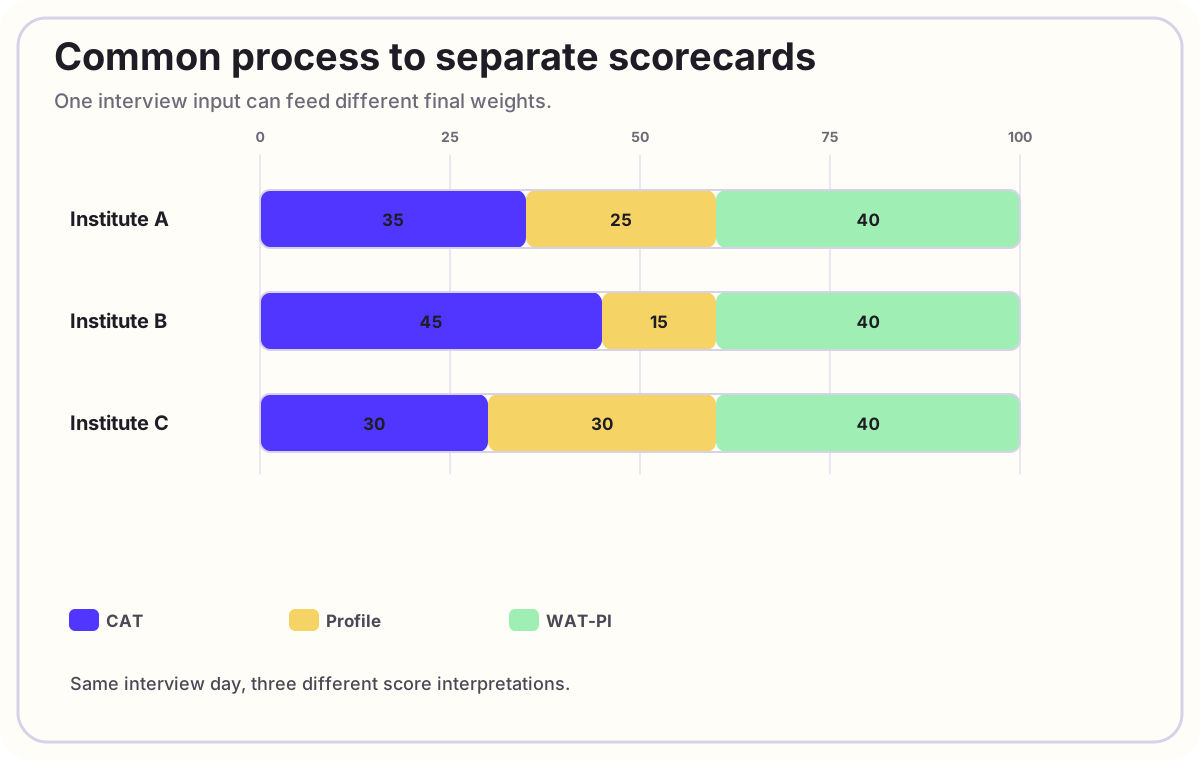
A common process can reduce uncertainty around interview scheduling. It does not remove category-wise gates, composite-score weightages, or institute-specific profile criteria. That is why a student should track both the interview process and the final admission policy.
The practical rule is simple: read the coordination notice for dates, then read the institute policy for weightages.
Which students should care most
If your target list includes several participating institutes, the common process affects interview preparation logistics. It can also reduce duplicated document prep. But it should not change how you set CAT sectional targets.
Keep one master document folder and one institute-wise score sheet. That gives both process readiness and policy clarity.
How to track updates
The list of participating institutes can change. For every cycle, confirm the current notice before writing final copy or preparing an admissions tracker. News reports can explain the change, but the official institute notice should remain the final publish source.
For the student, the next step is to mark the process group for each target IIM and update the shortlist calendar once dates are announced.
How to read the calendar signal
JAP and CAP are useful terms because they tell a candidate where operational coordination is happening. A shared process can mean common interview scheduling, common document checks, or a shared pool of interview scores. It does not automatically mean one shortlist formula or one final admission formula. The article's core distinction is therefore logistical process versus institute-level decision rule 1, [6].
The calendar signal is practical. If five campuses participate in a common process, a candidate should prepare one document folder, one profile story bank, and one WAT-PI evidence bank before the window starts. The final offer may still be campus-specific, but the preparation work can be centralised.
The mistake that causes wrong expectations
Students often read a common process notice and assume that one interview score will be treated identically by every campus. That is rarely the right model. The interview record may be common, but the final score can combine it with CAT, academics, category, diversity, and work experience in different proportions [2], [3], [4], [5].
The better worksheet has three columns: process name, participating institutes, and institute-specific final weights. This separation keeps the candidate from over-reading one shortlist call. It also makes waitlist movement easier to track because the same interview outcome can sit in different positions across institute lists.
FAQs
What is IIM JAP CAP?
IIM JAP CAP is the article's main operating idea. Read it as a decision rule with a number attached, not as a loose definition.
Which source should I trust first?
Use official CAT or institute pages for policy claims, then use coaching analyses for paper-pattern interpretation and academic studies for learning-strategy claims.
How often should this article be refreshed?
Refresh it once every CAT admission cycle, and sooner if an official institute policy page publishes a new PDF.
What is the practical next step?
Write the main number from this article into your mock sheet or shortlist sheet today, then check it after the next mock.
How does this link to Clymber preparation?
It turns a vague CAT-prep question into one measurable decision that can be reviewed by a student or mentor within 7 days.
Conclusion
Use this article as a working sheet, not only as a reading page. Record the main number for your target case, apply it to the next mock or shortlist decision, and review the result within 7 days.
Related reading
References
- Times of India, "IIM Trichy joins Joint Admission Process 2026." Available: https://timesofindia.indiatimes.com/education/news/iim-trichy-joins-joint-admission-process-2026-for-mba-pgpm-admissions/articleshow/124348236.cms. Accessed: 15-Jun-2026. [2] IIM Ahmedabad, "MBA admissions criteria for Indian candidates." Available: https://www.iima.ac.in/academics/mba/admissions/indians. Accessed: 15-Jun-2026. [3] IIM Bangalore, "PGP and PGP-BA admission process for 2026-28." Available: https://www.iimb.ac.in/sites/default/files/inline-files/PGP%20and%20PGP%20BA%20Admission%20process%20for%202026-28.pdf. Accessed: 15-Jun-2026. [4] IIM Lucknow, "Admission policy for MBA, MBA-ABM and MBA-SM 2026-28." Available: https://www.iiml.ac.in/sites/default/files/upload/admission_2026-28/AdmissionPolicy_2026-28.pdf. Accessed: 15-Jun-2026. [5] IIM CAT, "CAT official website." Available: https://iimcat.ac.in. Accessed: 15-Jun-2026. [6] NIRF, "India rankings management category." Available: https://www.nirfindia.org/Rankings/2025/ManagementRanking.html. Accessed: 15-Jun-2026. [7] IIM Kozhikode, "PGP admissions and selection policy." Available: https://iimk.ac.in/academic-programmes/pgp/admission. Accessed: 15-Jun-2026. [8] MBAUniverse, "CAT exam pattern and syllabus guide." Available: https://www.mbauniverse.com/cat/exam-pattern. Accessed: 15-Jun-2026. ↩