Quick Read
Why mock percentile is not your final CAT percentile
Mock percentile is useful, but one mock is not your final CAT percentile. A mock uses a smaller test-taking pool, a different difficulty mix, and a different day-state than the actual exam. The better habit is to read your last 3 mocks as a band and then ask which section is causing the movement.
Why one mock is noisy
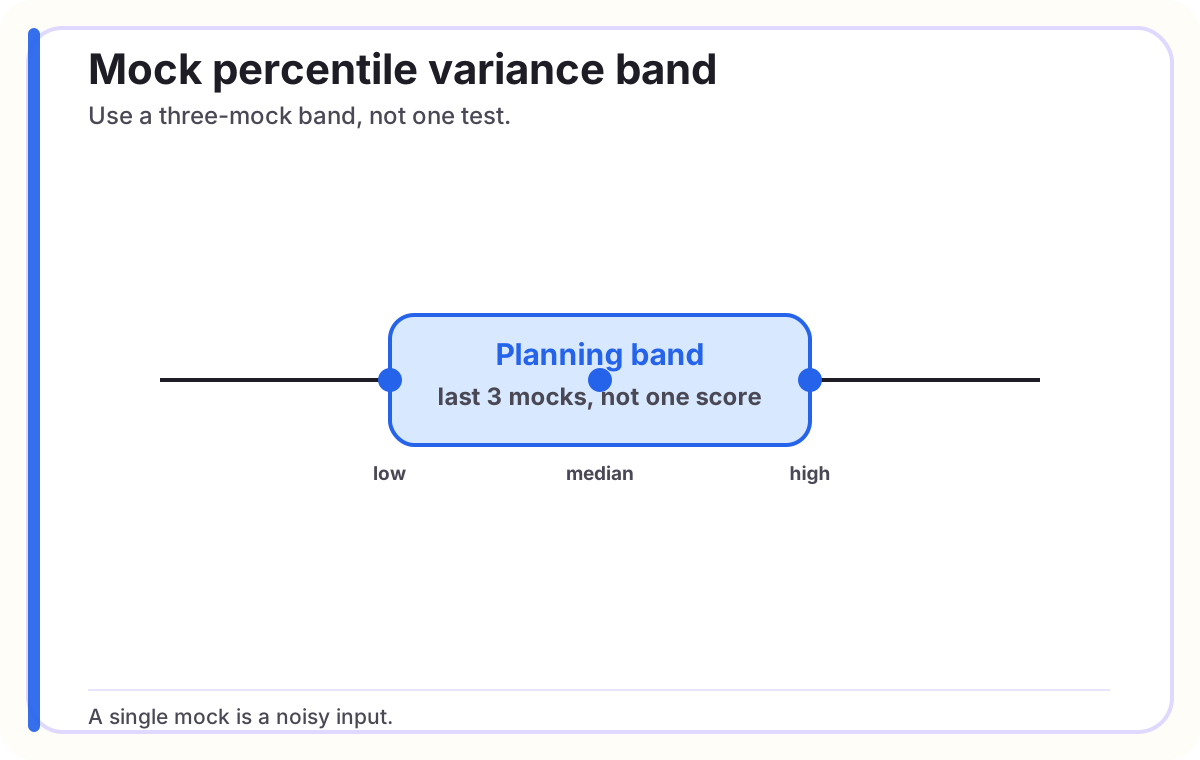
CAT percentile is a rank among the actual test pool, while mock percentile is a rank inside one vendor or cohort. Predictor tools can be useful, but they should not be treated as final truth [3].
A single score should start a review, not a conclusion.
Use variance as a signal, not as a verdict. For why one mock is noisy, compare the last 3 mocks by section, attempt count, and error type. A jump or drop without section evidence is only a story. A jump or drop with section evidence becomes a correction plan for the next seven days.
Use the three-mock band
Write your last 3 overall percentiles and each sectional percentile. Then identify the median and the widest swing. Past-paper sources help with test quality; the band helps with emotional stability and planning [4], [5].
Your band is more reliable than your last mock.
Use variance as a signal, not as a verdict. For use the three-mock band, compare the last 3 mocks by section, attempt count, and error type. A jump or drop without section evidence is only a story. A jump or drop with section evidence becomes a correction plan for the next seven days.
Who tends to jump
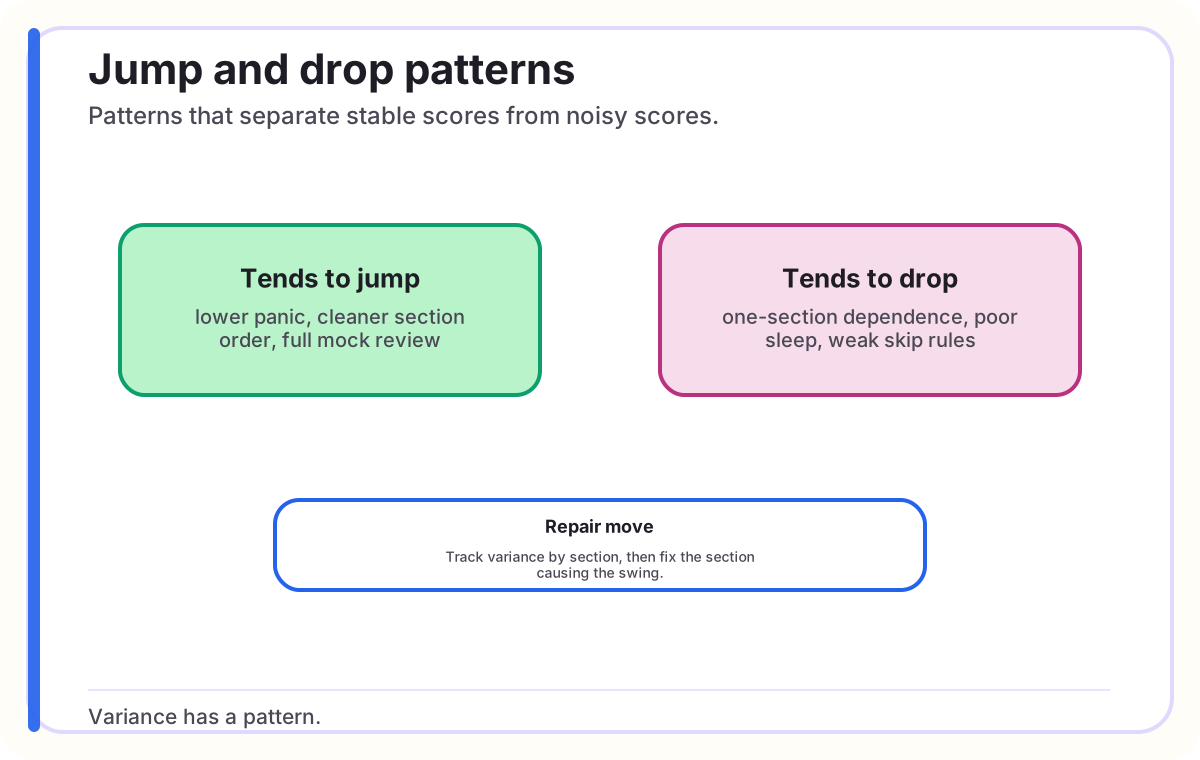
Students often outperform their last mock when they have stable section order, reviewed errors, good sleep, and a clear skip rule. The pattern is not magic. It is reduced variance.
If your process is stable, a low final mock is not automatically a collapse.
Use variance as a signal, not as a verdict. For who tends to jump, compare the last 3 mocks by section, attempt count, and error type. A jump or drop without section evidence is only a story. A jump or drop with section evidence becomes a correction plan for the next seven days.
Who tends to drop
Students often underperform when they depend on one section, take too many unreviewed mocks, or change strategy late. Sectional gates make this especially risky [6].
Look for the section that carries or breaks the overall score.
Use variance as a signal, not as a verdict. For who tends to drop, compare the last 3 mocks by section, attempt count, and error type. A jump or drop without section evidence is only a story. A jump or drop with section evidence becomes a correction plan for the next seven days.
How to use percentile predictors
Predictors and marks maps are useful for broad target-setting, especially after official results and slot analyses are published [2], [3]. They should not replace your error log.
Use the predictor to set a band, then use your notebook to set the drill.
What to do this week
Write last 3 overall scores and sectional scores. Circle the largest section swing. Plan one correction drill for that section.
Your target is one variance source, not a new target score.
FAQs
Is mock percentile equal to CAT percentile?
No. Mock percentile is based on a different pool and paper. Use it as a signal, not a final prediction.
How many mocks should I use to judge my level?
Use at least your last 3 serious mocks. A three-mock band is more useful than one score.
Can a student score higher in CAT than in mocks?
Yes, if the process is stable and the mock scores were affected by noise or poor paper fit.
Why do some students drop from mock to CAT?
Common reasons include unreviewed mocks, weak sectional balance, late strategy changes, and poor exam-day routine.
How should I use a percentile predictor?
Use it as a range for planning. Do not treat the output as a fixed final percentile.
Conclusion
Read the score as evidence, not as identity. The next step is one section, one variance source, or one cutoff risk that you can repair this week.
Related reading
References
- Indian Institutes of Management, "Common Admission Test official website," 2025. [Online]. Available: https://iimcat.ac.in/ [2] The Times of India, "CAT 2025 results: 12 candidates score 100 percentile, 9 from non-engineering backgrounds," 2025. [Online]. Available: https://timesofindia.indiatimes.com/education/news/cat-2025-results-12-candidates-score-100-percentile-9-from-non-engineering-backgrounds/articleshow/126171290.cms [3] Cracku, "CAT percentile predictor," 2025. [Online]. Available: https://cracku.in/cat-percentile-predictor [4] 2IIM, "CAT previous year question papers," 2025. [Online]. Available: https://online.2iim.com/CAT-question-paper/ [5] Cracku, "CAT previous papers," 2025. [Online]. Available: https://cracku.in/cat-previous-papers [6] Indian Institute of Management Ahmedabad, "Admission - MBA Indian," 2026. [Online]. Available: https://www.iima.ac.in/academics/mba/admissions/indians [7] MBAUniverse, "CAT syllabus and exam pattern," 2025. [Online]. Available: https://www.mbauniverse.com/articles/cat-syllabus [8] Career Launcher, "CAT exam pattern," 2025. [Online]. Available: https://www.careerlauncher.com/cat-mba/exam-pattern/ ↩