Topic Guide
Number theory for CAT: the 4 must-know patterns
Number theory is a small QA topic with a high precision ceiling. Four patterns do most of the work: divisibility, remainders, trailing zeroes, and bases. Learn those patterns deeply rather than chasing every rare trick. The topic rewards clean setup more than long calculation.
The 4 patterns
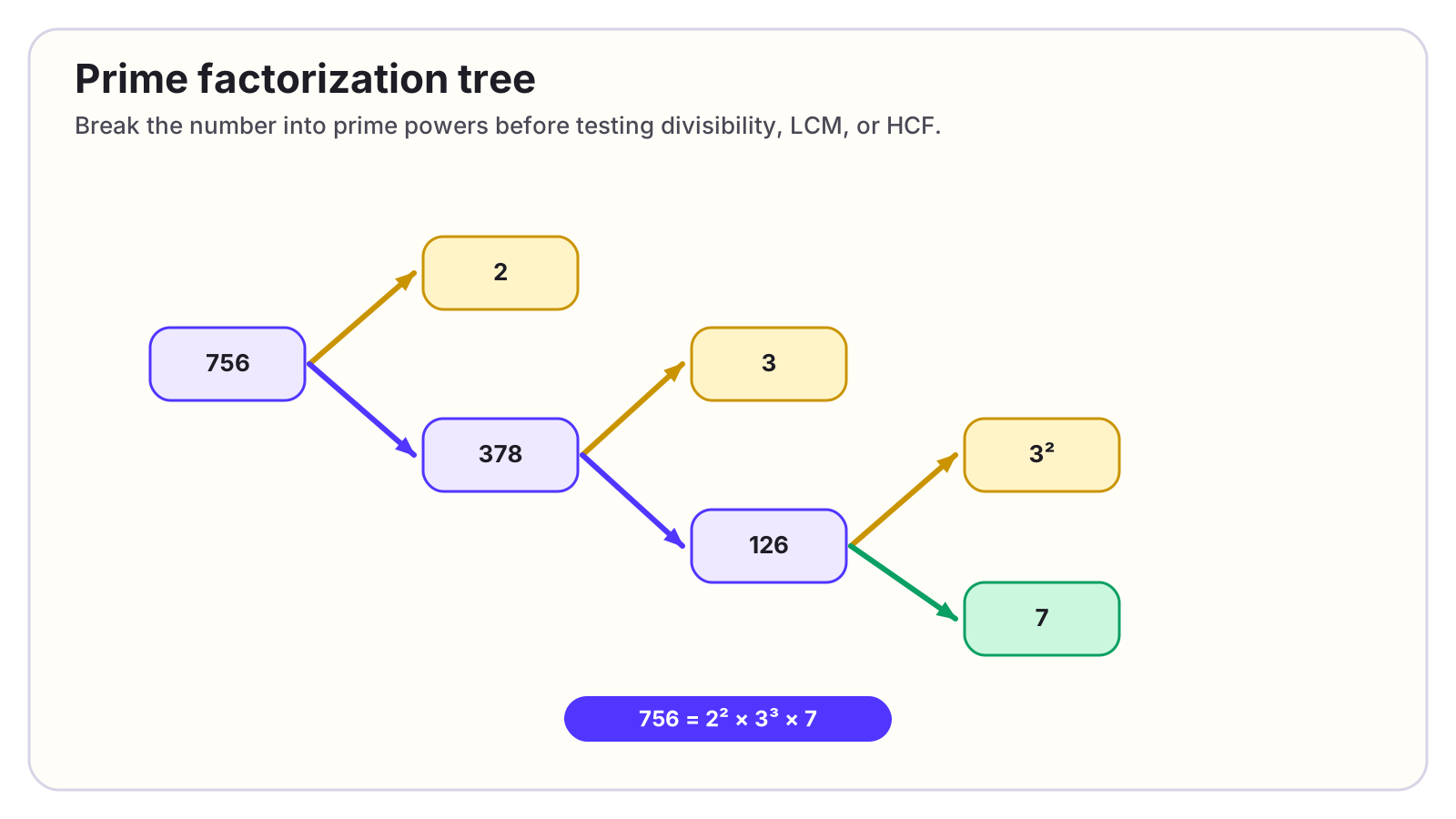
Use four buckets: divisibility, remainders, factorial trailing zeroes, and base systems. MBAUniverse’s 2021-2025 analysis estimates number systems at about 8 percent of QA, smaller than arithmetic and algebra 3. That share can still matter because the topic is self-contained and often trainable.
Do not chase every olympiad trick. CAT number theory rewards a compact pattern set.
Divisibility - factor before testing
Break the divisor into prime powers. Divisibility by 12 means divisibility by 3 and 4. Divisibility by 18 means 2 and 9. If a condition involves multiple divisors, use LCM and GCD language before testing examples.
NCERT textbooks can refresh factorisation basics, while past CAT papers show the exam-level framing 6, 2.
Remainders - cycle before computation
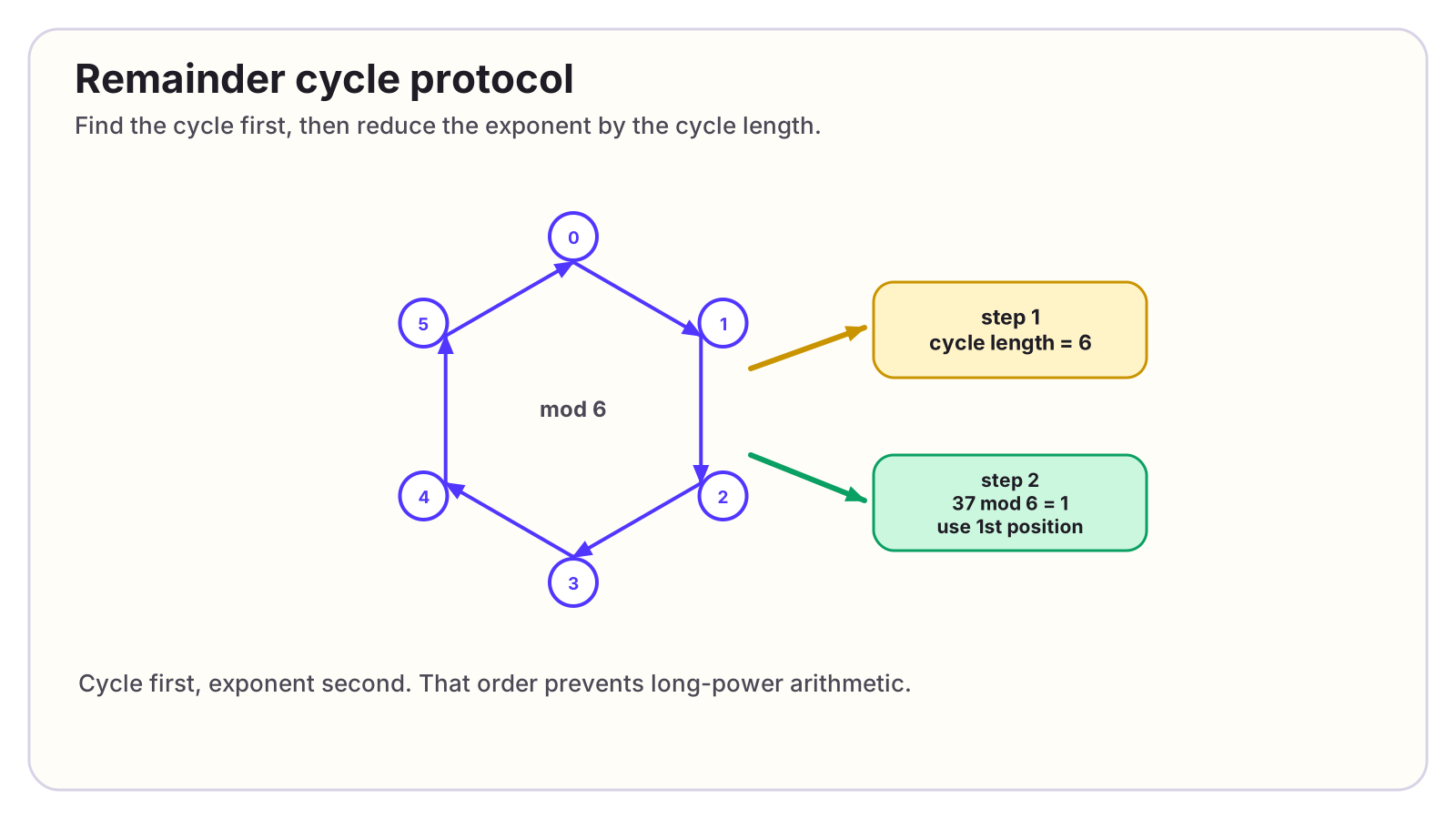
For a remainder problem, write the modulus, list powers until the cycle repeats, reduce the exponent, and test a small case. For example, powers of 2 modulo 5 cycle 2, 4, 3, 1. The 27th power uses the 3rd cycle position, so the remainder is 3.
This method is safer than mental expansion because every step is bounded.
Trailing zeroes - count the limiting prime
For n factorial, count floor(n/5) + floor(n/25) + floor(n/125) and continue until the term is zero. For 100 factorial, that is 20 + 4 = 24 zeroes. If the expression is not a factorial, factor it before using the shortcut.
IMS lists QA as a school-math-based section, but CAT framing often hides the basic factor count inside a word problem 5.
Base systems - place value is the whole topic
A number written as 243 in base 5 equals 2x25 + 4x5 + 3 = 73 in decimal. For decimal to another base, divide repeatedly by the base and read remainders upward. Most CAT base questions test this place-value logic, not advanced notation.
The official CAT site remains the annual source for exam updates 1. Use topic analyses for preparation priority, not for a promise about the exact next paper.
Practice protocol - 20 questions in 2 weeks
Do 20 problems over 2 weeks: 5 divisibility, 5 remainders, 5 trailing zeroes, 5 base systems. After each miss, write the missing pattern. Dunlosky et al. and Roediger and Karpicke support distributed practice and effortful testing 7, 8.
Your target is not volume. It is to identify the pattern in under 30 seconds.
FAQs
Is number theory important for CAT?
It is a smaller QA area than arithmetic and algebra, but it is compact and can become a high-accuracy topic.
Which number theory topics should I learn?
Divisibility, remainders, trailing zeroes, and base systems are the four priority patterns.
How do I solve remainder questions?
Name the modulus, find the cycle, reduce the exponent, and check with a small case.
How do I count trailing zeroes in factorials?
Count powers of 5: floor(n/5), floor(n/25), floor(n/125), and so on until zero.
How many number theory questions should I practise?
Start with 20 questions over 2 weeks, split evenly across the four patterns.
Conclusion
Do 5 remainder problems tonight using the 4-step protocol. If the modulus and cycle are not written in the first 30 seconds, repeat setup drills before harder questions.
Related reading
References
- Indian Institutes of Management, "CAT official website," 2026. [Online]. Available: https://iimcat.ac.in/. Accessed: Jun. 14, 2026. ↩
- 2IIM, "CAT previous year question papers (2017-2025) with solutions," 2026. [Online]. Available: https://online.2iim.com/CAT-question-paper/. Accessed: Jun. 14, 2026. ↩
- MBAUniverse, "CAT 2026 syllabus: section-wise topics and 5-year weightage analysis," 2026. [Online]. Available: https://www.mbauniverse.com/cat/syllabus. Accessed: Jun. 14, 2026. ↩
- Cracku, "CAT exam syllabus 2025," 2026. [Online]. Available: https://cracku.in/cat-exam-syllabus/. Accessed: Jun. 14, 2026. ↩
- IMS India, "CAT syllabus 2026: sections, topics, weightage, and exam pattern," 2026. [Online]. Available: https://www.imsindia.com/blog/cat/cat-syllabus/. Accessed: Jun. 14, 2026. ↩
- National Council of Educational Research and Training, "Textbooks PDF (I-XII)," 2026. [Online]. Available: https://ncert.nic.in/textbook.php. Accessed: Jun. 14, 2026. ↩
- J. Dunlosky, K. A. Rawson, E. J. Marsh, M. J. Nathan, and D. T. Willingham, "Improving students’ learning with effective learning techniques: Promising directions from cognitive and educational psychology," Psychological Science in the Public Interest, vol. 14, no. 1, pp. 4-58, 2013. [Online]. Available: https://journals.sagepub.com/doi/10.1177/1529100612453266. Accessed: Jun. 14, 2026. ↩
- H. L. Roediger III and J. D. Karpicke, "Test-enhanced learning: Taking memory tests improves long-term retention," Psychological Science, vol. 17, no. 3, pp. 249-255, 2006. [Online]. Available: https://doi.org/10.1111/j.1467-9280.2006.01693.x. Accessed: Jun. 14, 2026. ↩