Topic Guide
Para-summary for CAT: what gets cut, what stays
The right para-summary option always loses something. That is the job of a summary. The wrong option often keeps more nouns from the paragraph while changing the author’s claim. Your task is controlled loss: keep the claim, cut the ornament, reject the distortion.
What a summary is and is not
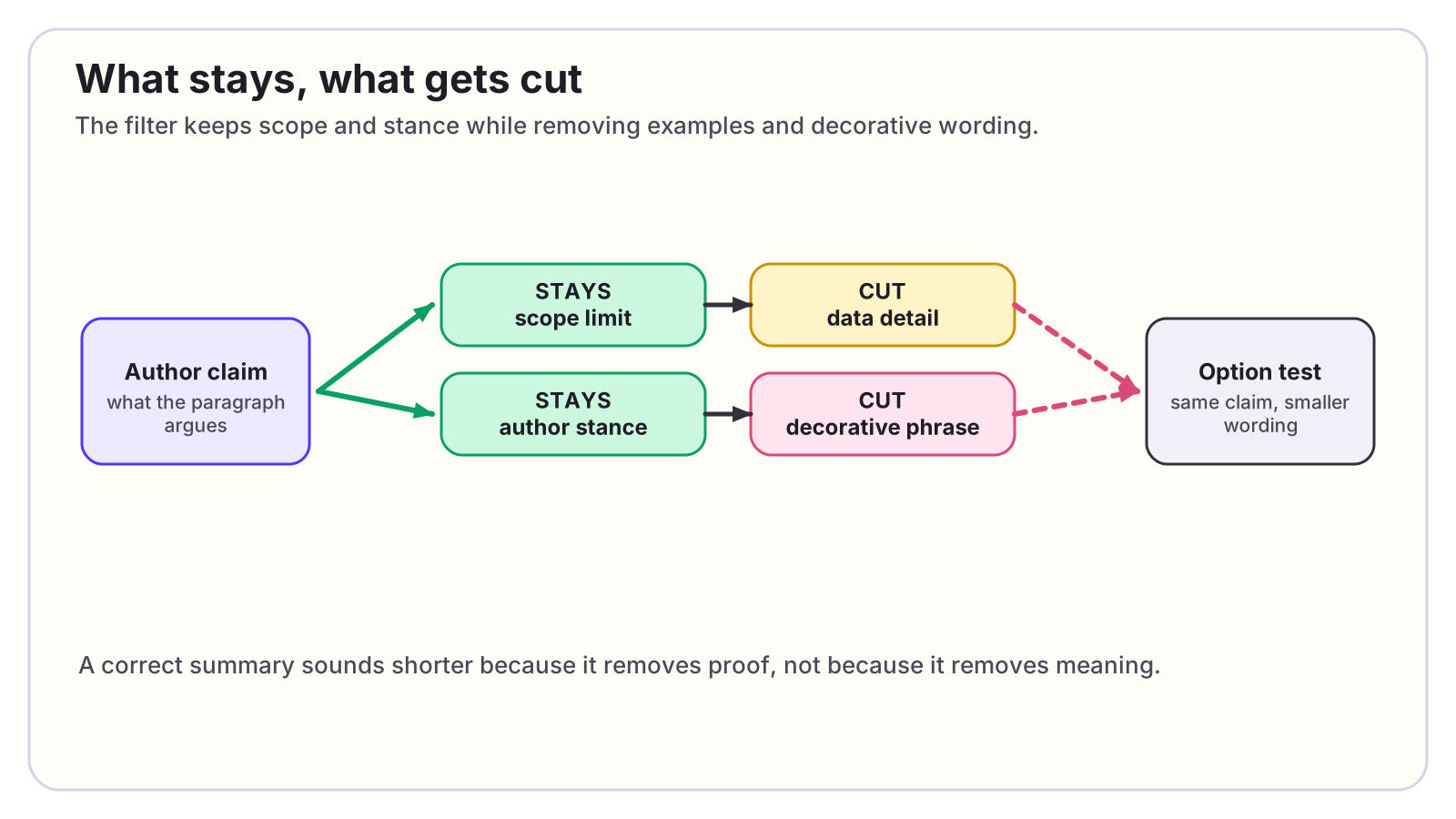
The right option will not keep every example. That is why many wrong options feel richer: they retain surface details while changing the main claim. CAT’s official page remains the source to refresh the annual test format 1, while recent VARC trend pages show para-summary as a recurring VA task 3.
Your first task is to separate claim from material. The claim stays. Examples, illustrations, and repeated phrasing usually go.
The 3-pass technique - compress without distortion
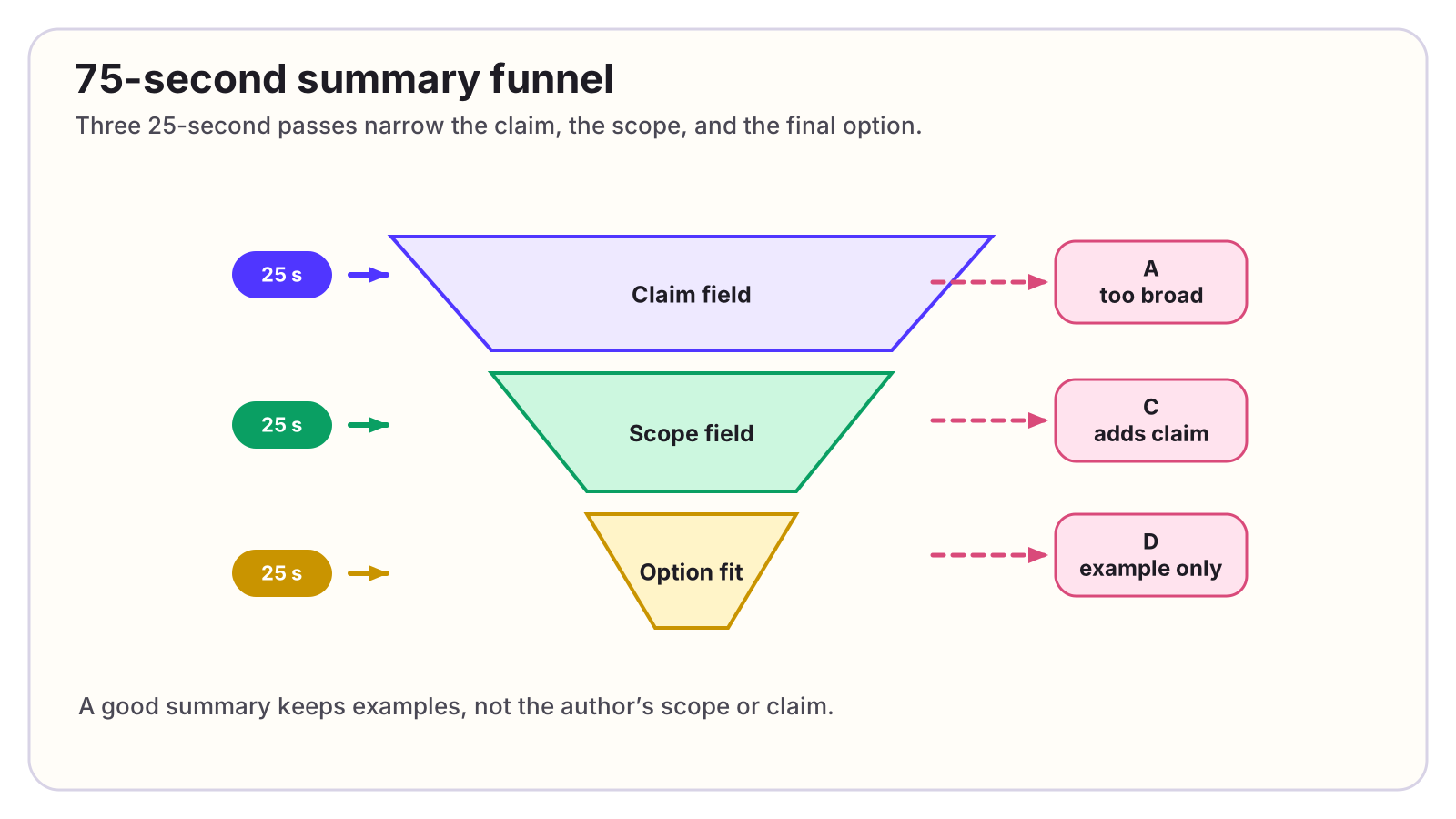
Pass 1: write a 7-10 word claim. Pass 2: mark the paragraph’s limit - time, population, cause, exception, or contrast. Pass 3: test options for omission, addition, and distortion. A 75-second cap works because CAT VA sits inside the 40-minute VARC section, not in a separate writing test 4.
If two options look close, pick the one that keeps the relationship between ideas, not the one that borrows more words from the paragraph.
The four trap options
The first trap is detail-hoarding: the option includes many nouns but misses the claim. The second is scope shift: a paragraph about one context becomes a claim about all contexts. The third is moralising: the option adds praise or blame. The fourth is cause injection: the option creates a cause the paragraph never proves.
IMS lists para-summary among the VA question types under the broader VARC syllabus 5. Practise the option test by writing the trap label before reading the solution.
Worked example - controlled loss wins
Imagine a paragraph arguing that remote work changed office culture mainly by weakening informal learning, while leaving formal meetings intact. A strong summary keeps “informal learning weakened” and “formal coordination remained.” A weak summary says “remote work damaged productivity” because that adds a claim not made.
2IIM’s past-paper archive is the safest practice bank because it keeps the item inside a real CAT-style slot context 2. Use synthetic examples for learning the method, then real papers for timing.
Review routine - build a trap ledger
Make four columns: added claim, lost claim, changed scope, wrong emphasis. After five para-summary attempts, every wrong option should sit in one column. Roediger and Karpicke’s retrieval-practice finding supports this attempt-before-solution method 7. Dunlosky et al. also rank practice testing and distributed practice as high-utility techniques 6.
The benefit is diagnostic. If all errors are changed-scope errors, more reading is not the next drill; scope marking is.
Six-week target - 5 items per week
Do five para-summary questions per week for six weeks. Keep the cap at 75 seconds, then spend 3 minutes reviewing options. Spaced-repetition research shows that delayed review protects against forgetting, so bring missed items back on day 3 and day 10 8.
By week 6, your target is 80 percent accuracy under the cap. If accuracy is lower, reduce speed pressure for one week and repair the trap category.
FAQs
What is para-summary in CAT VARC?
It is a verbal ability task where you choose the option that best compresses the paragraph’s central claim without adding or distorting meaning.
How much time should I spend on para-summary?
Use a 75-second cap in practice: claim, scope, option test. Review can take longer after the attempt.
Why does the wrong option sound more complete?
Many wrong options keep examples and keywords but change the author’s central claim or scope.
Should I choose the shortest option?
No. Choose the option that preserves the claim and logical relation. Length is not the decision rule.
How many para-summary questions should I practise weekly?
Five focused items per week is enough if every miss is tagged by trap type and reviewed after a delay.
Conclusion
Pick 5 para-summary questions and run the 75-second routine. Keep a 4-column trap ledger. By the end of the week, you should know whether you add, omit, shift, or overemphasise.
Related reading
References
- Indian Institutes of Management, "CAT official website," 2026. [Online]. Available: https://iimcat.ac.in/. Accessed: Jun. 14, 2026. ↩
- 2IIM, "CAT previous year question papers (2017-2025) with solutions," 2026. [Online]. Available: https://online.2iim.com/CAT-question-paper/. Accessed: Jun. 14, 2026. ↩
- Cracku, "CAT VARC topic-wise weightage," 2026. [Online]. Available: https://cracku.in/cat-varc-topic-wise-weightage/. Accessed: Jun. 14, 2026. ↩
- MBAUniverse, "CAT 2026 syllabus: section-wise topics and 5-year weightage analysis," 2026. [Online]. Available: https://www.mbauniverse.com/cat/syllabus. Accessed: Jun. 14, 2026. ↩
- IMS India, "CAT syllabus 2026: sections, topics, weightage, and exam pattern," 2026. [Online]. Available: https://www.imsindia.com/blog/cat/cat-syllabus/. Accessed: Jun. 14, 2026. ↩
- J. Dunlosky, K. A. Rawson, E. J. Marsh, M. J. Nathan, and D. T. Willingham, "Improving students’ learning with effective learning techniques: Promising directions from cognitive and educational psychology," Psychological Science in the Public Interest, vol. 14, no. 1, pp. 4-58, 2013. [Online]. Available: https://journals.sagepub.com/doi/10.1177/1529100612453266. Accessed: Jun. 14, 2026. ↩
- H. L. Roediger III and J. D. Karpicke, "Test-enhanced learning: Taking memory tests improves long-term retention," Psychological Science, vol. 17, no. 3, pp. 249-255, 2006. [Online]. Available: https://doi.org/10.1111/j.1467-9280.2006.01693.x. Accessed: Jun. 14, 2026. ↩
- S. Reddy, I. Labutov, S. Banerjee, and T. Joachims, "Unbounded human learning: Optimal scheduling for spaced repetition," 2016. [Online]. Available: https://arxiv.org/abs/1602.07032. Accessed: Jun. 14, 2026. ↩