Topic Guide
CAT for college students: fit preparation around classes, not against them
College students do not lack time; they lose it through unplanned campus weeks. The current CAT pattern is built around three timed sections, and recent public analyses report 68 questions across VARC, DILR, and QA with 40 minutes per section 1[3][4]. Previous-paper databases are the best practice base because they preserve real section phrasing, slot variation, and TITA/MCQ mix [2]. The plan below uses that exam structure plus learning-science evidence on retrieval and spaced review [6][7][8].
Map the semester first
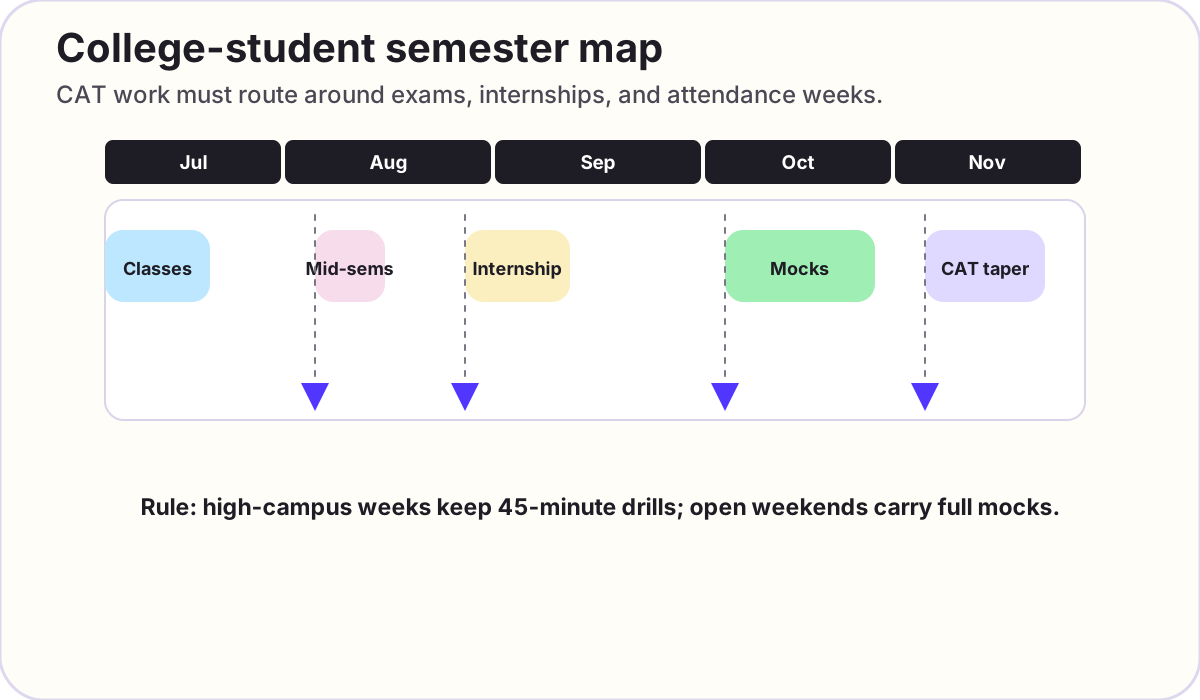
Put mid-sems, end-sems, projects, fests, internships, and placements on one timeline. CAT preparation must bend around these spikes. A plan that ignores college deadlines fails by week three. This links to the section and question-type structure reported by CAT-pattern sources [3][4][5].
Use small weekday blocks
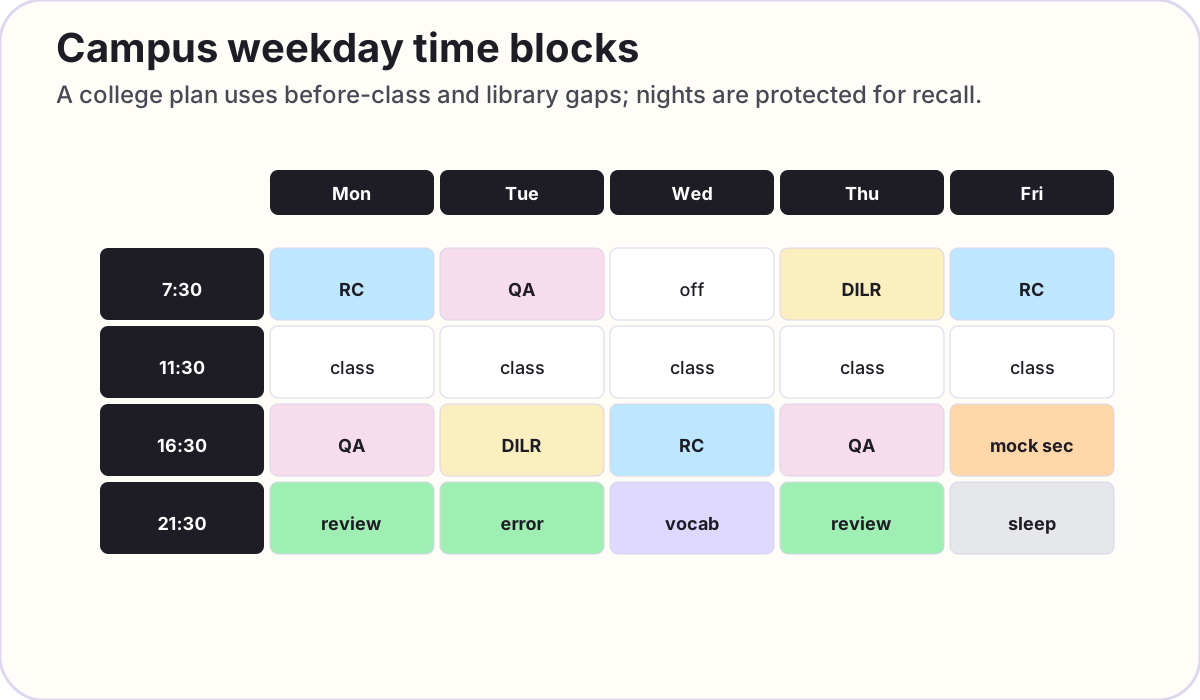
Before-class and library-gap blocks are useful for RC, formula recall, and 30-minute QA drills. Save full DILR sets and mocks for weekends or low-load days. Check the rule against previous CAT papers instead of isolated drills [2].
Protect sleep before heavy days
Late-night study before labs or submissions hurts recall and discipline. Use night blocks for error logs or light retrieval, not fresh difficult topics. The official CAT interface and timed-section design make this a practical constraint, not a stylistic preference 1[3].
Turn lectures into reading practice
Non-fiction reading from coursework, economics, psychology, or public policy can support RC stamina. The goal is structure reading, not random volume. The review step is also consistent with evidence that testing and retrieval improve durable learning [6][7].
Plan mock weeks around exams
Do not schedule a full mock during the week of an end-sem paper. Use sectional drills and restart full mocks after the academic spike. Spaced review prevents one-session performance from being mistaken for stable skill [8].
FAQs
Can college students prepare for CAT with classes?
Yes, if the plan uses protected blocks and accounts for exams, internships, and projects.
How many hours should a college student study for CAT?
A practical range is 8-12 hours per week during class periods, with more during breaks.
Should I take mocks during semester exams?
Use sectional drills during exam weeks and return to full mocks after the spike.
What is the best daily block for college students?
A 30-60 minute protected block before classes or during a library gap works better than an uncertain late-night block.
How can college reading help VARC?
Course readings can train structure, argument, and tone if reviewed deliberately.
Conclusion
Use the first diagram as your next drill plan, then review the result within 24 hours and repeat the same rule for 3 timed sets.
Related reading
- situational cat preparation guide
- cat study plan template
- how to prepare cat timeline
- cat weak qa background
- foundation
References
- IIMCAT, "CAT 2025 official portal." Available: https://iimcat.ac.in/ [2] 2IIM, "CAT previous year question papers, 2017-2025." Available: https://online.2iim.com/CAT-question-paper/ [3] IMS India, "CAT exam pattern 2026: sections, question types, and marks." Available: https://www.imsindia.com/blog/cat/cat-exam-pattern/ [4] MBAUniverse, "CAT exam pattern: sections, questions, duration, and marking scheme." Available: https://www.mbauniverse.com/cat/pattern [5] IMS India, "CAT syllabus 2026: section-wise topics and weightage." Available: https://www.imsindia.com/blog/cat/cat-syllabus/ [6] J. Dunlosky, K. A. Rawson, E. J. Marsh, M. J. Nathan, and D. T. Willingham, "Improving students' learning with effective learning techniques," Psychological Science in the Public Interest, 2013. Available: https://doi.org/10.1177/1529100612453266 [7] H. L. Roediger and J. D. Karpicke, "Test-enhanced learning: taking memory tests improves long-term retention," Psychological Science, 2006. Available: https://doi.org/10.1111/j.1467-9280.2006.01693.x [8] S. Reddy, I. Labutov, S. Banerjee, and T. Joachims, "Unbounded human learning: optimal scheduling for spaced repetition," arXiv, 2016. Available: https://arxiv.org/abs/1602.07032 ↩