Topic Guide
CAT preparation with weak QA background: the 4-month bridge
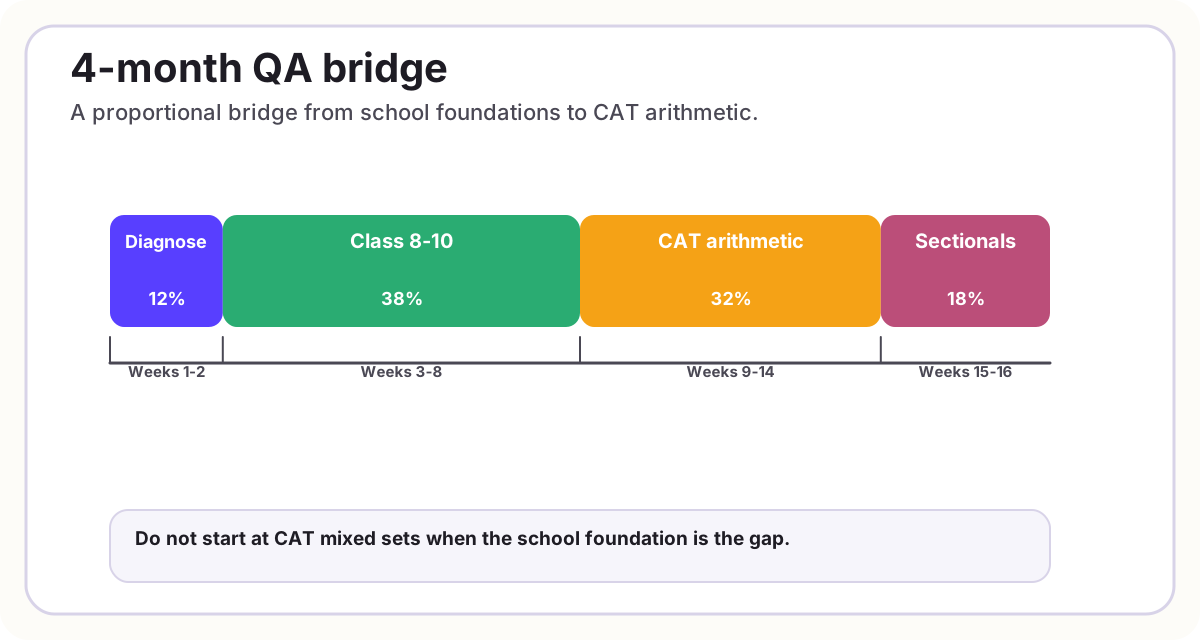
A weak QA background is a sequence problem. Start too late in the syllabus, and every problem feels like a wall. Start at the right diagnostic level, and the next four months become measurable. The bridge is not glamorous, but it is precise.
Start with diagnosis, not guilt
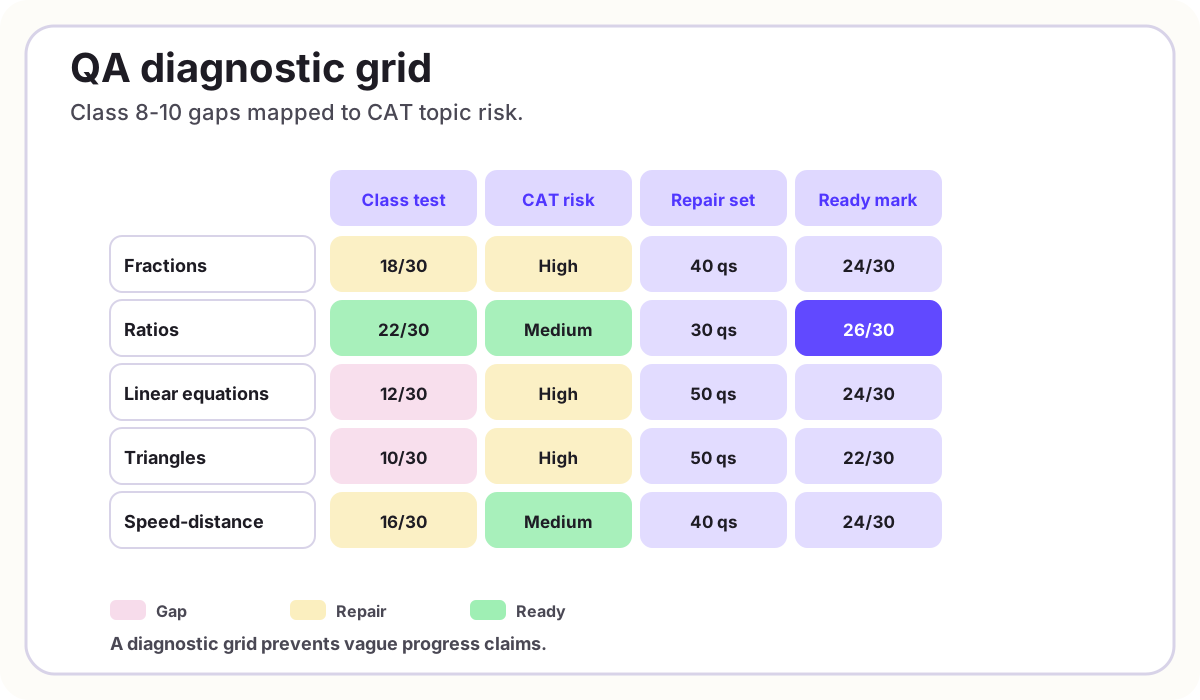
Use a Class 8-10 diagnostic before CAT-level questions. 2
Use this checkpoint before adding more unsorted practice or applications.
Month 1 rebuilds arithmetic language
Spend 8 hours a week on core arithmetic for 4 weeks. 3
Use this checkpoint before adding more unsorted practice or applications.
Month 2 adds algebra and geometry basics
Do 20 basics and 10 mixed problems each week. 4
Use this checkpoint before adding more unsorted practice or applications.
Months 3 and 4 move to CAT arithmetic
Use 25 problems per week with review notes, not 100 unreviewed questions. 5
Use this checkpoint before adding more unsorted practice or applications.
Mocks should start when review is possible
A mock without review is noise. 6
Use this checkpoint before adding more unsorted practice or applications.
The weekly scorecard matters more than confidence
Use 3 columns: concept gap, reading gap, calculation gap. 7
Use this checkpoint before adding more unsorted practice or applications.
FAQs
Can arts students prepare for CAT QA?
Yes. Start with a diagnostic and rebuild arithmetic before CAT-level mixed sets.
How long does a weak QA bridge take?
A focused 4-month bridge is realistic for many students if the first 2 months rebuild school-level foundations.
Should I take full mocks in month 1?
Take one diagnostic mock, then use sectionals until review becomes productive.
What topics should come first?
Fractions, ratios, percentages, averages, equations, triangles, and circles should come before advanced QA.
How many problems per week are enough?
Twenty-five reviewed CAT-level QA problems per week is a better target than a large unreviewed pile.
Conclusion
Use a 4-month bridge: diagnose, rebuild school math, shift to CAT arithmetic, then add mocks. Start with the article's numeric anchor today and update it after your next mock or source check.
Related reading
References
- IIM CAT, "Common Admission Test official website," 2025. Available: https://iimcat.ac.in/ ↩
- J. Dunlosky et al., "Improving Students’ Learning With Effective Learning Techniques," Psychological Science in the Public Interest, 2013. Available: https://journals.sagepub.com/doi/10.1177/1529100612453266 ↩
- H. L. Roediger and J. D. Karpicke, "Test-enhanced learning," Psychological Science, 2006. Available: https://doi.org/10.1111/j.1467-9280.2006.01693.x ↩
- NCERT, "Mathematics Textbook for Class VIII," 2025. Available: https://ncert.nic.in/textbook.php?hemh1=0-13 ↩
- IIM Ahmedabad, "Admission - MBA (Indian), PGP 2026-28 selection process," 2025. Available: https://www.iima.ac.in/academics/mba/admissions/indians ↩
- IIM Bangalore, "PGP admission process," 2026. Available: https://www.iimb.ac.in/programmes/post-graduate-programme-management ↩
- IIM Calcutta, "MBA admission policy for domestic candidates," 2026. Available: https://www.iimcal.ac.in/programs/pgp/admission-policy/admission-procedure-for-domestic-candidates ↩
- Times of India, "Rs 1.1 crore offer 2nd highest at IIM-A," reporting IIMA PGP 2025 IPRS figures, 2025. Available: https://timesofindia.indiatimes.com/city/ahmedabad/rs-1-1-crore-offer-2nd-highest-at-iim-a/articleshow/124004385.cms ↩