Pillar Guide
CAT Situational Preparation Guide 2026
Two aspirants can both have 6 months left and need completely different plans. One has a full-time job and 90 tired minutes at night. Another is in college with long free afternoons but exam weeks every month. A third has cleared CAT once before — at the 92nd percentile — and is back for the 99th. A CAT plan that ignores the constraint will look disciplined on paper and fail by Day 10.
This guide gives you a real weekly template for each situation — working professional, final-year student, and repeater — alongside the time-protection rules that survive a bad week and the signals that say it is time to ask for mentor support. You will pick a profile, copy the week, and remove one unrealistic task from your calendar. That is the whole job.
Working professional — the 11-hour week
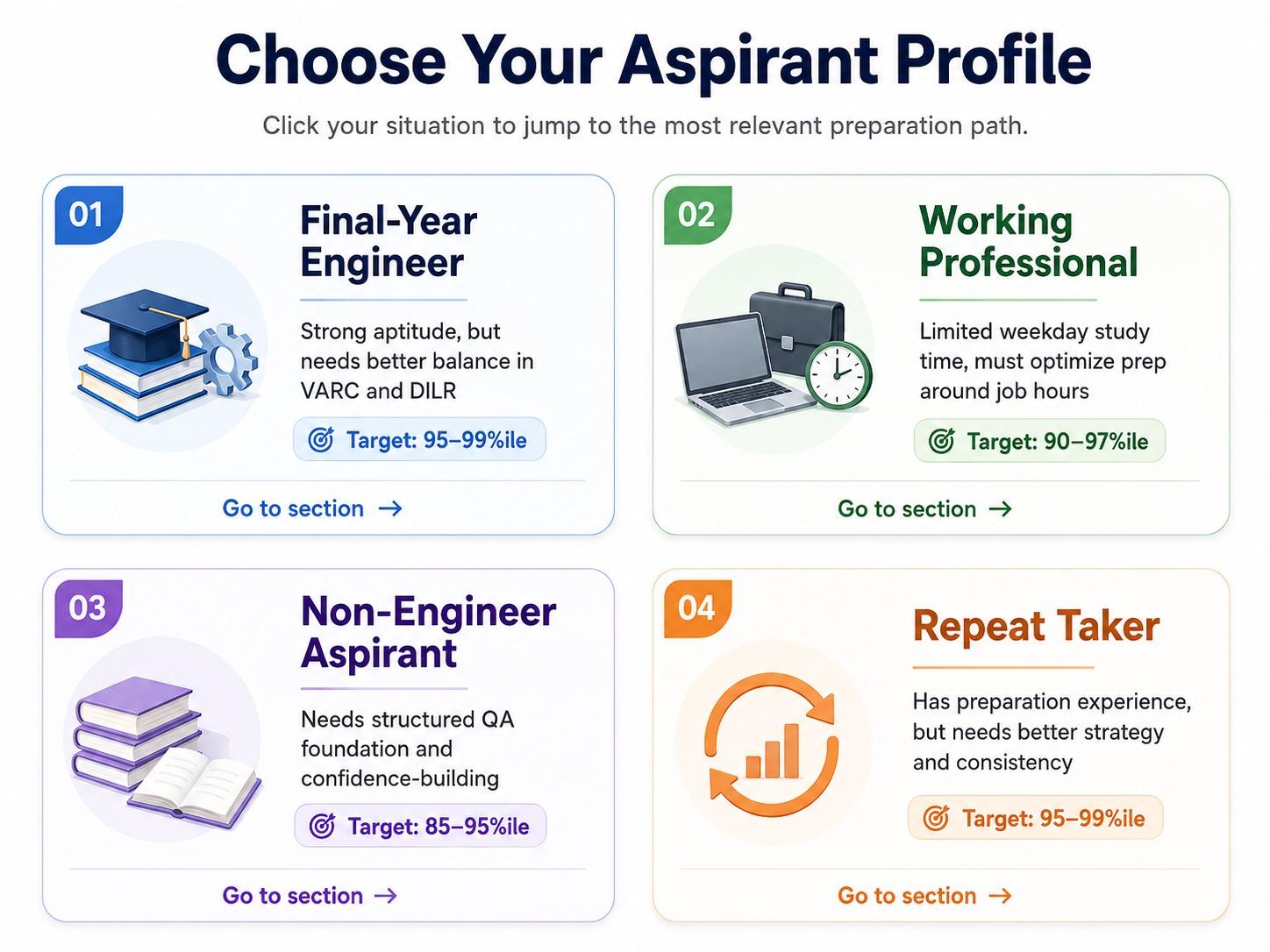

Most working professionals try to study like they are in college, then quit by Week 3. The fix is to stop pretending. You have roughly 11 protected hours a week: five 1-hour weekday micro-sessions, two 3-hour weekend depth blocks, and zero negotiable carry-over. Everything else is bonus, not baseline.
The structure below is the survivable version. IMS India's working-professional guidance also notes that consistency beats volume — 2 to 3 weekday hours plus 5 to 6 weekend hours is the realistic ceiling for someone holding a full-time job 10. The plan below sits inside that envelope.
The week
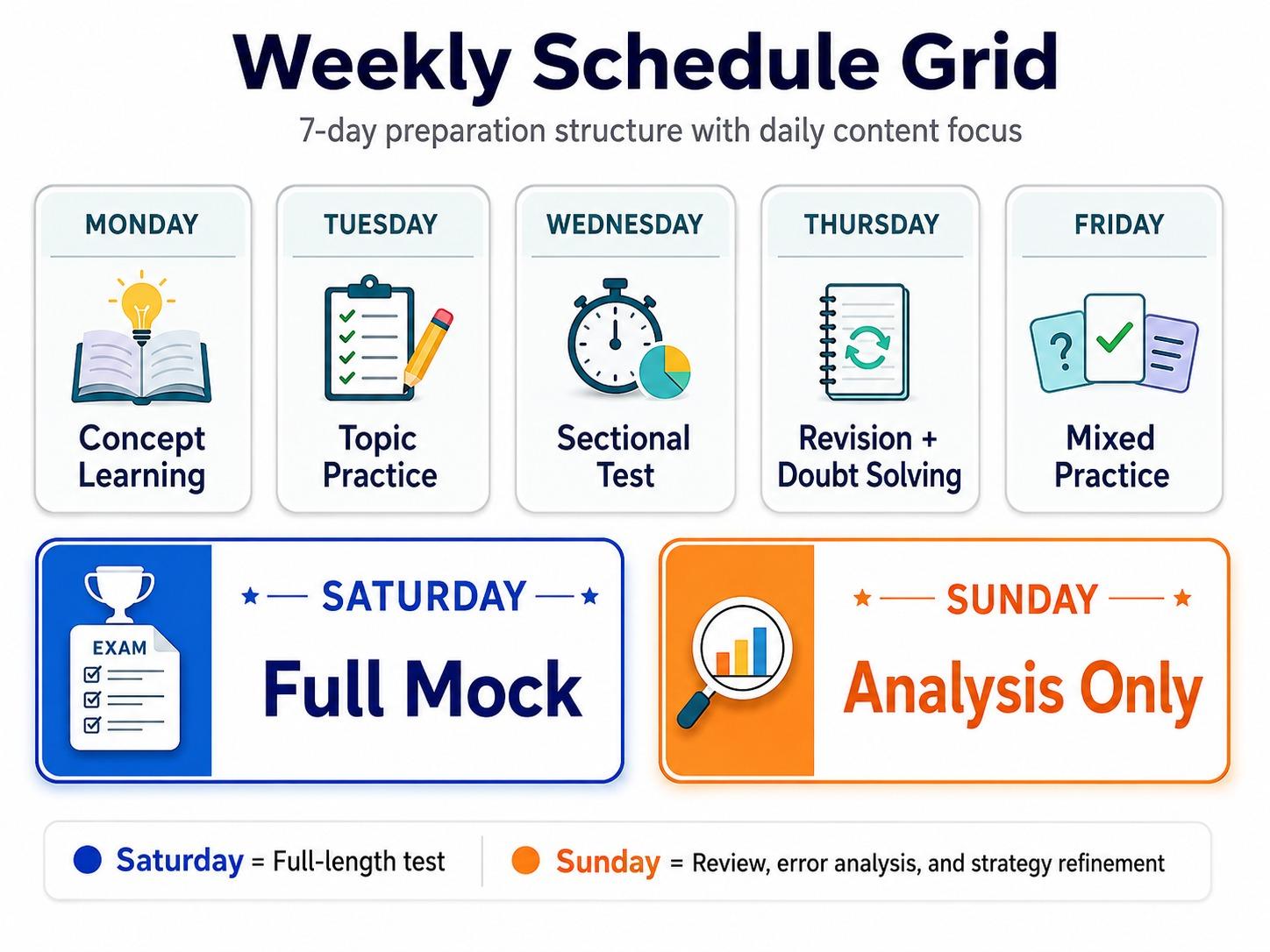
| Day | Slot | Block | Output |
|---|---|---|---|
| Mon | 9:00–10:00 PM | QA — 1 concept + 8 mixed | Solved-log entry |
| Tue | 9:00–10:00 PM | VARC — 1 RC + trap labels | Trap-label note |
| Wed | 7:00–8:00 AM (or skip) | Maintenance — vocab + 1 caselet | Spaced-repetition tick |
| Thu | 9:00–10:00 PM | DILR — 1 caselet, timed | Set-selection note |
| Fri | Off | Rest | Sleep |
| Sat | 9:00 AM–12:00 PM | Sectional test (60 min) + debrief (120 min) | Error-pattern note |
| Sun | 9:00 AM–12:00 PM | Full mock (alt week) or topic depth | Score-attempt log |
Wednesday is morning-or-skip on purpose — most working professionals lose Wednesdays to client calls. Plan around that, not against it. Friday is the rest day; it is not a "catch-up" slot in disguise.
What to drop from your week
- Drop the daily group study chat. Notifications burn the 60-minute slot before you start.
- Drop the two-mock weekends. One mock done well outperforms two mocks done tired.
- Drop the "I'll watch one more concept video" habit on weeknights. Concept videos belong to weekends, debriefs belong to weeknights.
The hardest part of a working-professional plan is not the studying — it is refusing to add the 12th hour. Specifically, the 12th hour is where injury starts. You miss Saturday, then you miss Monday, then you miss the next mock. Protect the 11.
Final-year student — the 24-hour week
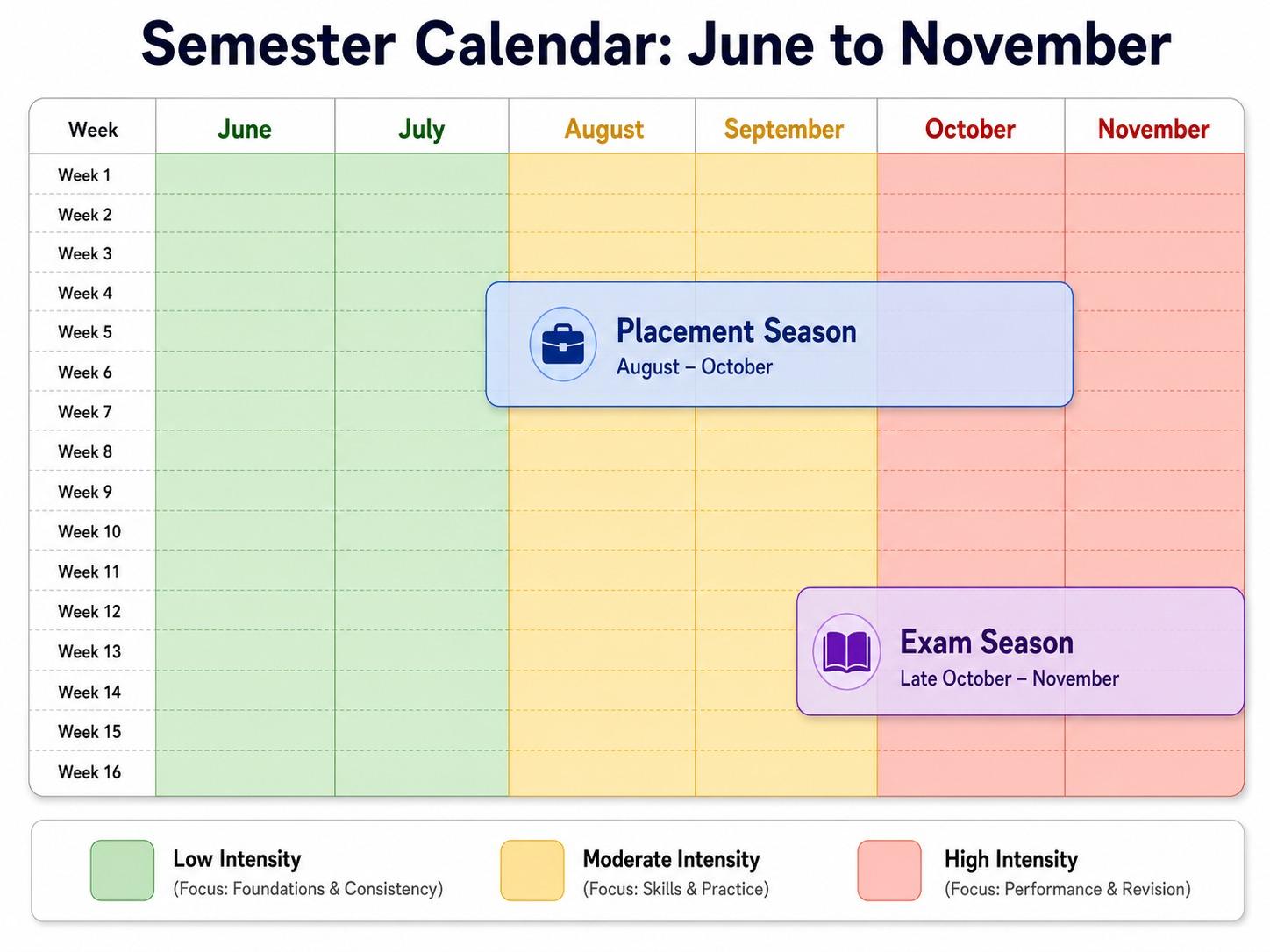
Final-year students have more raw hours than working professionals and less protection. The week below is the 24-hour version: two weekday hours each day, two depth weekend mornings, one mock, one debrief. This holds during a normal semester week. It does not hold during placement weeks, midterms, or end-semester exams — those weeks get their own retention-only fallback below.
Cracku's preparation framework for college students centers on a daily targets approach — small, repeatable deliverables (5 questions plus 1 RC plus 1 DILR set) layered into evening routines 3. The week below uses that same daily-target spine but adds explicit depth blocks for QA and DILR, where college students hold an edge over working professionals.
The week
| Day | Slot | Block | Output |
|---|---|---|---|
| Mon | 5:00–7:00 PM | QA — 1 concept + 12 mixed | Concept summary + solved log |
| Tue | 5:00–7:00 PM | VARC — 2 RCs + trap labels | Trap-label note per RC |
| Wed | 5:00–7:00 PM | DILR — 2 caselets, timed | Set-selection + accuracy note |
| Thu | 5:00–7:00 PM | QA — mixed practice + error-log review | Repeat-error tag |
| Fri | 5:00–6:00 PM | Vocab + 1 light RC | Maintenance tick |
| Sat | 9:00 AM–1:00 PM | Sectional test + 90-min debrief | Error-pattern note |
| Sun | 9:00 AM–1:00 PM | Full mock + 90-min debrief | Score-attempt log + plan adjustment |
Two real changes versus the working-professional plan: weekdays carry 2 hours instead of 1, and the weekend depth blocks compound into the same morning as the mock. You can absorb the cost because campus mornings are quiet; office mornings rarely are.
Campus calendar conflict notes
Placement season hits between October and December at most institutes, which is also the mock cycle that matters most for CAT. Two specific collisions to plan for:
- Placement prep, pre-placement talks, and shortlists swallow whole weekday evenings between October 1 and December 15. Move CAT depth blocks to mornings in October. Treat evenings as bonus, not baseline.
- End-semester exams in November overlap directly with the highest-stakes mock window (Mock 6 through Mock 10 in most coaching cycles). Drop to a 30-minute retention block on exam-prep days — 15 minutes of QA mixed practice plus 15 minutes of reading. Do not try to run a full sectional during an exam week.
The students who clear CAT in their final year are not the ones who studied through placement season. They are the ones who studied harder in July, August, and September so that October to December could be a retention-and-mocks phase, not a learning-new-things phase. Front-load the deep work.
Repeater — the 18-hour diagnostic-first week
A repeater who restarts from Day 1 of the syllabus will end up at the same percentile. The reason your first attempt landed where it did is usually not "I did not finish the syllabus." It is one of three specific failures: you attempted too many questions in the wrong order (scope), you spent too long per question (time), or you ran clean attempts on the wrong subset (accuracy). Find which one first.
IMS India's repeater-strategy framing makes the same point — preparation for a second attempt is both an advantage and a trap, and the trap is treating Year 2 as a re-run of Year 1 rather than a targeted intervention 11. Cracku's topper interviews echo this: the highest-scoring repeaters used Year 2 to fill a small set of identified gaps, not to redo the full syllabus 3.
Week 1 — diagnostic, not study
The week begins with a mock. Not a "warm-up" mock — a full-length CAT 2025 paper, taken in real conditions, scored honestly. Then a 4-hour debrief across two evenings. By the end of Week 1, you should have a one-line answer to: "What broke last year — scope, time, or accuracy?" If you cannot name the answer in one line, the diagnostic is not done.
The week (Week 2 onwards)
| Day | Slot | Block | Output |
|---|---|---|---|
| Mon | 6:00–8:00 PM | Weakest section — concept | Concept summary |
| Tue | 6:00–8:00 PM | Weakest section — timed practice | Timing log |
| Wed | 6:00–8:00 PM | Weakest section — error-log review | Repeat-error tag |
| Thu | 6:00–7:30 PM | Second weakest section — maintenance | Solved log |
| Fri | 6:00–7:00 PM | Strongest section — accuracy check | One sectional half-test |
| Sat | 9:00 AM–1:00 PM | Full mock (alt week) or sectional + debrief | Error-pattern note |
| Sun | 9:00 AM–12:00 PM | Mock debrief + plan adjustment | Adjusted next-week plan |
Notice the asymmetry — three out of seven slots, plus most of Saturday, route to the weakest section. That is the 60% rule. A repeater who splits 18 hours evenly across three sections will replicate last year's profile. A repeater who routes 60% to one section moves that section's percentile measurably in 6 to 8 weeks.
The "strongest section" Friday slot exists for a reason. Repeaters routinely lose their strong section in Year 2 because they neglect it while chasing the weak one. A weekly accuracy check on the strong section keeps it from drifting downward by 4 to 6 percentile points — the exact margin between a 99 and a 95.
Weak-section candidate — cap the rescue window at 30 days
Use a 30-day rescue window. Pick one section, one metric, and one weekly proof. For VARC, proof could be trap-label accuracy. For DILR, it could be set-selection accuracy. For QA, it could be concept-to-mixed transfer.
| Weak section | 30-day proof | Weekly target |
|---|---|---|
| VARC | Trap labels | 8 passages |
| DILR | Set selection | 10 sets |
| QA | Mixed accuracy | 100 questions |
If the 30-day proof does not move, the diagnosis was wrong — not the effort. Re-diagnose before extending the window. See the deeper VARC, DILR, and QA strategy guides for what "trap labels," "set selection," and "concept-to-mixed transfer" mean in practice.
Late starter — reduce scope before increasing intensity
If less than 3 months remain, do not chase a full syllabus fantasy. Choose high-utility topics, take weekly mocks, and repair only the top 3 error causes. The goal is score protection and decision quality.
Time-protection rules — 5 boundaries that survive
Every plan in this guide assumes the rules below are non-negotiable. They are not "ideals" — they are the structural protection that lets the 11, 18, or 24-hour week actually compound. Most students lose 20 to 30 percentile points not because the plan was wrong, but because the boundaries collapsed by Week 4.
- No QA after 10:00 PM. Late-night QA produces tired errors that contaminate your error log — you tag them as concept gaps, but they are sleep gaps. Move QA to mornings or skip the slot.
- No mock without a 2-hour debrief slot already scheduled. A mock without a debrief is a score-attempt, not a learning event. Specifically, if Saturday is the mock, Sunday morning must already be marked "debrief" on your calendar before you start. No debrief slot, no mock.
- No skipping the rest day. The rest day is what keeps Week 5 from collapsing. You will be tempted to study on Friday in Week 3 because you feel behind. Do not. The catch-up version of Week 4 is worse than the rest-day version of Week 4.
- No swapping the rest week. Every 6 weeks gets one half-volume "rest week" — half the practice load, no full mock, normal sleep. Repeaters in particular skip this and pay for it with a Week 9 plateau.
- One off-day per week, non-negotiable. Not a "light day" — an actual off-day. Read, walk, sleep, see family. The plan does not care about your willpower; it cares about your Week 10 sustainability.
The rules above are boring. That is the point. Plans fail at the edges, not the center — and the edges are the late-night QA slot, the mock you took without a debrief, the rest day you skipped. Protect the edges.
When to seek mentor support — 3 signals
Most students wait too long to ask for help. The cost is not the help itself — it is the 4 to 6 weeks spent grinding the wrong fix before realizing the fix was wrong. The signals below are the early ones.
Signal 1 — Mock plateau across 3 consecutive weeks
Your last three mock scores sit within a 4-mark band, and the band is not moving up. This is rarely a syllabus problem. It is usually an attempt-selection or time-allocation problem — the same questions are being attempted in the same order, and the marginal hour of study is not changing the marginal mark. The intervention that helps here is a peer study group focused on attempt strategy, not content review. Compare your section-by-section attempt order with two other students at your percentile.
Signal 2 — Sectional gap that does not close after a 30-day rescue
You ran the 30-day rescue window on your weak section and the weekly proof did not move. This is a diagnosis-quality problem. The intervention that helps here is a focused 1:1 mentor session — someone who has scored 99+ in that section and can look at your error log and tell you what the actual gap is. A mentor session is not "encouragement." It is a working session to re-diagnose the failure pattern.
Signal 3 — Motivation collapse
You skipped 3 of the last 7 planned slots, and the next slot feels heavier than the last. This is not a discipline failure — it is a schedule design failure that compounded. The intervention that helps here is a schedule reset, ideally with someone who has run the same plan before and knows where the realistic boundaries are. A reset usually means cutting weekly hours by 30%, restoring the rest day, and rebuilding from a 4-week plan rather than a 4-month one.
If you want a structured version of the third signal's intervention — a real mentor who has run the plan, not a content library — see Mentor Pro. Most students do not need it for the first 4 months. Some need it from Week 1. The signals above are how you know which one you are.
FAQs
Which CAT plan is best for working professionals?
A weekday-light, weekend-heavy plan usually survives better than a daily 3-hour plan. Target 11 hours a week — five 1-hour weekday slots plus two 3-hour weekend blocks — and protect the rest day.
What should repeaters do differently?
Use old mock data to find the failure pattern before reopening the syllabus. Spend Week 1 on a diagnostic mock and 4-hour debrief, then route 60% of weekly time to the single weakest section for 6 to 8 weeks.
How do I handle a weak section?
Use a 30-day rescue sprint with one metric and one proof of work. If the proof does not move in 30 days, re-diagnose — do not extend the window.
Can I crack CAT while working full-time?
Yes — most years, working professionals make up a meaningful share of new IIM cohorts 9. The constraint is not the hours; it is the discipline to cap weekday slots at 1 hour and protect Sunday morning for the mock and debrief. Specifically, the working professionals who clear CAT are usually the ones who treat the 11-hour week as a ceiling, not a floor.
Should I take a sabbatical for CAT?
For most candidates, no. A sabbatical removes the schedule discipline that a job provides, and the extra hours rarely translate to extra percentile points. Take a sabbatical only if (a) the job's hours have collapsed your weekly sleep to under 6 hours, or (b) you have already cleared a 95+ percentile mock and the gap to 99 is mock-fatigue rather than learning. In all other cases, the structured 11-hour week beats an unstructured 40-hour week.
How do I handle work travel during mock weeks?
Move the mock to the weekend before travel, not after. A post-travel mock is a tired mock — it produces a score that misleads your plan rather than informs it. If the mock cannot move, drop it for that week and run a 60-minute sectional from your hotel room. Specifically, the rule is: a mock postponed is fine; a mock taken tired is not.
Is 4 hours a day enough for a repeater?
Yes — and more is usually counter-productive. A repeater's 4-hour day routed 60% to the weak section, with a 90-minute mock debrief on weekends, will outperform a 6-hour day spread evenly across three sections. The repeater's enemy is not insufficient hours; it is the temptation to redo the whole syllabus.
Conclusion
This week, pick your profile and remove one unrealistic task from your calendar. Then schedule 5 proof blocks: 3 weekdays, 1 sectional, and 1 review. Print the week. Protect the rest day. Ask for help at the first signal, not the third.
Related reading
- Foundation plan
- Self-Study plan
- Mentor Pro plan
- Preparation timeline
- VARC strategy for CAT 2026
- DILR strategy for CAT 2026
- QA strategy for CAT 2026
- CAT mock test playbook
- Self-study vs coaching for CAT
References
- Indian Institutes of Management, "CAT official website," 2025. [Online]. Available: https://iimcat.ac.in/. Accessed: Jun. 15, 2026. ↩
- Times of India Education, "CAT 2025 exam pattern and strategy reporting," 2025. [Online]. Available: https://timesofindia.indiatimes.com/education/news. Accessed: Jun. 15, 2026. ↩
- Times of India Education, "CAT 2025 result reporting and candidate pool," 2025. [Online]. Available: https://timesofindia.indiatimes.com/education/news. Accessed: Jun. 15, 2026. ↩
- 2IIM, "CAT previous-year question papers," 2025. [Online]. Available: https://online.2iim.com/CAT-question-paper/. Accessed: Jun. 15, 2026. ↩
- 2IIM, "CAT score calculator and score-vs-percentile estimates," 2025. [Online]. Available: https://online.2iim.com/CAT-question-paper/. Accessed: Jun. 15, 2026. ↩
- Cracku, "CAT score calculator," 2025. [Online]. Available: https://cracku.in/cat-score-calculator/. Accessed: Jun. 15, 2026. ↩
- Career Launcher, "CAT marks vs percentile," 2025. [Online]. Available: https://www.careerlauncher.com/cat-mba/cat-marks-vs-percentile/. Accessed: Jun. 15, 2026. ↩
- MBAUniverse, "CAT score vs percentile analysis," 2025. [Online]. Available: https://www.mbauniverse.com/articles/cat-score-vs-percentile. Accessed: Jun. 15, 2026. ↩
- InsideIIM, "CAT preparation and admission analysis," 2025. [Online]. Available: https://insideiim.com/. Accessed: Jun. 15, 2026. ↩
- IMS India, "How to balance CAT preparation with college or job in 2026," 2026. [Online]. Available: https://www.imsindia.com/blog/cat/how-to-balance-cat-preparation-with-college-job-in-2026/. Accessed: Jun. 15, 2026. ↩
- IMS India, "CAT QA strategy for repeaters 2026: how to score 99 percentile," 2026. [Online]. Available: https://www.imsindia.com/blog/cat/. Accessed: Jun. 15, 2026. ↩
- Cracku, "CAT preparation strategies and topper interviews," 2025. [Online]. Available: https://cracku.in/. Accessed: Jun. 15, 2026. ↩
- Career Launcher, "CAT preparation resources," 2025. [Online]. Available: https://www.careerlauncher.com/cat-mba/. Accessed: Jun. 15, 2026. ↩
- National Institutional Ranking Framework, Ministry of Education, "India Rankings 2025: Management," 2025. [Online]. Available: https://www.nirfindia.org/Rankings/2025/ManagementRanking.html. Accessed: Jun. 15, 2026. ↩