Topic Guide
How to analyse a CAT mock: the 3-block routine
A mock without review is a score event, not a learning event. The value appears after the test, when the error is named, repaired, and retested. The 3-block routine keeps the review finite: 30 minutes for same-day triage, 45 minutes for untimed repair, and 30 minutes for a delayed reattempt.
Block 1: same-day pass
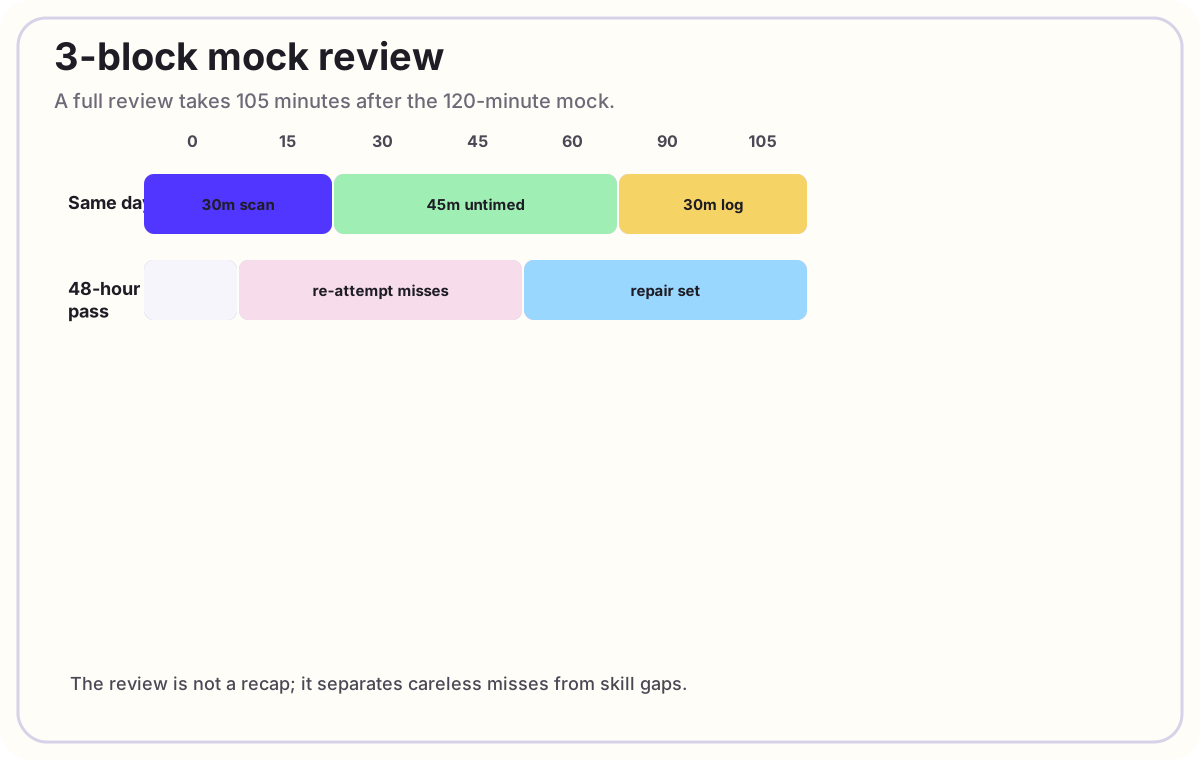
Do not start by rereading every solution. First mark each miss as concept gap, trap, setup error, calculation slip, or time-order error. The goal is to see the error shape while the exam memory is fresh.
Keep the pass short. If the first pass takes 2 hours, it becomes another test-taking session rather than a diagnostic.
Block 2: untimed solve
Untimed solving reveals whether the topic is unknown or the timed execution failed. If the item is still unsolved without the clock, it is a concept gap. If it becomes solvable, the repair is time allocation or method selection.
This distinction matters because the next practice set should target the cause, not the wrong answer.
Block 3: 48-hour reattempt
A delayed reattempt checks whether the repair survived. Retrieval practice works because the brain has to reconstruct the move, not reread it. This is why a cold retry is more informative than reading the solution twice.
Only retry selected items: high-value misses, repeated error types, and items you solved untimed but missed under the clock.
The spreadsheet template
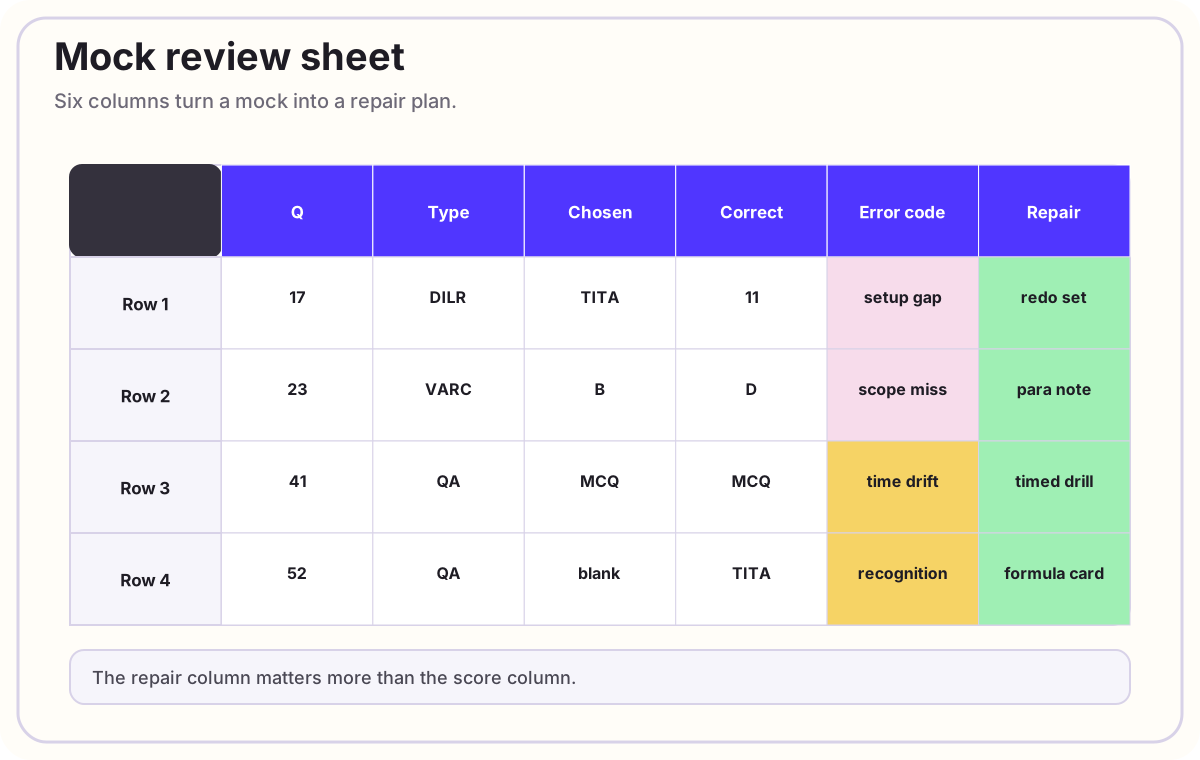
The template should include question, type, chosen answer, correct answer, error code, and repair action. More columns may look serious, but they often reduce usage. The spreadsheet should be filled after every mock and skimmed before the next one.
A repair action must be concrete: redo a table, revise a formula family, practise 3 RC scope questions, or change attempt order.
The weekly review meeting
At the end of the week, filter the spreadsheet for repeated error codes. Pick the top 2 repairs. If everything is selected, nothing changes.
A mentor review can help here because an outside reader sees whether the issue is content, timing, or test temperament.
The 6-column review sheet
Use six columns: question ID, section, topic, decision, error code, and repair action. The decision column records whether the question was attempted, skipped, guessed, or abandoned. The error code should be short: concept, calculation, time, set selection, or option trap. The repair action should be one line that can be done before the next mock [6], [11], [12].
This sheet matters because memory is unreliable after a 2-hour paper. Students often remember the one painful error and miss the repeated pattern. The table exposes the pattern. If 6 of 12 errors are set-selection mistakes, the next week needs decision practice, not more topic revision.
The 48-hour reattempt rule
The same-day review is useful, but it can be inflated by memory. A 48-hour reattempt changes the test. The candidate has forgotten some surface details and must rebuild the method. If the same question fails again, the issue is deeper than fatigue. It belongs in the repair log.
Use 8 to 12 selected questions for the 48-hour block, not the whole paper. Pick questions that were wrong, skipped after partial work, or solved too slowly. The point is to identify transferable repair, not to re-live the entire mock [11], [12].
What a completed review looks like
A review that ends with insights but no calendar entry does not change the next score. The final row of the review sheet should name one drill, one source, one duration, and one date. Example: "DILR arrangements, 4 sets, 60 minutes, Wednesday." That row turns analysis into training.
The target is not a perfect spreadsheet. The target is a repeated loop: mock, diagnose, repair, retest. If a student cannot identify the next repair within 105 minutes of review, the review process is too broad.
FAQs
What is how to analyse CAT mock?
how to analyse CAT mock is the article's main operating idea. Read it as a decision rule with a number attached, not as a loose definition.
Which source should I trust first?
Use official CAT or institute pages for policy claims, then use coaching analyses for paper-pattern interpretation and academic studies for learning-strategy claims.
How often should this article be refreshed?
Refresh it once every CAT admission cycle, and sooner if an official institute policy page publishes a new PDF.
What is the practical next step?
Write the main number from this article into your mock sheet or shortlist sheet today, then check it after the next mock.
How does this link to Clymber preparation?
It turns a vague CAT-prep question into one measurable decision that can be reviewed by a student or mentor within 7 days.
Conclusion
Use this article as a working sheet, not only as a reading page. Record the main number for your target case, apply it to the next mock or shortlist decision, and review the result within 7 days.
Related reading
- /blog/cat-mock-test-playbook
- /blog/how-many-cat-mocks
- /plans/mentor-pro
- /blog/cat-mock-score-plateau
- /plans/self-study
References
- 2IIM, "CAT previous year papers and CAT paper database." Available: https://online.2iim.com/CAT-question-paper/. Accessed: 15-Jun-2026. [2] Cracku, "CAT previous year papers and section-wise analysis." Available: https://cracku.in/cat-previous-papers. Accessed: 15-Jun-2026. [3] IMS India, "CAT syllabus and exam pattern overview." Available: https://www.imsindia.com/blog/cat/cat-syllabus/. Accessed: 15-Jun-2026. [4] MBAUniverse, "CAT exam pattern and syllabus guide." Available: https://www.mbauniverse.com/cat/exam-pattern. Accessed: 15-Jun-2026. [5] J. Dunlosky et al., "Improving students' learning with effective learning techniques." Available: https://journals.sagepub.com/doi/10.1177/1529100612453266. Accessed: 15-Jun-2026. [6] H. L. Roediger III and J. D. Karpicke, "Test-enhanced learning: taking memory tests improves long-term retention." Available: https://doi.org/10.1111/j.1467-9280.2006.01693.x. Accessed: 15-Jun-2026. [7] A. Reddy et al., "Spaced learning and retrieval practice in education." Available: https://pmc.ncbi.nlm.nih.gov/articles/PMC5126970/. Accessed: 15-Jun-2026. [8] IIM CAT, "CAT official website." Available: https://iimcat.ac.in. Accessed: 15-Jun-2026. ↩