Topic Guide
How many CAT mocks to take: and why 40 is too many
The number of mocks is not the achievement. Analysed mocks matter. A 25-mock plan with disciplined review usually teaches more than a 40-mock plan with thin review. The right count depends on the months left, the quality of analysis, and whether full-length testing has started too early.
The diminishing-returns curve
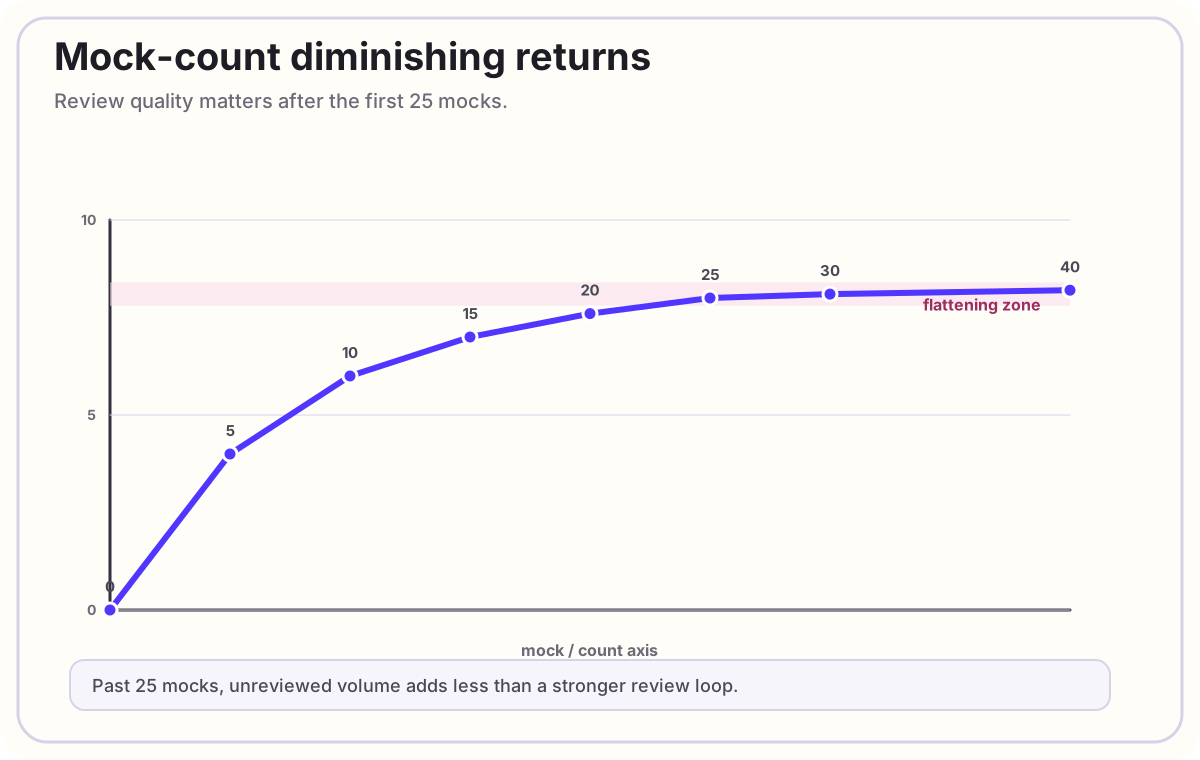
The first few mocks teach exam structure and section pacing. The middle mocks expose repeated errors. After that, extra mocks add less if the candidate is not repairing the errors.
That is why 25–30 analysed mocks is a better planning range than 40 unreviewed mocks. The curve rewards review quality more than count after a point.
Cadence by month
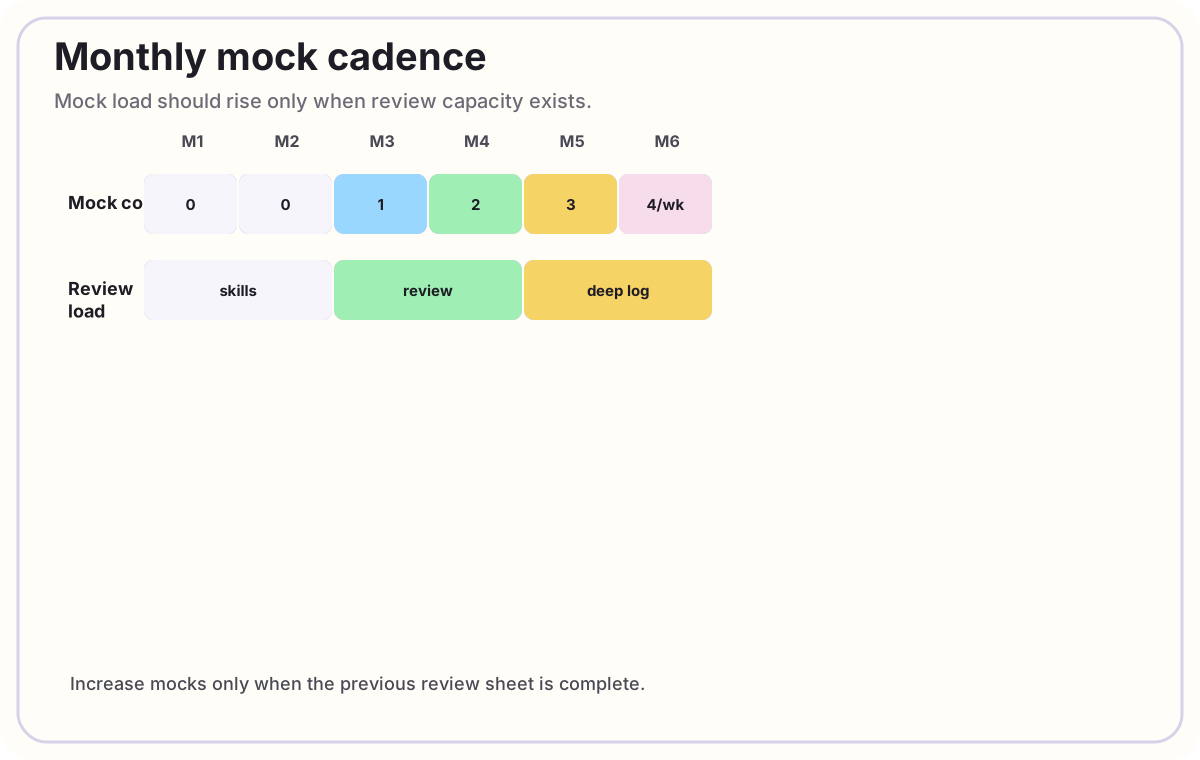
Early preparation should not be full of full-length mocks. Use the first months for topic repair and section tests. Increase full-length mocks when the student can review each one properly.
A common rhythm is zero or low full-length mocks early, then 1 per week, then 2–3 per week only when review systems are stable.
The mock-too-early problem
If a student has not built section basics, a full-length mock may only confirm that the basics are missing. That can feel like evidence of low ability when it is actually evidence of timing.
Sectional testing is better during early repair. Full-length testing becomes useful when the student needs fatigue management, section order, and recovery practice.
When to increase the count
Before adding mocks, check whether the last 3 reviews produced specific repairs. If the sheet has only marks and percentile, add review quality first. If it has repeated errors and repair outcomes, the student is ready for a higher mock load.
The test is not emotional readiness. It is review evidence.
The final count rule
Count the number already taken, the number of weeks left, and the number you can review fully. Then cap the plan at the count you can analyse.
A student with 8 weeks left and a full-time job may be better served by 12 reviewed mocks than 20 rushed ones.
Why 25 to 30 mocks is a planning range
The useful number is not a moral rule. It is a capacity estimate. A full mock takes about 2 hours, and a meaningful review can take 90 to 120 minutes. A student taking two mocks every week without review may collect scorecards, but the error pattern remains unchanged. That is why a lower count with disciplined review often beats a higher count with shallow analysis [6], [11], [12].
The range should shift by starting level. A student who begins late may need fewer full mocks and more section tests. A student with strong fundamentals may use more mocks to refine decision-making. The constant is not the count; it is the review-to-mock ratio.
Month-wise cadence
In the early months, full mocks can produce noisy scores because too many topics are still unfinished. Sectional tests and timed sets may be more useful. In the middle phase, one full mock every 2 weeks gives enough data without crowding out repair. In the final phase, weekly mocks build stamina and decision rhythm.
A six-month cadence can be 0, 1, 2, 3, 4, and 4-5 mocks by month. That creates around 14-15 full mocks in the last half, with earlier mocks added if the student has already built the base. The exact count should be planned backward from the exam date and the student's review capacity.
The stop condition
If three consecutive mocks show the same error pattern, adding another mock is weak evidence gathering. Pause and repair the pattern. For example, if QA accuracy stays stable but DILR set selection fails twice, the next task is a DILR selection drill, not another full paper.
A mock is a measurement tool. It should be used when the candidate has changed something worth measuring.
FAQs
What is how many CAT mocks?
how many CAT mocks is the article's main operating idea. Read it as a decision rule with a number attached, not as a loose definition.
Which source should I trust first?
Use official CAT or institute pages for policy claims, then use coaching analyses for paper-pattern interpretation and academic studies for learning-strategy claims.
How often should this article be refreshed?
Refresh it once every CAT admission cycle, and sooner if an official institute policy page publishes a new PDF.
What is the practical next step?
Write the main number from this article into your mock sheet or shortlist sheet today, then check it after the next mock.
How does this link to Clymber preparation?
It turns a vague CAT-prep question into one measurable decision that can be reviewed by a student or mentor within 7 days.
Conclusion
Use this article as a working sheet, not only as a reading page. Record the main number for your target case, apply it to the next mock or shortlist decision, and review the result within 7 days.
Related reading
- /blog/cat-mock-test-playbook
- /blog/cat-mock-analysis
- /plans/self-study
- /blog/sectional-vs-full-length-mocks
- /plans/mentor-pro
References
- 2IIM, "CAT previous year papers and CAT paper database." Available: https://online.2iim.com/CAT-question-paper/. Accessed: 15-Jun-2026. [2] Cracku, "CAT previous year papers and section-wise analysis." Available: https://cracku.in/cat-previous-papers. Accessed: 15-Jun-2026. [3] IMS India, "CAT syllabus and exam pattern overview." Available: https://www.imsindia.com/blog/cat/cat-syllabus/. Accessed: 15-Jun-2026. [4] MBAUniverse, "CAT exam pattern and syllabus guide." Available: https://www.mbauniverse.com/cat/exam-pattern. Accessed: 15-Jun-2026. [5] J. Dunlosky et al., "Improving students' learning with effective learning techniques." Available: https://journals.sagepub.com/doi/10.1177/1529100612453266. Accessed: 15-Jun-2026. [6] H. L. Roediger III and J. D. Karpicke, "Test-enhanced learning: taking memory tests improves long-term retention." Available: https://doi.org/10.1111/j.1467-9280.2006.01693.x. Accessed: 15-Jun-2026. [7] A. Reddy et al., "Spaced learning and retrieval practice in education." Available: https://pmc.ncbi.nlm.nih.gov/articles/PMC5126970/. Accessed: 15-Jun-2026. [8] IIM CAT, "CAT official website." Available: https://iimcat.ac.in. Accessed: 15-Jun-2026. ↩