Topic Guide
CAT for non-engineering backgrounds: commerce, arts, and others
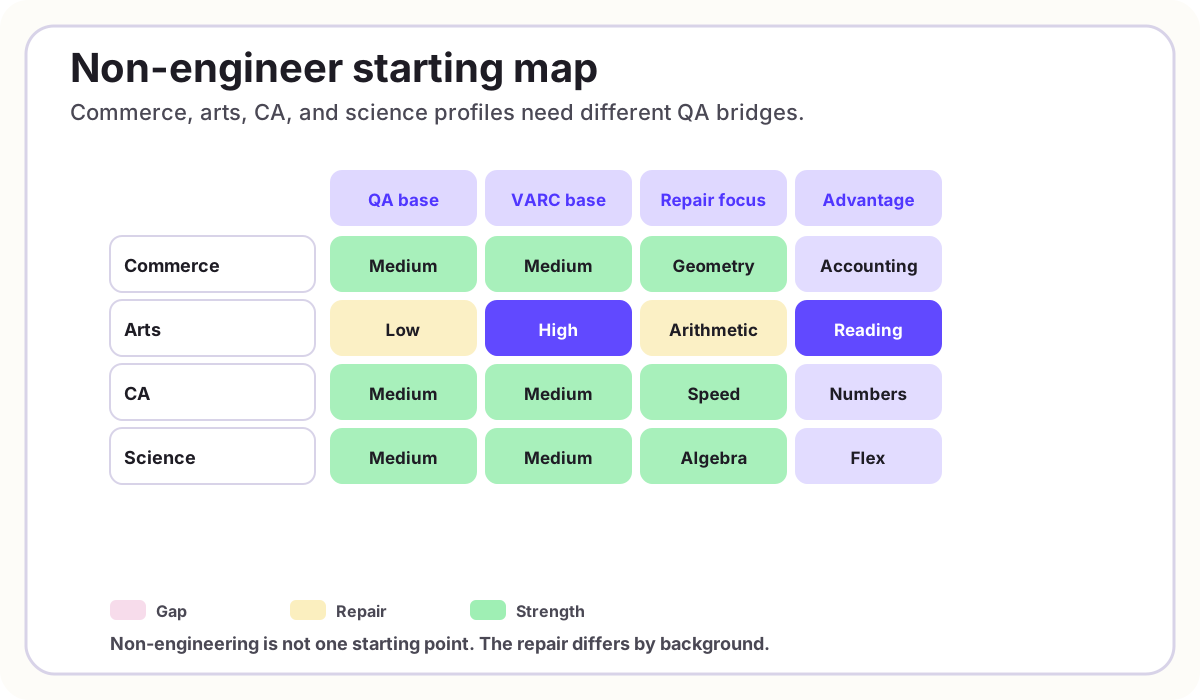
Non-engineering is not a disadvantage by itself. It is a planning label. Some candidates need arithmetic language. Some need geometry repair. Some already read better than the average engineer. The right plan starts by finding the exact gap, not by apologising for the degree.
Non-engineering is not the same as weak QA
Diagnose QA separately from degree background. 2
Use this checkpoint before adding more unsorted practice or applications.
Diversity rules can help, but they do not solve CAT
Use diversity as context, not as a plan. 3
Use this checkpoint before adding more unsorted practice or applications.
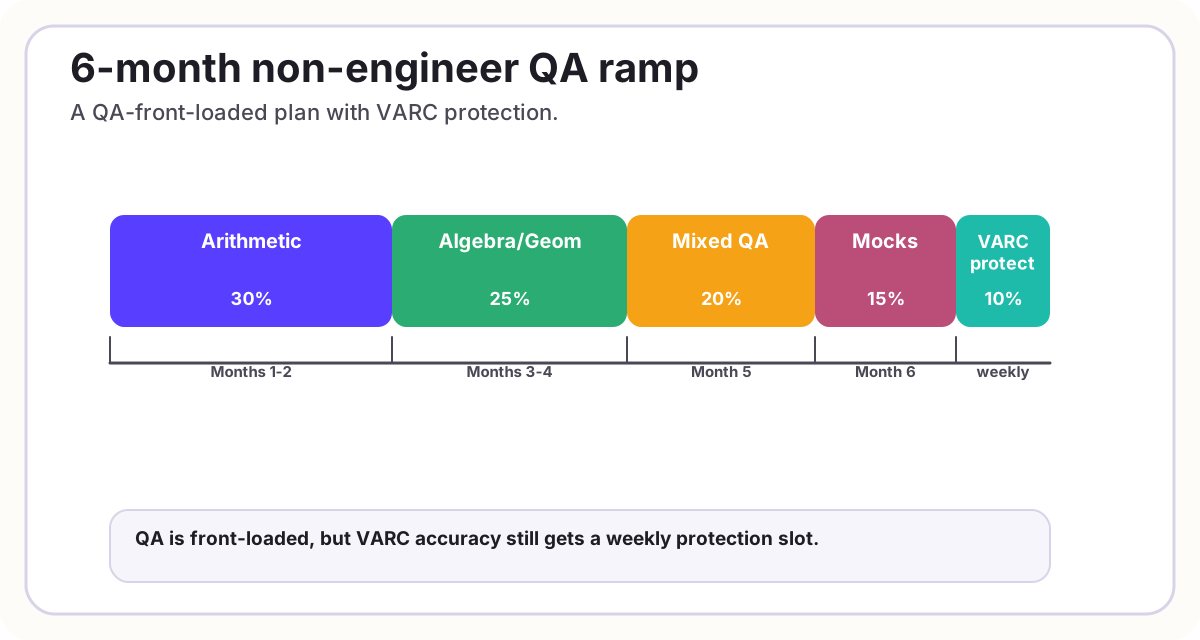
QA must be front-loaded
A 6-month QA plan should start in week 1. 4
Use this checkpoint before adding more unsorted practice or applications.
VARC can be a real advantage
Track RC accuracy and inference errors weekly. 5
Use this checkpoint before adding more unsorted practice or applications.
CA and commerce profiles need a different bridge
The bridge must match the starting point. 6
Use this checkpoint before adding more unsorted practice or applications.
Your next action is a 6-month QA scorecard
The scorecard prevents vague progress. 7
Use this checkpoint before adding more unsorted practice or applications.
FAQs
Can non-engineers do well in CAT?
Yes. The plan must diagnose QA early and turn any VARC strength into CAT-specific accuracy.
Does academic diversity guarantee IIM calls?
No. It can help in some selection frameworks, but section-wise CAT and composite score still matter.
What should non-engineers study first?
Start with arithmetic foundations, then algebra and geometry recognition.
Do commerce students need the same plan as arts students?
No. Commerce or CA candidates often need different repairs from arts candidates.
What is the first 6-month task?
Build a QA scorecard with arithmetic, algebra, geometry, mixed-set accuracy, and VARC accuracy.
Conclusion
For non-engineers, front-load QA for 6 months while protecting any VARC advantage. Start with the article's numeric anchor today and update it after your next mock or source check.
Related reading
References
- IIM Ahmedabad, "Admission - MBA (Indian), PGP 2026-28 selection process," 2025. Available: https://www.iima.ac.in/academics/mba/admissions/indians ↩
- IIM Bangalore, "PGP admission process," 2026. Available: https://www.iimb.ac.in/programmes/post-graduate-programme-management ↩
- IIM Calcutta, "MBA admission policy for domestic candidates," 2026. Available: https://www.iimcal.ac.in/programs/pgp/admission-policy/admission-procedure-for-domestic-candidates ↩
- IIM CAT, "Common Admission Test official website," 2025. Available: https://iimcat.ac.in/ ↩
- NCERT, "Mathematics Textbook for Class VIII," 2025. Available: https://ncert.nic.in/textbook.php?hemh1=0-13 ↩
- J. Dunlosky et al., "Improving Students’ Learning With Effective Learning Techniques," Psychological Science in the Public Interest, 2013. Available: https://journals.sagepub.com/doi/10.1177/1529100612453266 ↩
- H. L. Roediger and J. D. Karpicke, "Test-enhanced learning," Psychological Science, 2006. Available: https://doi.org/10.1111/j.1467-9280.2006.01693.x ↩
- Times of India, "Rs 1.1 crore offer 2nd highest at IIM-A," reporting IIMA PGP 2025 IPRS figures, 2025. Available: https://timesofindia.indiatimes.com/city/ahmedabad/rs-1-1-crore-offer-2nd-highest-at-iim-a/articleshow/124004385.cms ↩