Topic Guide
CAT time management: a two-pass route for every section
Time management is not speed; it is a route through green, amber, and red questions. The current CAT pattern is built around three timed sections, and recent public analyses report 68 questions across VARC, DILR, and QA with 40 minutes per section 1[3][4]. Previous-paper databases are the best practice base because they preserve real section phrasing, slot variation, and TITA/MCQ mix [2]. The plan below uses that exam structure plus learning-science evidence on retrieval and spaced review [6][7][8].
Accept the section lock
CAT sections are time-locked. You cannot borrow unused minutes from VARC for QA. Build a 40-minute route for each section instead of one exam-wide plan. This links to the section and question-type structure reported by CAT-pattern sources [3][4][5].
Use two passes
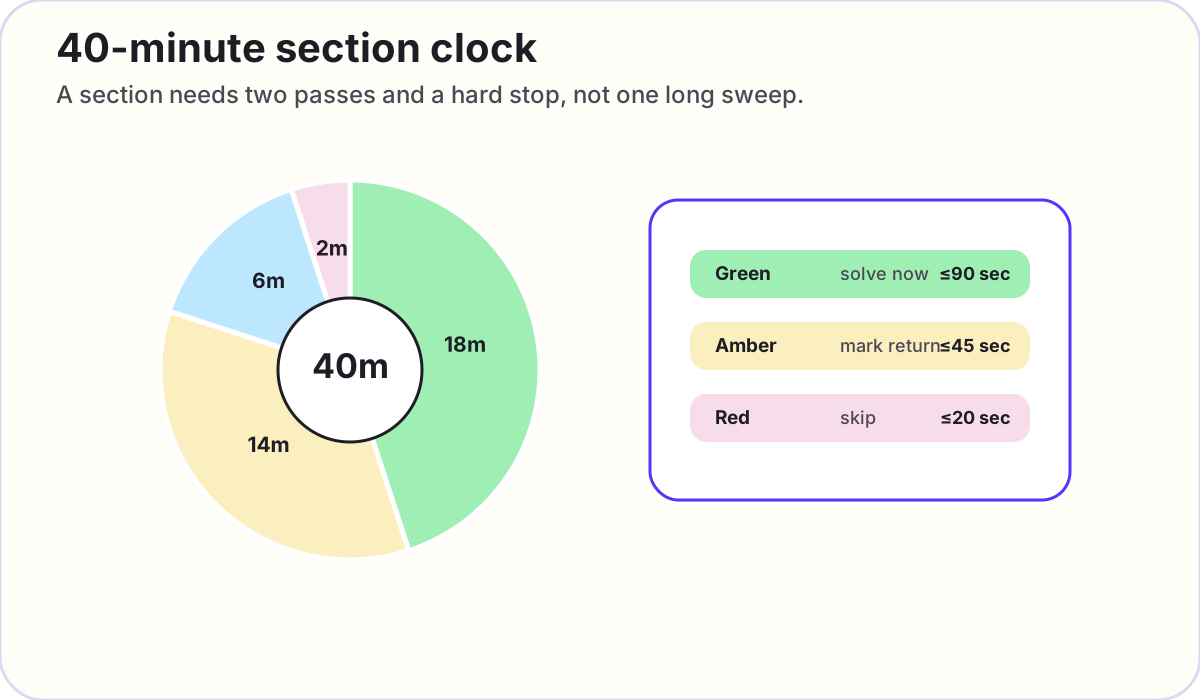
First pass: solve green questions. Second pass: return to amber questions. Red questions need proof before time. This prevents one hostile question from taking 6 minutes. Check the rule against previous CAT papers instead of isolated drills [2].
Set a per-question stop rule
A question that does not show a method in 60-90 seconds should be marked or skipped. This is stricter in QA and DILR than in RC, where reading investment can be longer. The official CAT interface and timed-section design make this a practical constraint, not a stylistic preference 1[3].
Use expected value for MCQs
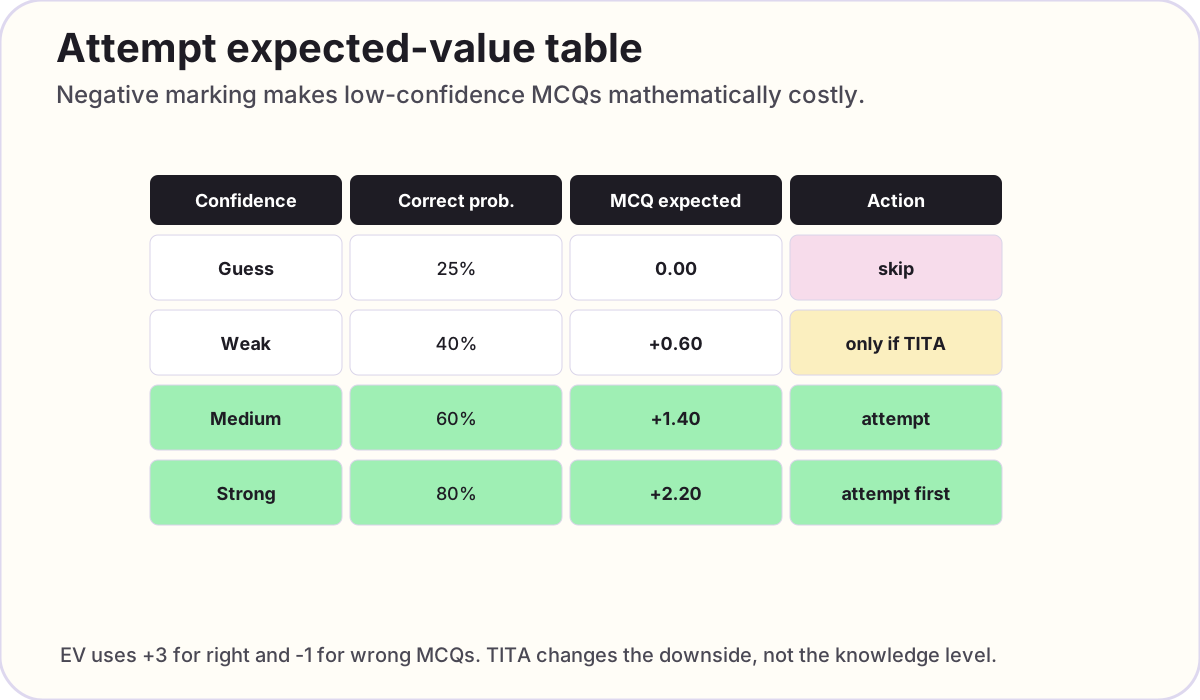
With +3 and -1 MCQ marking, a weak guess can damage net score. TITA has no minus-one penalty, but it still costs time. The review step is also consistent with evidence that testing and retrieval improve durable learning [6][7].
Practise route, not only content
During mocks, record when you marked, skipped, and returned. The route becomes trainable when it is visible. Spaced review prevents one-session performance from being mistaken for stable skill [8].
FAQs
How should I manage time in CAT?
Use a 40-minute plan for each section with a first pass, second pass, and buffer.
How long should I spend on one QA question?
If no method appears within 60-90 seconds, mark or skip and return later.
Can I switch sections in CAT?
No. Each section has its own time lock.
Should I guess in MCQs?
Guess only when you can eliminate enough options to make the expected value reasonable.
How do I practise time management?
Track solve, mark, skip, and return decisions in every mock.
Conclusion
Use the first diagram as your next drill plan, then review the result within 24 hours and repeat the same rule for 3 timed sets.
Related reading
- cat exam pattern 2026
- cat question selection
- cat negative marking
- cat tita strategy
- cat exam day checklist
References
- IIMCAT, "CAT 2025 official portal." Available: https://iimcat.ac.in/ [2] 2IIM, "CAT previous year question papers, 2017-2025." Available: https://online.2iim.com/CAT-question-paper/ [3] IMS India, "CAT exam pattern 2026: sections, question types, and marks." Available: https://www.imsindia.com/blog/cat/cat-exam-pattern/ [4] MBAUniverse, "CAT exam pattern: sections, questions, duration, and marking scheme." Available: https://www.mbauniverse.com/cat/pattern [5] IMS India, "CAT syllabus 2026: section-wise topics and weightage." Available: https://www.imsindia.com/blog/cat/cat-syllabus/ [6] J. Dunlosky, K. A. Rawson, E. J. Marsh, M. J. Nathan, and D. T. Willingham, "Improving students' learning with effective learning techniques," Psychological Science in the Public Interest, 2013. Available: https://doi.org/10.1177/1529100612453266 [7] H. L. Roediger and J. D. Karpicke, "Test-enhanced learning: taking memory tests improves long-term retention," Psychological Science, 2006. Available: https://doi.org/10.1111/j.1467-9280.2006.01693.x [8] S. Reddy, I. Labutov, S. Banerjee, and T. Joachims, "Unbounded human learning: optimal scheduling for spaced repetition," arXiv, 2016. Available: https://arxiv.org/abs/1602.07032 ↩