Topic Guide
CAT TITA strategy: use the no-penalty format without wasting time
TITA questions remove negative marking, but they do not remove opportunity cost. The current CAT pattern is built around three timed sections, and recent public analyses report 68 questions across VARC, DILR, and QA with 40 minutes per section 1[3][4]. Previous-paper databases are the best practice base because they preserve real section phrasing, slot variation, and TITA/MCQ mix [2]. The plan below uses that exam structure plus learning-science evidence on retrieval and spaced review [6][7][8].
Know the scoring difference
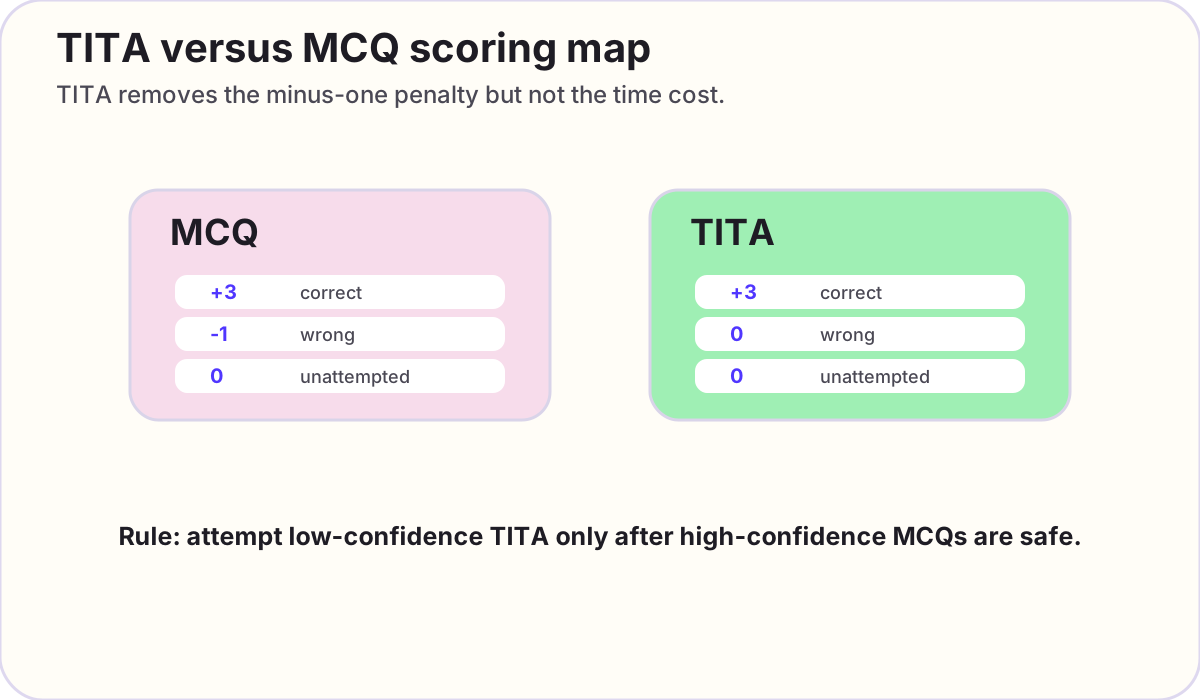
MCQs carry +3 for correct and -1 for incorrect. TITA carries +3 for correct and no negative mark for a wrong answer. That changes risk, but it does not make every TITA worth attempting. This links to the section and question-type structure reported by CAT-pattern sources [3][4][5].
Attempt TITA when the method is visible
If the first method is visible and computation is short, TITA is attractive. If the setup is unclear, no penalty still does not justify 4 wasted minutes. Check the rule against previous CAT papers instead of isolated drills [2].
Check range before entry
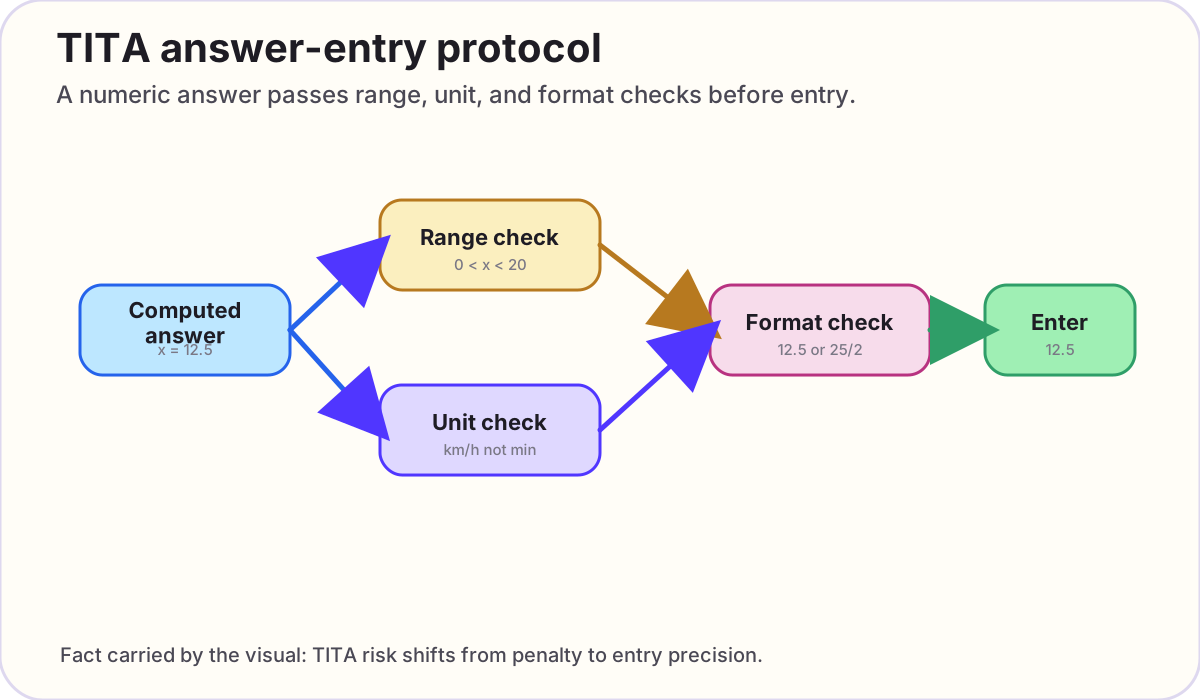
Because no options are visible, range checks matter. Estimate whether the answer should be positive, integer, percentage, or bounded by the data. The official CAT interface and timed-section design make this a practical constraint, not a stylistic preference 1[3].
Check format before submission
Some TITA answers are integers; others allow decimals. Enter the form required by the interface and avoid carrying units into the box unless instructed. The review step is also consistent with evidence that testing and retrieval improve durable learning [6][7].
Review TITA mistakes separately
A TITA miss can be a concept error, computation error, range error, or entry error. Put it in its own review column. Spaced review prevents one-session performance from being mistaken for stable skill [8].
FAQs
What is TITA in CAT?
TITA means Type in the Answer. You enter the answer rather than selecting from options.
Is there negative marking for TITA?
No. Wrong TITA answers do not carry the MCQ minus-one penalty.
Should I attempt every TITA question?
No. Attempt when the method is visible and time cost is controlled.
How do I avoid TITA entry errors?
Check range, unit, and format before typing the answer.
Are TITA questions harder than MCQs?
Not always. The challenge is that there are no options to guide or verify the answer.
Conclusion
Use the first diagram as your next drill plan, then review the result within 24 hours and repeat the same rule for 3 timed sets.
Related reading
- cat tita questions
- cat negative marking
- cat exam pattern 2026
- cat time management
- cat question selection
References
- IIMCAT, "CAT 2025 official portal." Available: https://iimcat.ac.in/ [2] 2IIM, "CAT previous year question papers, 2017-2025." Available: https://online.2iim.com/CAT-question-paper/ [3] IMS India, "CAT exam pattern 2026: sections, question types, and marks." Available: https://www.imsindia.com/blog/cat/cat-exam-pattern/ [4] MBAUniverse, "CAT exam pattern: sections, questions, duration, and marking scheme." Available: https://www.mbauniverse.com/cat/pattern [5] IMS India, "CAT syllabus 2026: section-wise topics and weightage." Available: https://www.imsindia.com/blog/cat/cat-syllabus/ [6] J. Dunlosky, K. A. Rawson, E. J. Marsh, M. J. Nathan, and D. T. Willingham, "Improving students' learning with effective learning techniques," Psychological Science in the Public Interest, 2013. Available: https://doi.org/10.1177/1529100612453266 [7] H. L. Roediger and J. D. Karpicke, "Test-enhanced learning: taking memory tests improves long-term retention," Psychological Science, 2006. Available: https://doi.org/10.1111/j.1467-9280.2006.01693.x [8] S. Reddy, I. Labutov, S. Banerjee, and T. Joachims, "Unbounded human learning: optimal scheduling for spaced repetition," arXiv, 2016. Available: https://arxiv.org/abs/1602.07032 ↩