Topic Guide
CAT exam day checklist: what to finish before the morning starts
Exam-day discipline is mostly a T-minus-24-hour job. The current CAT pattern is built around three timed sections, and recent public analyses report 68 questions across VARC, DILR, and QA with 40 minutes per section 1[3][4]. Previous-paper databases are the best practice base because they preserve real section phrasing, slot variation, and TITA/MCQ mix [2]. The plan below uses that exam structure plus learning-science evidence on retrieval and spaced review [6][7][8].
Finish documents the previous day
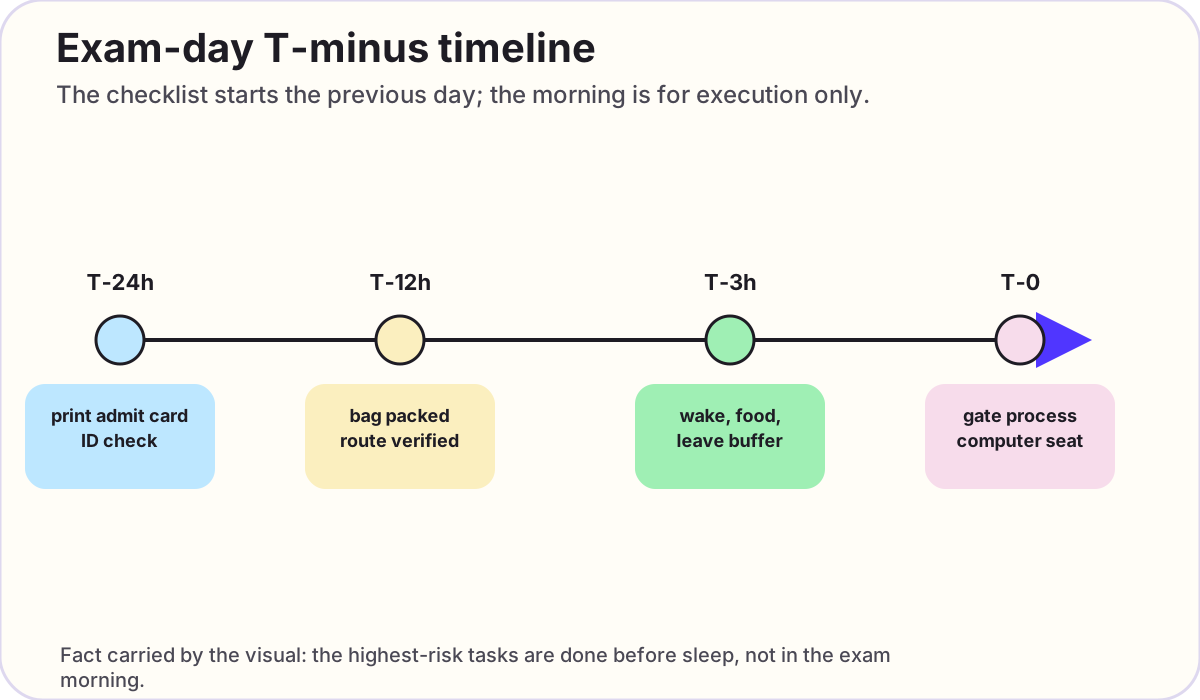
Download and print the admit card, check photo ID, read centre instructions, and place everything in one transparent folder if the instructions allow it. Do not leave this to the morning. This links to the section and question-type structure reported by CAT-pattern sources [3][4][5].
Plan the route with buffer
Check centre location, travel time, reporting time, and backup transport. The goal is to arrive calm, not early enough to exhaust yourself. Check the rule against previous CAT papers instead of isolated drills [2].
Keep the morning plain
Use familiar food, familiar clothes, and a short warm-up. Avoid new material. Your job is to enter the first section with stable attention. The official CAT interface and timed-section design make this a practical constraint, not a stylistic preference 1[3].
Separate allowed and banned items
Follow the admit-card instructions. Phones, watches, calculators, notes, and bags can create centre-entry friction. Treat the gate as a compliance step, not a negotiation. The review step is also consistent with evidence that testing and retrieval improve durable learning [6][7].
Set the first-section rule
Before the test begins, remind yourself of the section's first-pass rule. VARC, DILR, and QA all need a route, not emotion after the first hard question. Spaced review prevents one-session performance from being mistaken for stable skill [8].
FAQs
What should I carry on CAT exam day?
Carry the admit card, required photo ID, and only items allowed in the official instructions.
When should I print the CAT admit card?
Print it at least 24 hours before the exam and check every detail.
Should I study on CAT exam morning?
Use a light warm-up only. Do not add new topics.
How early should I leave for the centre?
Leave with a buffer based on traffic, reporting time, and centre distance.
What should I do before the first section starts?
Recall your first-pass rule and the skip threshold for that section.
Conclusion
Use the first diagram as your next drill plan, then review the result within 24 hours and repeat the same rule for 3 timed sets.
Related reading
References
- IIMCAT, "CAT 2025 official portal." Available: https://iimcat.ac.in/ [2] 2IIM, "CAT previous year question papers, 2017-2025." Available: https://online.2iim.com/CAT-question-paper/ [3] IMS India, "CAT exam pattern 2026: sections, question types, and marks." Available: https://www.imsindia.com/blog/cat/cat-exam-pattern/ [4] MBAUniverse, "CAT exam pattern: sections, questions, duration, and marking scheme." Available: https://www.mbauniverse.com/cat/pattern [5] IMS India, "CAT syllabus 2026: section-wise topics and weightage." Available: https://www.imsindia.com/blog/cat/cat-syllabus/ [6] J. Dunlosky, K. A. Rawson, E. J. Marsh, M. J. Nathan, and D. T. Willingham, "Improving students' learning with effective learning techniques," Psychological Science in the Public Interest, 2013. Available: https://doi.org/10.1177/1529100612453266 [7] H. L. Roediger and J. D. Karpicke, "Test-enhanced learning: taking memory tests improves long-term retention," Psychological Science, 2006. Available: https://doi.org/10.1111/j.1467-9280.2006.01693.x [8] S. Reddy, I. Labutov, S. Banerjee, and T. Joachims, "Unbounded human learning: optimal scheduling for spaced repetition," arXiv, 2016. Available: https://arxiv.org/abs/1602.07032 ↩