Topic Guide
TITA questions in CAT: what they are and how they score
TITA means Type In The Answer. Instead of choosing an option, the student enters the numeric answer. The important scoring difference is not the interface. It is that a wrong TITA answer normally carries no negative marking, while MCQ errors do. That changes the attempt rule.
What TITA means
TITA appears in CAT mocks and past papers across sections, especially QA. The answer box removes option elimination, so the item tests whether the student can reach the answer independently. This is why TITA feels less guessable than MCQ even when the topic is familiar.
The format is also common in TITA-style parajumbles or numerical answers. The visible interface changes, but the prep rule remains the same: solve cleanly or move on after the time cap.
How TITA scores
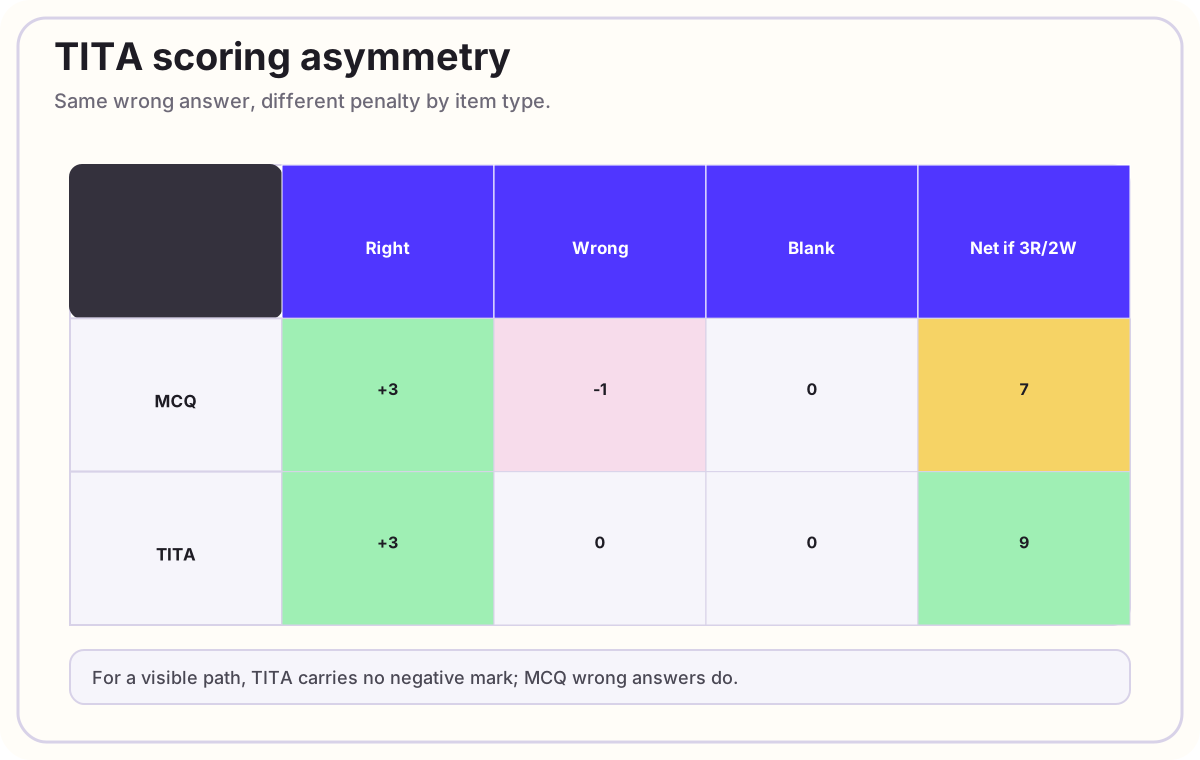
In MCQ items, a wrong answer usually costs marks. In TITA items, the wrong answer normally costs no negative marks. This does not make every TITA item worth unlimited time. It means the fear of penalty should not be the reason to leave the answer blank.
The better rule is time-based: if a path appears within 60–90 seconds, attempt; if the path does not appear, leave the item and protect the section clock.
Why TITA is not a free-for-all
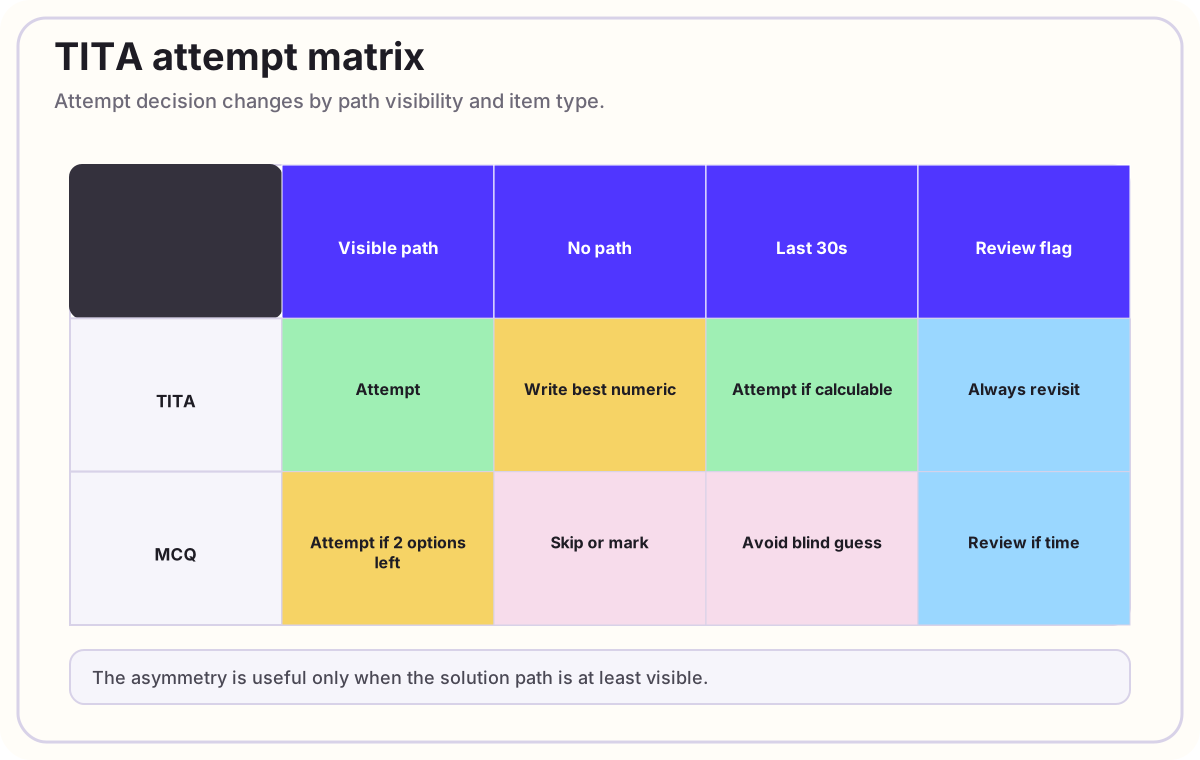
The main cost of TITA is time. A student can spend 4 minutes on a no-penalty question and lose two solvable MCQs later. That is still a negative outcome, even if the score sheet does not subtract marks.
For QA, write the expression, check whether the computation is stable, and then type the answer. For VARC-style TITA, lock the sequence only after a visible dependency survives a second check.
The attempt rule for mocks
A useful mock review has two rows: MCQ accuracy and TITA completion. If a student leaves many TITA items blank, the diagnosis may be hesitation rather than topic weakness. If the student attempts every TITA but loses time, the diagnosis is time control.
Use a 3-column review: TITA seen, TITA attempted, TITA correct. After 5 mocks, the pattern is visible enough to adjust strategy.
The floor target
The right end-state is not random typing. It is disciplined completion: every TITA with a visible path gets a typed answer. Blank TITA items in the final stretch should be explained by time, not by fear of a penalty.
That distinction matters because TITA questions can add marks without adding penalty risk. In a tight percentile band, 1 correct typed answer can matter.
Budget TITA time separately
The absence of negative marking changes the decision after you have a usable method. It does not remove the time cost. A TITA question that consumes 3 minutes and still ends blank has the same opportunity cost as a difficult MCQ. The correct comparison is not TITA versus MCQ in isolation; it is TITA-with-visible-path versus the next solvable question in the section 1, [6].
A practical rule is to split TITA into three labels while reviewing a mock: solved, typed after partial calculation, and no-entry. The first group is a scoring area. The second group needs accuracy review. The third group should not receive more time in the next mock unless the topic is already part of that week's repair plan.
What no negative marking really changes
For MCQs, a blind guess can reduce the score because a wrong answer carries a penalty. For TITA, a wrong typed value is scored as 0, so a candidate should enter the best calculated value when there is a concrete path. That is different from random entry. Random entry usually teaches nothing in review because there is no method to diagnose 1, [7].
In the review sheet, write the topic and the error type next to every missed TITA item. If the miss came from arithmetic, add two similar drills. If the miss came from no entry point, leave it as a set-selection signal. This is how the scoring asymmetry becomes a real practice rule instead of a slogan.
FAQs
What is CAT TITA questions?
CAT TITA questions is the article's main operating idea. Read it as a decision rule with a number attached, not as a loose definition.
Which source should I trust first?
Use official CAT or institute pages for policy claims, then use coaching analyses for paper-pattern interpretation and academic studies for learning-strategy claims.
How often should this article be refreshed?
Refresh it once every CAT admission cycle, and sooner if an official institute policy page publishes a new PDF.
What is the practical next step?
Write the main number from this article into your mock sheet or shortlist sheet today, then check it after the next mock.
How does this link to Clymber preparation?
It turns a vague CAT-prep question into one measurable decision that can be reviewed by a student or mentor within 7 days.
Conclusion
Use this article as a working sheet, not only as a reading page. Record the main number for your target case, apply it to the next mock or shortlist decision, and review the result within 7 days.
Related reading
- /blog/cat-exam-pattern-2026
- /blog/cat-percentile-explained
- /glossary
- /blog/qa-strategy-cat-2026
- /blog/parajumbles-cat
References
- IIM CAT, "CAT official website." Available: https://iimcat.ac.in. Accessed: 15-Jun-2026. [2] 2IIM, "CAT previous year papers and CAT paper database." Available: https://online.2iim.com/CAT-question-paper/. Accessed: 15-Jun-2026. [3] Cracku, "CAT previous year papers and section-wise analysis." Available: https://cracku.in/cat-previous-papers. Accessed: 15-Jun-2026. [4] IMS India, "CAT syllabus and exam pattern overview." Available: https://www.imsindia.com/blog/cat/cat-syllabus/. Accessed: 15-Jun-2026. [5] MBAUniverse, "CAT exam pattern and syllabus guide." Available: https://www.mbauniverse.com/cat/exam-pattern. Accessed: 15-Jun-2026. [6] J. Dunlosky et al., "Improving students' learning with effective learning techniques." Available: https://journals.sagepub.com/doi/10.1177/1529100612453266. Accessed: 15-Jun-2026. [7] H. L. Roediger III and J. D. Karpicke, "Test-enhanced learning: taking memory tests improves long-term retention." Available: https://doi.org/10.1111/j.1467-9280.2006.01693.x. Accessed: 15-Jun-2026. [8] A. Reddy et al., "Spaced learning and retrieval practice in education." Available: https://pmc.ncbi.nlm.nih.gov/articles/PMC5126970/. Accessed: 15-Jun-2026. ↩