Topic Guide
Critical reasoning for CAT VARC: map the argument before the option
Critical reasoning errors happen when students debate the option before mapping the argument. The current CAT pattern is built around three timed sections, and recent public analyses report 68 questions across VARC, DILR, and QA with 40 minutes per section 1[3][4]. Previous-paper databases are the best practice base because they preserve real section phrasing, slot variation, and TITA/MCQ mix [2]. The plan below uses that exam structure plus learning-science evidence on retrieval and spaced review [6][7][8].
Find the conclusion first
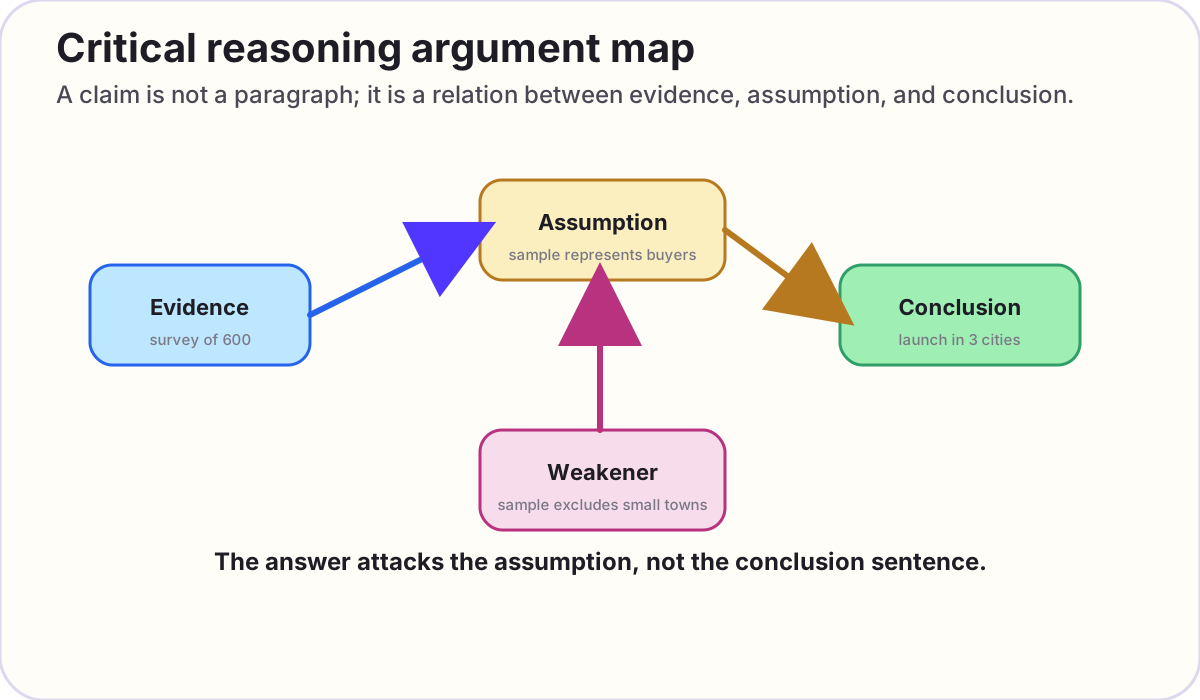
The conclusion is the statement the author wants you to accept. In an argument, the evidence points toward it, while assumptions bridge the gap. Under CAT time pressure, label evidence, assumption, and conclusion before opening the options. This links to the section and question-type structure reported by CAT-pattern sources [3][4][5].
Separate assumption from evidence
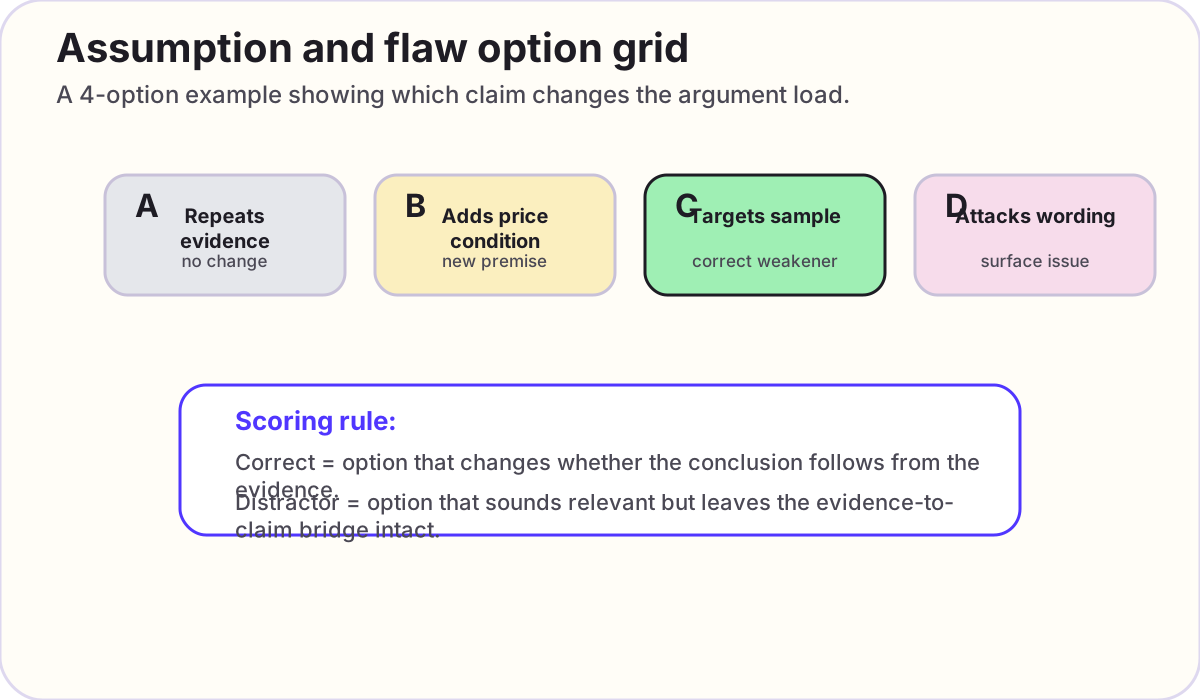
Evidence is stated. An assumption is unstated but needed. If an option repeats evidence, it feels safe but rarely answers an assumption question. If it attacks the bridge between evidence and conclusion, it may be the weakener. Check the rule against previous CAT papers instead of isolated drills [2].
Watch for outside information
A tempting option may introduce a fact not present in the passage. For inference and CR items, outside facts are unsafe even when they are true in the world. Keep the proof inside the text. The official CAT interface and timed-section design make this a practical constraint, not a stylistic preference 1[3].
Use the negate test carefully
For necessary assumptions, negate the option and see whether the argument collapses. Do not overuse this for strengthen and weaken questions, where the option only needs to move probability. The review step is also consistent with evidence that testing and retrieval improve durable learning [6][7].
Review with argument sketches
After each drill, sketch a 3-node map: evidence, assumption, conclusion. This retrieval act teaches the structure of the argument better than copying the explanation. Spaced review prevents one-session performance from being mistaken for stable skill [8].
FAQs
What is critical reasoning in CAT?
It is the skill of judging how evidence supports a conclusion, often through assumption, strengthen, weaken, or flaw tasks.
How do I identify the conclusion?
Find the claim that other statements are trying to support.
What is a necessary assumption?
It is an unstated idea without which the argument fails.
Should I use outside knowledge in CR questions?
No. Use only the passage and the option text.
How should I review CR mistakes?
Draw the evidence-assumption-conclusion map and mark which edge the correct option changed.
Conclusion
Use the first diagram as your next drill plan, then review the result within 24 hours and repeat the same rule for 3 timed sets.
Related reading
- rc inference questions cat
- rc strategy cat
- varc strategy cat 2026
- cat question selection
- cat mock analysis
References
- IIMCAT, "CAT 2025 official portal." Available: https://iimcat.ac.in/ [2] 2IIM, "CAT previous year question papers, 2017-2025." Available: https://online.2iim.com/CAT-question-paper/ [3] IMS India, "CAT exam pattern 2026: sections, question types, and marks." Available: https://www.imsindia.com/blog/cat/cat-exam-pattern/ [4] MBAUniverse, "CAT exam pattern: sections, questions, duration, and marking scheme." Available: https://www.mbauniverse.com/cat/pattern [5] IMS India, "CAT syllabus 2026: section-wise topics and weightage." Available: https://www.imsindia.com/blog/cat/cat-syllabus/ [6] J. Dunlosky, K. A. Rawson, E. J. Marsh, M. J. Nathan, and D. T. Willingham, "Improving students' learning with effective learning techniques," Psychological Science in the Public Interest, 2013. Available: https://doi.org/10.1177/1529100612453266 [7] H. L. Roediger and J. D. Karpicke, "Test-enhanced learning: taking memory tests improves long-term retention," Psychological Science, 2006. Available: https://doi.org/10.1111/j.1467-9280.2006.01693.x [8] S. Reddy, I. Labutov, S. Banerjee, and T. Joachims, "Unbounded human learning: optimal scheduling for spaced repetition," arXiv, 2016. Available: https://arxiv.org/abs/1602.07032 ↩