Topic Guide
Sectional vs full-length mocks: which to take when
Sectional and full-length mocks answer different questions. A sectional mock asks whether one section is improving. A full-length mock asks whether the whole exam system holds under time, fatigue, and switching. Mixing them well matters more than choosing one permanently.
When sectional mocks help
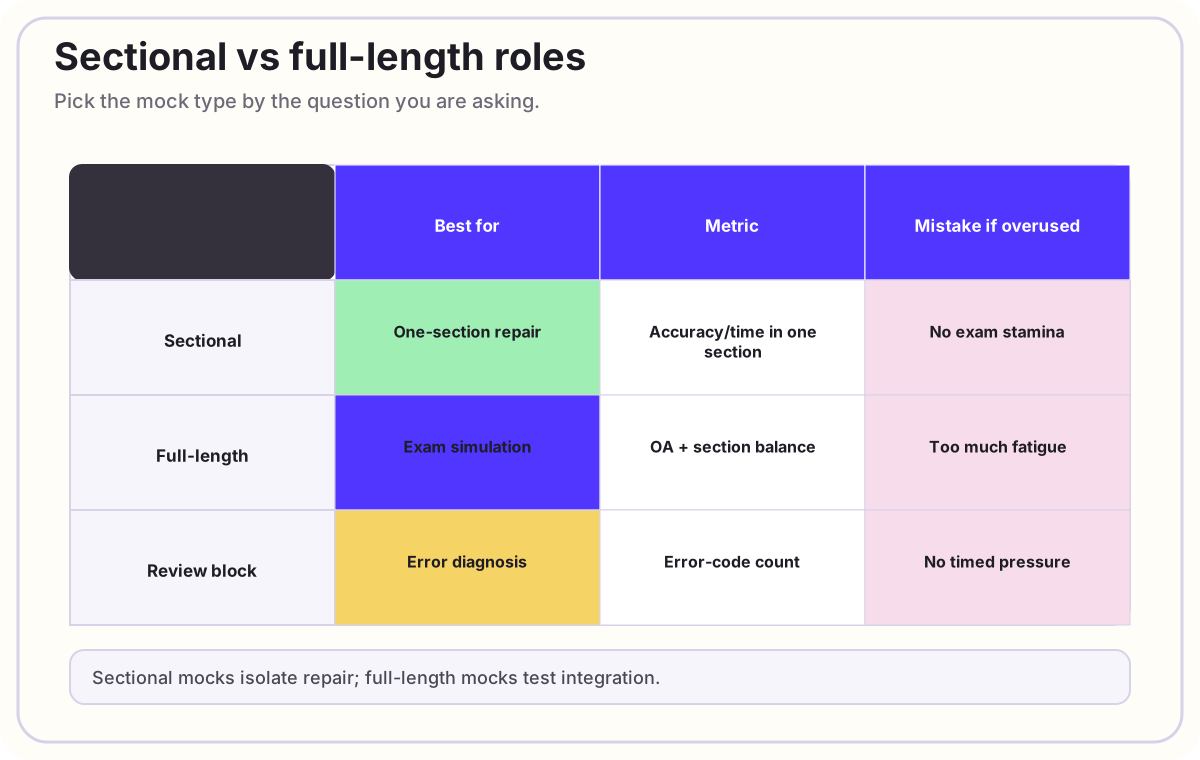
A sectional mock is useful after you know the weak section. It removes full-exam fatigue and focuses the diagnostic on one area. This is helpful for VARC timing, DILR set selection, or QA topic leakage.
The mistake is taking sectional mocks as a comfort format. If the student never returns to full-length testing, the exam system remains untested.
When full-length mocks help
Full-length mocks expose how one bad section affects the next. They also test the student's ability to protect the clock and recover after a poor set. These skills cannot be measured fully in a sectional mock.
A candidate close to exam month needs full-length rhythm because the CAT is not three separate days. It is one sitting.
The ratio by phase
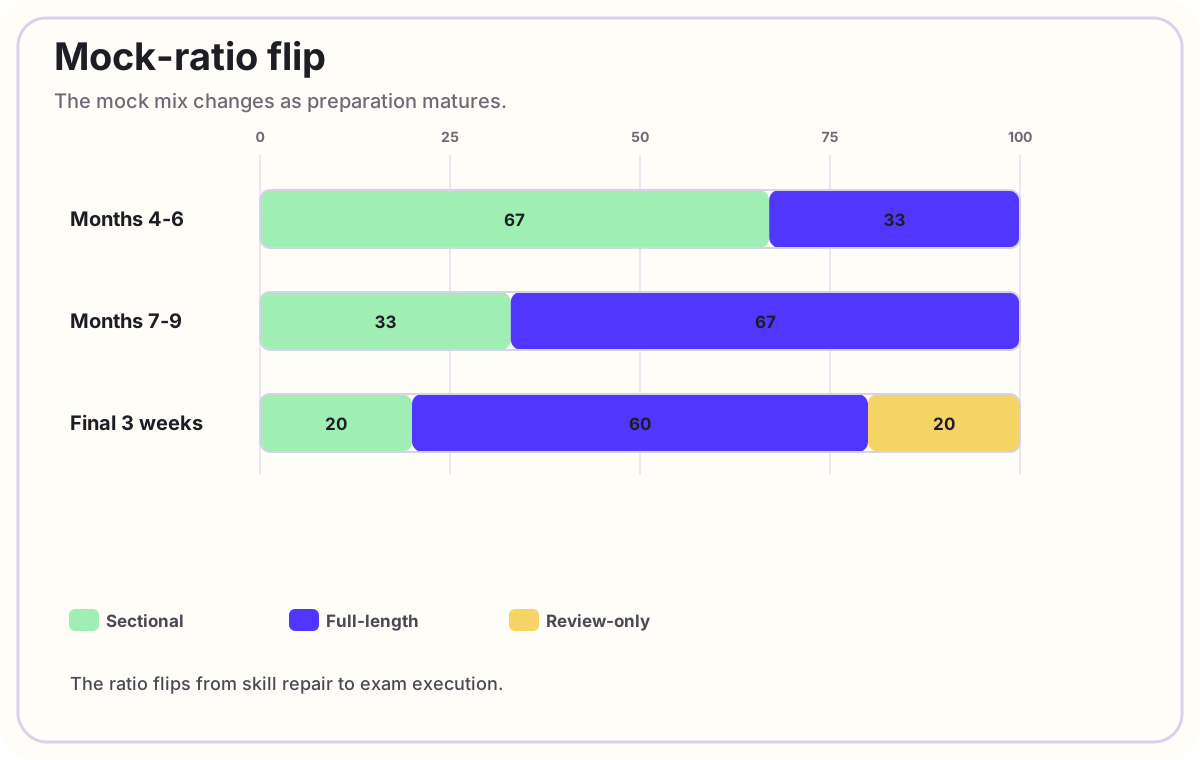
In the repair phase, 2 sectional mocks for every 1 full-length mock can make sense. In the execution phase, move toward 1 sectional for every 2 full-length mocks. The ratio changes because the limiting skill changes.
Keep the ratio visible in the calendar. If the calendar does not show the shift, the prep may stay stuck in repair mode.
How to review sectional mocks
A sectional mock should produce one decision rule. For VARC it may be passage order. For DILR it may be set-selection threshold. For QA it may be skip timing.
Do not extract ten lessons from a sectional mock. Pick the one rule that changes the next attempt.
How to decide this week
If one section is below the target gate, take sectional mocks on that section. If all sections are near the target but the full score is unstable, take a full-length mock and review order.
The right choice is visible in the last two mock sheets.
When sectional mocks are the better tool
A sectional mock is precise when the student knows the section that needs repair. If VARC accuracy is stable but DILR set selection is weak, a DILR sectional gives more useful feedback than a full mock. It removes cross-section fatigue and isolates the decision quality inside that section [6], [11], [12].
The score should be reviewed differently. In a sectional mock, focus on question choice, time blocks, and error types within that section. Do not over-read the percentile because the test pool and peer pool may differ from a full-length paper.
When full-length mocks are the better tool
A full-length mock tests more than content. It tests whether the candidate can move from VARC to DILR to QA without carrying frustration from one section into the next. It also tests whether the planned skip rules survive exam pressure.
This is why full-length mocks become more important near the exam. The candidate may already know the topics, but the sequence and pressure reveal a different failure mode. That failure mode cannot be seen in isolated section tests.
The ratio by phase
A workable ratio is 2 sectionals for every 1 full-length mock during the repair phase, then 1 sectional for every 2 full-length mocks during the rehearsal phase. The ratio is not fixed by month alone. It changes when the student's weakness changes.
Track the ratio on the calendar. If all practice is full-length, weak sections may remain vague. If all practice is sectional, the student may miss stamina and transition problems.
FAQs
What is sectional mock CAT?
sectional mock CAT is the article's main operating idea. Read it as a decision rule with a number attached, not as a loose definition.
Which source should I trust first?
Use official CAT or institute pages for policy claims, then use coaching analyses for paper-pattern interpretation and academic studies for learning-strategy claims.
How often should this article be refreshed?
Refresh it once every CAT admission cycle, and sooner if an official institute policy page publishes a new PDF.
What is the practical next step?
Write the main number from this article into your mock sheet or shortlist sheet today, then check it after the next mock.
How does this link to Clymber preparation?
It turns a vague CAT-prep question into one measurable decision that can be reviewed by a student or mentor within 7 days.
Conclusion
Use this article as a working sheet, not only as a reading page. Record the main number for your target case, apply it to the next mock or shortlist decision, and review the result within 7 days.
Related reading
- /blog/cat-mock-test-playbook
- /blog/how-many-cat-mocks
- /plans/self-study
- /blog/cat-mock-analysis
- /blog/cat-mock-score-plateau
References
- 2IIM, "CAT previous year papers and CAT paper database." Available: https://online.2iim.com/CAT-question-paper/. Accessed: 15-Jun-2026. [2] Cracku, "CAT previous year papers and section-wise analysis." Available: https://cracku.in/cat-previous-papers. Accessed: 15-Jun-2026. [3] IMS India, "CAT syllabus and exam pattern overview." Available: https://www.imsindia.com/blog/cat/cat-syllabus/. Accessed: 15-Jun-2026. [4] MBAUniverse, "CAT exam pattern and syllabus guide." Available: https://www.mbauniverse.com/cat/exam-pattern. Accessed: 15-Jun-2026. [5] J. Dunlosky et al., "Improving students' learning with effective learning techniques." Available: https://journals.sagepub.com/doi/10.1177/1529100612453266. Accessed: 15-Jun-2026. [6] H. L. Roediger III and J. D. Karpicke, "Test-enhanced learning: taking memory tests improves long-term retention." Available: https://doi.org/10.1111/j.1467-9280.2006.01693.x. Accessed: 15-Jun-2026. [7] A. Reddy et al., "Spaced learning and retrieval practice in education." Available: https://pmc.ncbi.nlm.nih.gov/articles/PMC5126970/. Accessed: 15-Jun-2026. [8] IIM CAT, "CAT official website." Available: https://iimcat.ac.in. Accessed: 15-Jun-2026. ↩