Topic Guide
Modern math for CAT: P&C and probability without the panic
Most permutation-combination errors in CAT are not arithmetic errors. They begin when the solver treats a selection question like an arrangement question, or counts dependent probability events as if replacement happened. This guide gives you one taxonomy for P&C and one protocol for probability, so the first 20 seconds are spent naming the object before doing arithmetic. Use it as a compact modern-math routine for the next 3 weeks.
The 3-question taxonomy
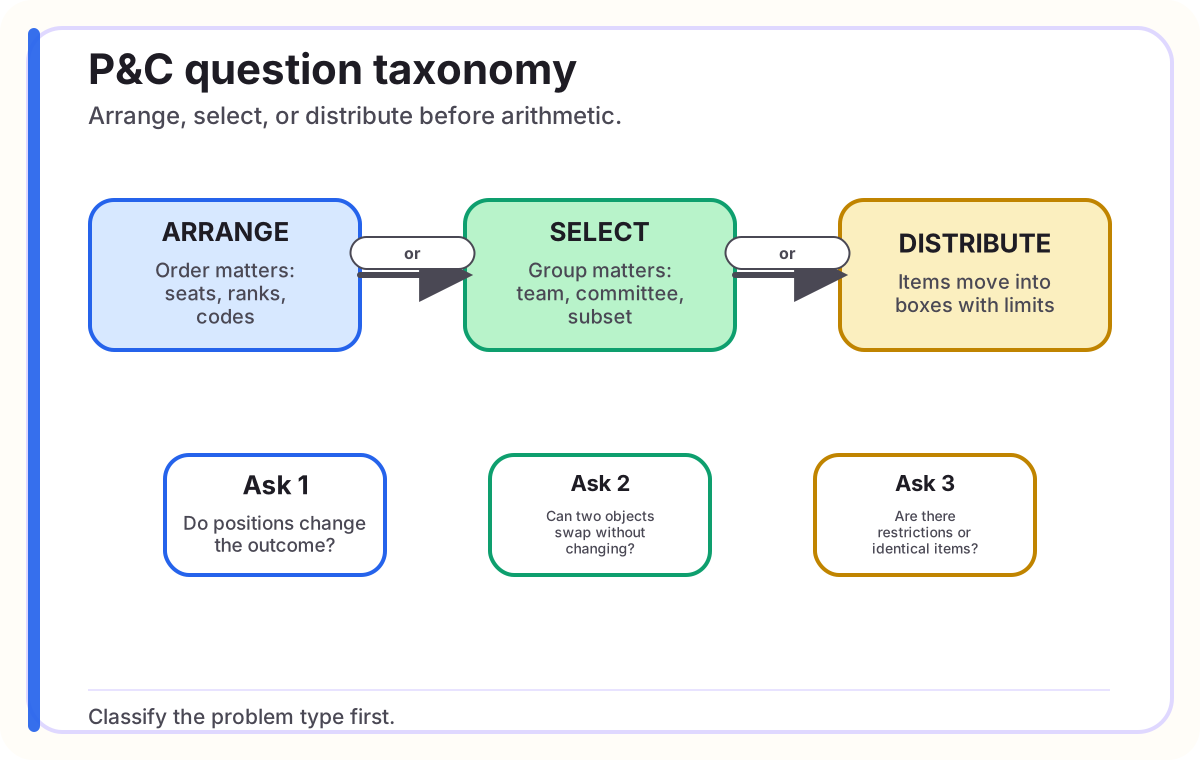
Ask: are you arranging positions, selecting a group, or distributing items into boxes. The taxonomy is deliberately smaller than a chapter list because CAT questions usually hide one of these three structures under a story. Past paper practice from 2IIM and Cracku is useful here because you can label the problem before solving it and then compare the label with the solution route [2], [3].
Try a 6-question warm-up: write only A, S, or D next to each question. Do not solve until all 6 are classified. If two labels feel possible, write the condition that would decide the route, such as whether order matters or whether boxes are distinct.
Use this section as a classification drill before it becomes a calculation drill. For the 3-question taxonomy, the first line in the notebook should name the trigger, the operation, and the stop rule. Then attempt the item. This prevents formula hunting and gives the error review a stable label. Past CAT papers and solved-paper repositories are useful for this because they show the variety of language around the same underlying frame [2], [3].
Run the next practice block in sets of 12 to 16 questions. Mark every miss with one tag: wrong classification, missed condition, arithmetic slip, or time loss. The repair session should train the largest tag, not the topic that feels most recent. The aim is to know what to measure in the next block, not only what to read next.
Arrange, select, distribute - the diagnostic questions
Arrangement questions change when two objects swap. Selection questions do not. Distribution questions add constraints such as identical items, boxes, upper limits, or at least-one conditions. NCERT chapters are useful for formula grounding, but CAT practice rewards recognising the condition before copying the formula [8].
Use three diagnostic questions: can two chosen objects swap, are places named, and are items or boxes identical. This is enough to prevent the common nPr-nCr swap and most overcounting errors.
Use this section as a classification drill before it becomes a calculation drill. For arrange, select, distribute - the diagnostic questions, the first line in the notebook should name the trigger, the operation, and the stop rule. Then attempt the item. This prevents formula hunting and gives the error review a stable label. Past CAT papers and solved-paper repositories are useful for this because they show the variety of language around the same underlying frame [2], [3].
Run the next practice block in sets of 12 to 16 questions. Mark every miss with one tag: wrong classification, missed condition, arithmetic slip, or time loss. The repair session should train the largest tag, not the topic that feels most recent. The aim is to know what to measure in the next block, not only what to read next.
Probability protocol - four named steps
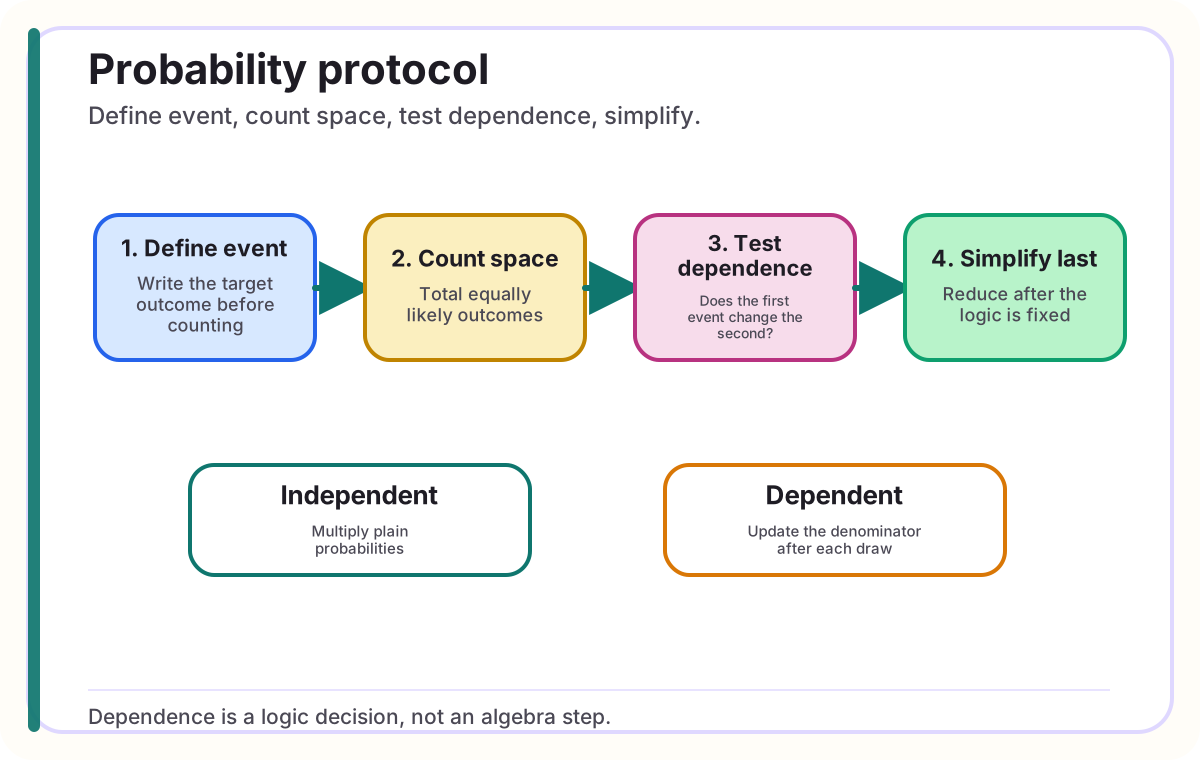
Probability becomes fragile when the target event is vague. Write the exact event first, then count the total space, then test dependence, then reduce. The official CAT format can vary by year, so the stable skill is not memorising a question type; it is building a clean event-space statement 1.
For dependent events, update the denominator after each draw. For independent events, keep the denominator stable. The dependence decision belongs before arithmetic, not after a messy fraction appears.
Use this section as a classification drill before it becomes a calculation drill. For probability protocol - four named steps, the first line in the notebook should name the trigger, the operation, and the stop rule. Then attempt the item. This prevents formula hunting and gives the error review a stable label. Past CAT papers and solved-paper repositories are useful for this because they show the variety of language around the same underlying frame [2], [3].
Run the next practice block in sets of 12 to 16 questions. Mark every miss with one tag: wrong classification, missed condition, arithmetic slip, or time loss. The repair session should train the largest tag, not the topic that feels most recent. The aim is to know what to measure in the next block, not only what to read next.
Three traps to mark in your notebook
Trap 1 is double-counting arrangements that should be divided by repeated objects. Trap 2 is treating identical objects as if they were labelled. Trap 3 is using replacement logic when the problem removes an object after a draw. These traps show up across modern-math and set-theory neighbourhoods in CAT syllabus maps [4], [5].
Write the trap name next to every wrong solution. After 20 problems, the repeated trap tells you what to repair.
Use this section as a classification drill before it becomes a calculation drill. For three traps to mark in your notebook, the first line in the notebook should name the trigger, the operation, and the stop rule. Then attempt the item. This prevents formula hunting and gives the error review a stable label. Past CAT papers and solved-paper repositories are useful for this because they show the variety of language around the same underlying frame [2], [3].
Run the next practice block in sets of 12 to 16 questions. Mark every miss with one tag: wrong classification, missed condition, arithmetic slip, or time loss. The repair session should train the largest tag, not the topic that feels most recent. The aim is to know what to measure in the next block, not only what to read next.
Practice routine for 3 weeks
Do 5 arrange, 5 select, and 5 distribute/probability problems per week. Keep the problem mix visible rather than solving from one subtopic at a time. Career Launcher and Shiksha pattern pages are useful for annual format checks, but topic balance still needs past-paper review [6], [7].
After solving, mark each item as concept miss, classification miss, or arithmetic miss. A classification miss is the most important one because it repeats across problems.
Use this section as a classification drill before it becomes a calculation drill. For practice routine for 3 weeks, the first line in the notebook should name the trigger, the operation, and the stop rule. Then attempt the item. This prevents formula hunting and gives the error review a stable label. Past CAT papers and solved-paper repositories are useful for this because they show the variety of language around the same underlying frame [2], [3].
Run the next practice block in sets of 12 to 16 questions. Mark every miss with one tag: wrong classification, missed condition, arithmetic slip, or time loss. The repair session should train the largest tag, not the topic that feels most recent. The aim is to know what to measure in the next block, not only what to read next.
What to do today
Pick any 6 modern-math problems from a past CAT or reliable practice set. Write Arrange, Select, or Distribute next to each. Solve only after the labels are final. This takes 25 minutes and gives you a clean baseline for the next week.
Your first target is 5 correct classifications out of 6. If you get fewer than 5, spend the next session only on classification drills.
Use this section as a classification drill before it becomes a calculation drill. For what to do today, the first line in the notebook should name the trigger, the operation, and the stop rule. Then attempt the item. This prevents formula hunting and gives the error review a stable label. Past CAT papers and solved-paper repositories are useful for this because they show the variety of language around the same underlying frame [2], [3].
Run the next practice block in sets of 12 to 16 questions. Mark every miss with one tag: wrong classification, missed condition, arithmetic slip, or time loss. The repair session should train the largest tag, not the topic that feels most recent. The aim is to know what to measure in the next block, not only what to read next.
FAQs
Is modern math important for CAT?
Modern math is usually lower-frequency than arithmetic or algebra, but it is still worth preparing because one clean P&C or probability item can be scored in under two minutes when the type is clear.
Should I memorise all P&C formulas?
Memorise the core formulas, but do not start from memory. Start from the taxonomy: arrange, select, or distribute. The formula follows the classification.
How many probability problems should I practise?
Use 5 probability problems per week for 3 weeks. Review dependence errors separately because they are the most common source of wrong answers.
What is the safest first step in P&C?
Ask whether order changes the outcome. That one question separates arrangement from selection in most CAT-style items.
Can I skip modern math if QA is weak?
If the exam is close and arithmetic is weak, limit modern math. If you have 8 weeks or more, prepare the taxonomy enough to capture the direct questions.
Conclusion
Use the next practice session to test the method on a small set, then record the exact error type. One clean error category is more useful than 20 unreviewed solutions.
Related reading
References
- Indian Institutes of Management, "Common Admission Test official website," 2025. [Online]. Available: https://iimcat.ac.in/ [2] 2IIM, "CAT previous year question papers," 2025. [Online]. Available: https://online.2iim.com/CAT-question-paper/ [3] Cracku, "CAT previous papers," 2025. [Online]. Available: https://cracku.in/cat-previous-papers [4] IMS India, "CAT syllabus and preparation guide," 2025. [Online]. Available: https://www.imsindia.com/blog/cat/cat-syllabus/ [5] MBAUniverse, "CAT syllabus and exam pattern," 2025. [Online]. Available: https://www.mbauniverse.com/articles/cat-syllabus [6] Career Launcher, "CAT exam pattern," 2025. [Online]. Available: https://www.careerlauncher.com/cat-mba/exam-pattern/ [7] Shiksha, "CAT exam pattern," 2025. [Online]. Available: https://www.shiksha.com/mba/cat-exam-pattern [8] National Council of Educational Research and Training, "NCERT textbook portal," 2025. [Online]. Available: https://ncert.nic.in/textbook.php ↩