Topic Guide
Odd-one-out questions in CAT VARC: the 5-sentence sort
The odd sentence is rarely the sentence that sounds strange. It is the sentence that cannot play a role in the paragraph formed by the other four. The reliable method is to build the chain first and reject after. That shift turns odd-one-out from taste into structure.
What odd means in CAT context
The odd sentence often uses the same vocabulary as the paragraph. That is the trap. Your task is to find the four sentences that form a coherent paragraph, then identify the sentence that cannot serve a stable role. Cracku’s VARC trend analysis records odd sentence or out-of-context items across recent CAT VARC patterns 3.
Do not ask which sentence sounds unusual. Ask which sentence the paragraph can lose without breaking its claim-reason-example chain.
The 5-sentence sort - build the chain before rejection
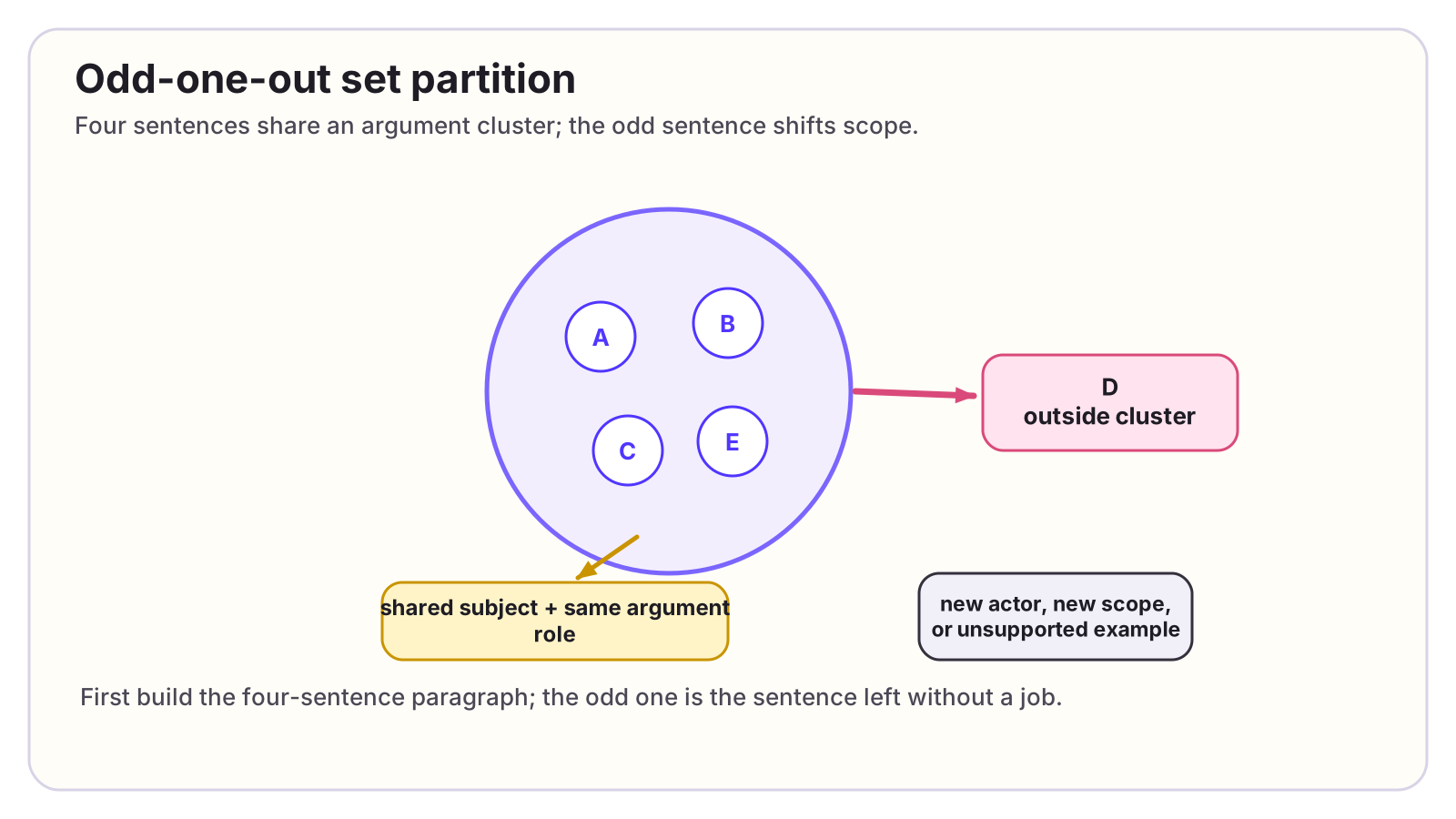
Use four passes. First, name the shared topic in 5 words. Second, label each sentence: claim, reason, example, contrast, implication. Third, test two possible chains. Fourth, remove the sentence that does not play a role in either chain.
The official CAT site should be refreshed for the current year’s task mix 1, but the 80-second practice cap works because VA items must fit inside VARC’s 40-minute section 4.
Anchor versus odd - do not confuse them
Many students reject a sentence because it begins with “this,” “however,” or “for instance.” That is unsafe. Such a sentence may be a bridge or example. The odd sentence is the one whose role cannot be attached after you build the chain.
IMS lists odd-one-out with para-jumbles and summaries in VA task types 5. The shared skill is role labelling, but the final decision differs: parajumbles seek order; odd-one-out seeks exclusion.
The two failure modes
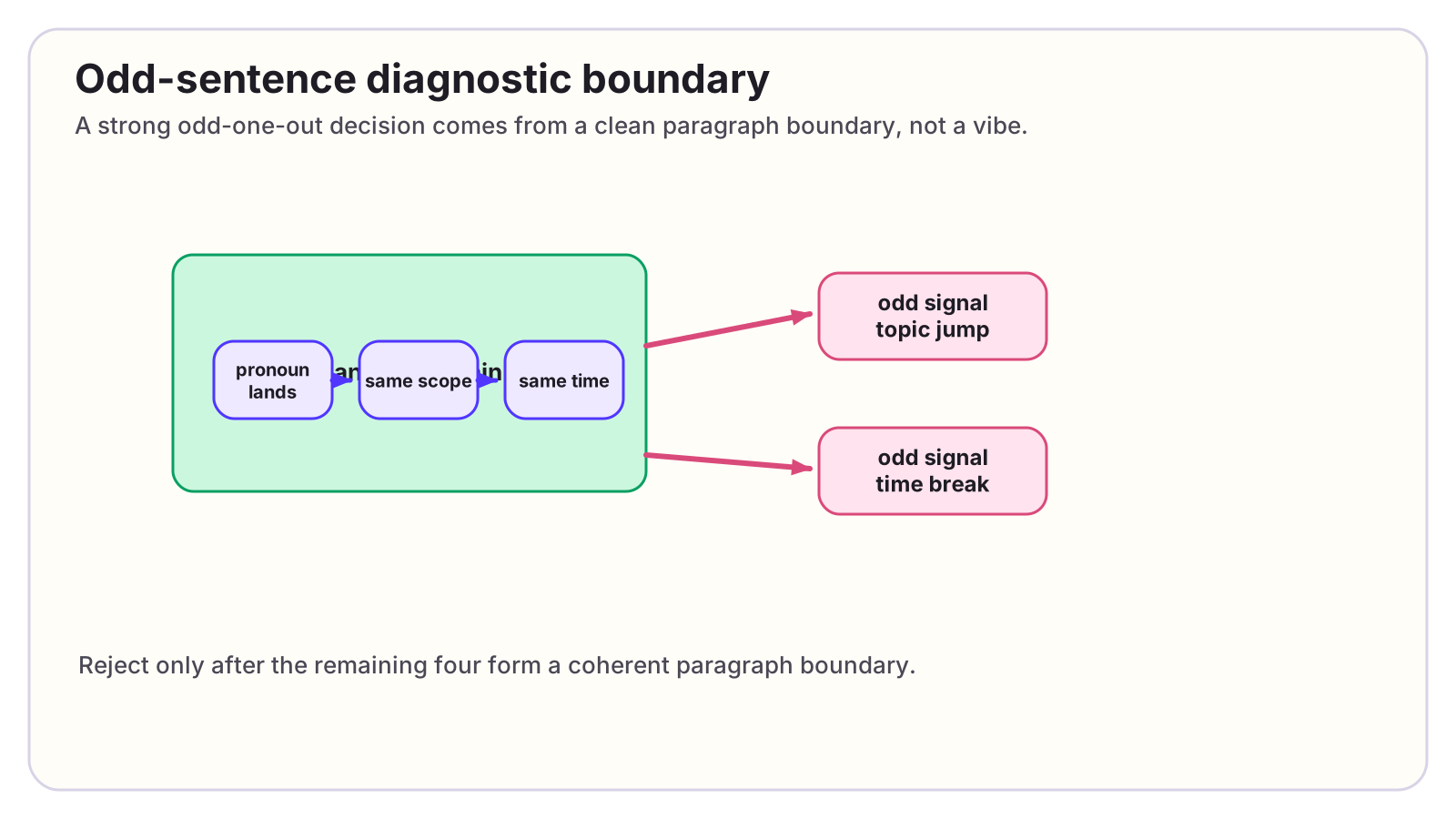
Topic drift means the sentence belongs to a nearby theme but not the paragraph’s claim. Role break means the sentence looks relevant but cannot support the chain. A sentence about “digital privacy” may not belong in a paragraph about “platform governance” if the paragraph is about institutions rather than users.
Use a margin note: drift or break. That label makes review faster and keeps the next drill focused.
Worked example - remove after the chain is built
Suppose four sentences form this chain: a city faces heat stress, tree cover reduces local temperature, poorer wards have lower cover, and planning should prioritise shaded routes. A fifth sentence about global carbon markets shares the climate theme but does not support the local planning chain. It is the odd sentence.
Retrieval-practice research supports solving before viewing explanations, because the act of recall strengthens later recognition 7. Write the four-sentence chain before checking the answer.
Practice routine - 4 items per week
Attempt four odd-one-out items each week for four weeks. For every miss, write whether you failed topic naming, role labelling, chain building, or exclusion. Dunlosky et al. identify distributed practice as a strong study technique 6, so repeat missed items after a delay rather than redoing them immediately.
Your target is 75 percent accuracy under 80 seconds by the end of week 4.
FAQs
What does odd one out mean in CAT VARC?
It means one sentence does not belong to the coherent paragraph formed by the remaining sentences.
How do I solve odd-one-out questions?
Name the topic, label each sentence role, build the four-sentence chain, then remove the sentence with no stable role.
How much time should I spend on odd-one-out questions?
Train with an 80-second cap. If no chain appears by 60 seconds, mark it for review.
Is the odd sentence always off-topic?
No. It may share the broad theme but break the paragraph’s logic, scope, or tone.
How should I review these questions?
Record the failed step: topic, role, chain, or exclusion. Drill the repeated failure step next week.
Conclusion
Run 4 odd-one-out questions tonight. Write the 4-sentence chain before rejecting the odd sentence. Your review metric is the failed step: topic, role, chain, or exclusion.
Related reading
References
- Indian Institutes of Management, "CAT official website," 2026. [Online]. Available: https://iimcat.ac.in/. Accessed: Jun. 14, 2026. ↩
- 2IIM, "CAT previous year question papers (2017-2025) with solutions," 2026. [Online]. Available: https://online.2iim.com/CAT-question-paper/. Accessed: Jun. 14, 2026. ↩
- Cracku, "CAT VARC topic-wise weightage," 2026. [Online]. Available: https://cracku.in/cat-varc-topic-wise-weightage/. Accessed: Jun. 14, 2026. ↩
- MBAUniverse, "CAT 2026 syllabus: section-wise topics and 5-year weightage analysis," 2026. [Online]. Available: https://www.mbauniverse.com/cat/syllabus. Accessed: Jun. 14, 2026. ↩
- IMS India, "CAT syllabus 2026: sections, topics, weightage, and exam pattern," 2026. [Online]. Available: https://www.imsindia.com/blog/cat/cat-syllabus/. Accessed: Jun. 14, 2026. ↩
- J. Dunlosky, K. A. Rawson, E. J. Marsh, M. J. Nathan, and D. T. Willingham, "Improving students’ learning with effective learning techniques: Promising directions from cognitive and educational psychology," Psychological Science in the Public Interest, vol. 14, no. 1, pp. 4-58, 2013. [Online]. Available: https://journals.sagepub.com/doi/10.1177/1529100612453266. Accessed: Jun. 14, 2026. ↩
- H. L. Roediger III and J. D. Karpicke, "Test-enhanced learning: Taking memory tests improves long-term retention," Psychological Science, vol. 17, no. 3, pp. 249-255, 2006. [Online]. Available: https://doi.org/10.1111/j.1467-9280.2006.01693.x. Accessed: Jun. 14, 2026. ↩
- S. Reddy, I. Labutov, S. Banerjee, and T. Joachims, "Unbounded human learning: Optimal scheduling for spaced repetition," 2016. [Online]. Available: https://arxiv.org/abs/1602.07032. Accessed: Jun. 14, 2026. ↩