Topic Guide
Percentages and ratios for CAT: the chained-percentage trick
A 20 percent increase followed by a 20 percent decrease is not neutral. It leaves you at 96 percent of the starting value. CAT uses this failure mode because students add percentage changes when they should multiply multipliers. This guide gives you the multiplier method, the ratio-of-changes shortcut, profit-loss reframing, and the alligation see-saw.
The chained-percentage trick
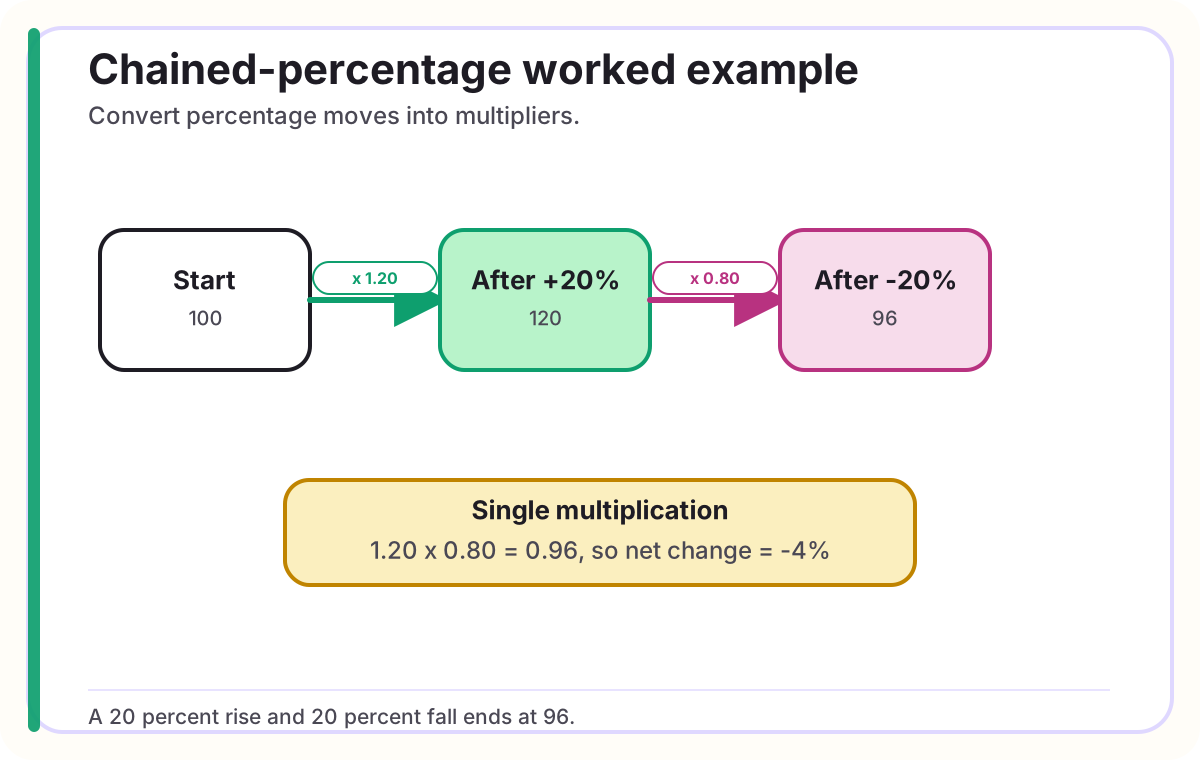
A percentage rise of 20 percent is a multiplier of 1.20. A fall of 20 percent is a multiplier of 0.80. Chained changes multiply: 1.20 x 0.80 = 0.96, so the net change is a 4 percent fall. Past CAT arithmetic sets reward this because one line replaces a long unitary-method route [2], [3].
Write the multiplier under each change. Do not add the percentages unless the base is unchanged.
Use this section as a classification drill before it becomes a calculation drill. For the chained-percentage trick, the first line in the notebook should name the trigger, the operation, and the stop rule. Then attempt the item. This prevents formula hunting and gives the error review a stable label. Past CAT papers and solved-paper repositories are useful for this because they show the variety of language around the same underlying frame [2], [3].
Run the next practice block in sets of 12 to 16 questions. Mark every miss with one tag: wrong classification, missed condition, arithmetic slip, or time loss. The repair session should train the largest tag, not the topic that feels most recent. The aim is to know what to measure in the next block, not only what to read next.
Ratio-of-changes shortcut
If price rises and consumption falls with expenditure fixed, the quantity ratio is the inverse of the price ratio. For example, a 25 percent price rise makes price 5:4, so consumption must move 4:5 to keep spend unchanged. This is a 20 percent fall in consumption.
The shortcut is powerful because it keeps the base visible. It also prevents the false symmetry that makes +25 and -25 look equal.
Use this section as a classification drill before it becomes a calculation drill. For ratio-of-changes shortcut, the first line in the notebook should name the trigger, the operation, and the stop rule. Then attempt the item. This prevents formula hunting and gives the error review a stable label. Past CAT papers and solved-paper repositories are useful for this because they show the variety of language around the same underlying frame [2], [3].
Run the next practice block in sets of 12 to 16 questions. Mark every miss with one tag: wrong classification, missed condition, arithmetic slip, or time loss. The repair session should train the largest tag, not the topic that feels most recent. The aim is to know what to measure in the next block, not only what to read next.
Profit-loss as cost-price reframing
Profit-loss questions are percentage questions with names. Mark the base first: cost price, selling price, or marked price. Discounts usually sit on marked price; profit usually sits on cost price. CAT syllabus guides keep profit-loss inside arithmetic for a reason: the algebra is light if the base is correct [4], [5].
Write CP = 100 when the base is unknown. Then move every percentage from that base.
Use this section as a classification drill before it becomes a calculation drill. For profit-loss as cost-price reframing, the first line in the notebook should name the trigger, the operation, and the stop rule. Then attempt the item. This prevents formula hunting and gives the error review a stable label. Past CAT papers and solved-paper repositories are useful for this because they show the variety of language around the same underlying frame [2], [3].
Run the next practice block in sets of 12 to 16 questions. Mark every miss with one tag: wrong classification, missed condition, arithmetic slip, or time loss. The repair session should train the largest tag, not the topic that feels most recent. The aim is to know what to measure in the next block, not only what to read next.
Alligation in 90 seconds
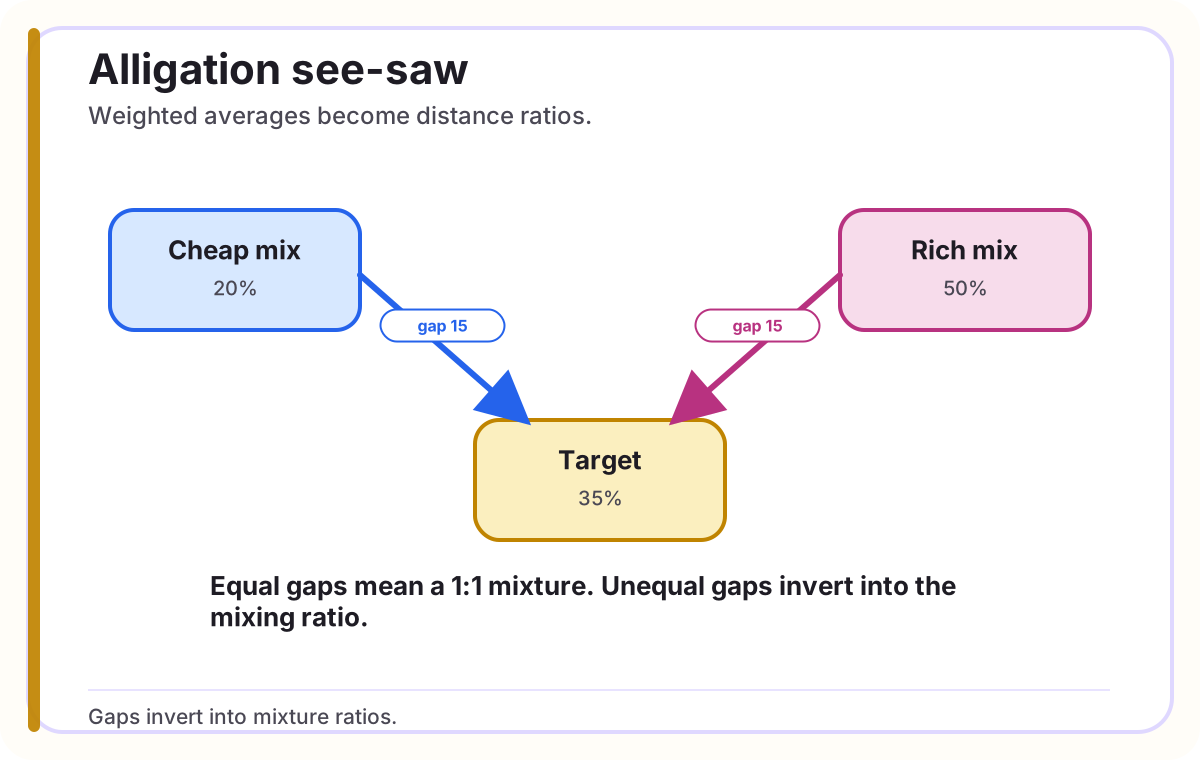
Alligation is a weighted-average shortcut. Put the lower value on the left, the higher value on the right, and the target in the middle. The distance from target to one side gives the opposite quantity ratio.
This is safer than solving two equations when the problem only asks for the mixing ratio.
Use this section as a classification drill before it becomes a calculation drill. For alligation in 90 seconds, the first line in the notebook should name the trigger, the operation, and the stop rule. Then attempt the item. This prevents formula hunting and gives the error review a stable label. Past CAT papers and solved-paper repositories are useful for this because they show the variety of language around the same underlying frame [2], [3].
Run the next practice block in sets of 12 to 16 questions. Mark every miss with one tag: wrong classification, missed condition, arithmetic slip, or time loss. The repair session should train the largest tag, not the topic that feels most recent. The aim is to know what to measure in the next block, not only what to read next.
Practice routine
For the first 5 problems, solve with multipliers only. For the next 5, circle the base before any arithmetic. Pattern sources such as Career Launcher and Shiksha help with yearly format checks, but your arithmetic score improves from repeated base discipline [6], [7].
Mark each wrong answer as multiplier error, base error, or calculation error.
Use this section as a classification drill before it becomes a calculation drill. For practice routine, the first line in the notebook should name the trigger, the operation, and the stop rule. Then attempt the item. This prevents formula hunting and gives the error review a stable label. Past CAT papers and solved-paper repositories are useful for this because they show the variety of language around the same underlying frame [2], [3].
Run the next practice block in sets of 12 to 16 questions. Mark every miss with one tag: wrong classification, missed condition, arithmetic slip, or time loss. The repair session should train the largest tag, not the topic that feels most recent. The aim is to know what to measure in the next block, not only what to read next.
What to do today
Pick 5 mixed percentage items. Write only the multiplier chain first, then calculate. A clean first line is the target.
Your target is 5 complete multiplier chains, not 5 fast answers.
Use this section as a classification drill before it becomes a calculation drill. For what to do today, the first line in the notebook should name the trigger, the operation, and the stop rule. Then attempt the item. This prevents formula hunting and gives the error review a stable label. Past CAT papers and solved-paper repositories are useful for this because they show the variety of language around the same underlying frame [2], [3].
Run the next practice block in sets of 12 to 16 questions. Mark every miss with one tag: wrong classification, missed condition, arithmetic slip, or time loss. The repair session should train the largest tag, not the topic that feels most recent. The aim is to know what to measure in the next block, not only what to read next.
FAQs
Why is a 20 percent rise followed by a 20 percent fall equal to a 4 percent fall?
The base changes after the rise. The chain is 1.20 x 0.80 = 0.96, so the final value is 4 percent below the start.
What is the fastest way to solve chained percentages?
Convert each percentage into a multiplier and multiply the chain. Convert the final multiplier back into net percentage change.
How do ratios help in percentage questions?
Ratios keep the base stable. When total spend is fixed, price and quantity move in inverse ratios.
Is alligation useful for CAT?
Yes, when the problem combines two mixtures or weighted averages into one target value.
What should I practise first?
Start with base identification. Most percentage errors begin before calculation.
Conclusion
Use the next practice session to test the method on a small set, then record the exact error type. One clean error category is more useful than 20 unreviewed solutions.
Related reading
References
- Indian Institutes of Management, "Common Admission Test official website," 2025. [Online]. Available: https://iimcat.ac.in/ [2] 2IIM, "CAT previous year question papers," 2025. [Online]. Available: https://online.2iim.com/CAT-question-paper/ [3] Cracku, "CAT previous papers," 2025. [Online]. Available: https://cracku.in/cat-previous-papers [4] IMS India, "CAT syllabus and preparation guide," 2025. [Online]. Available: https://www.imsindia.com/blog/cat/cat-syllabus/ [5] MBAUniverse, "CAT syllabus and exam pattern," 2025. [Online]. Available: https://www.mbauniverse.com/articles/cat-syllabus [6] Career Launcher, "CAT exam pattern," 2025. [Online]. Available: https://www.careerlauncher.com/cat-mba/exam-pattern/ [7] Shiksha, "CAT exam pattern," 2025. [Online]. Available: https://www.shiksha.com/mba/cat-exam-pattern [8] National Council of Educational Research and Training, "NCERT textbook portal," 2025. [Online]. Available: https://ncert.nic.in/textbook.php ↩