Topic Guide
Time-speed-distance for CAT: the boats-trains-races trio
Boats, trains, races, and circular motion look like four topics. They are one relative-motion topic with different costumes. The solver who names the frame first writes fewer equations and makes fewer unit errors. This guide gives you a 3-step protocol, two worked frames, and a trap list you can review before the next QA sectional.
The relative-velocity framework
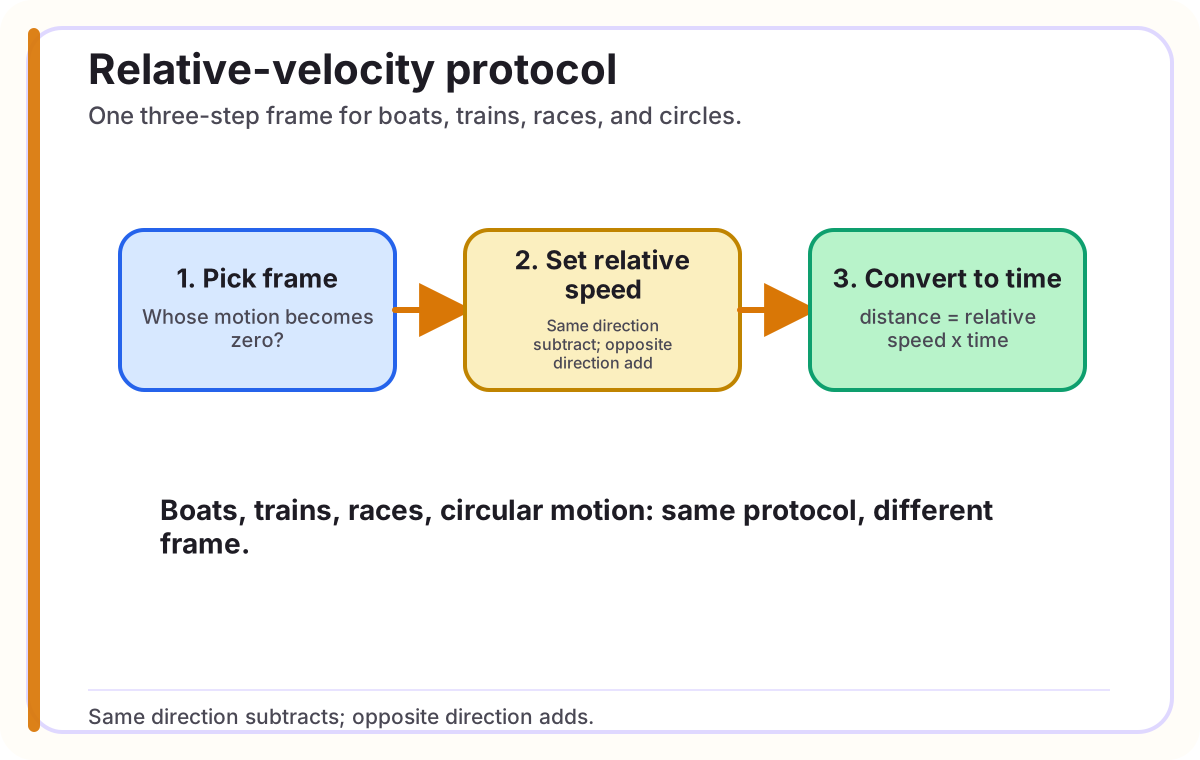
Start by asking whose motion you want to freeze. In a train-crossing problem, the platform may be fixed and the train length matters. In a race, the lead distance matters. In boats and streams, the water current becomes part of the effective speed. Past-paper databases are useful because the same frame logic repeats across surface stories [2], [3].
Write the frame in words before numbers: boat against stream, train against platform, runner against runner, or object against circular track.
Use this section as a classification drill before it becomes a calculation drill. For the relative-velocity framework, the first line in the notebook should name the trigger, the operation, and the stop rule. Then attempt the item. This prevents formula hunting and gives the error review a stable label. Past CAT papers and solved-paper repositories are useful for this because they show the variety of language around the same underlying frame [2], [3].
Run the next practice block in sets of 12 to 16 questions. Mark every miss with one tag: wrong classification, missed condition, arithmetic slip, or time loss. The repair session should train the largest tag, not the topic that feels most recent. The aim is to know what to measure in the next block, not only what to read next.
Boats and streams
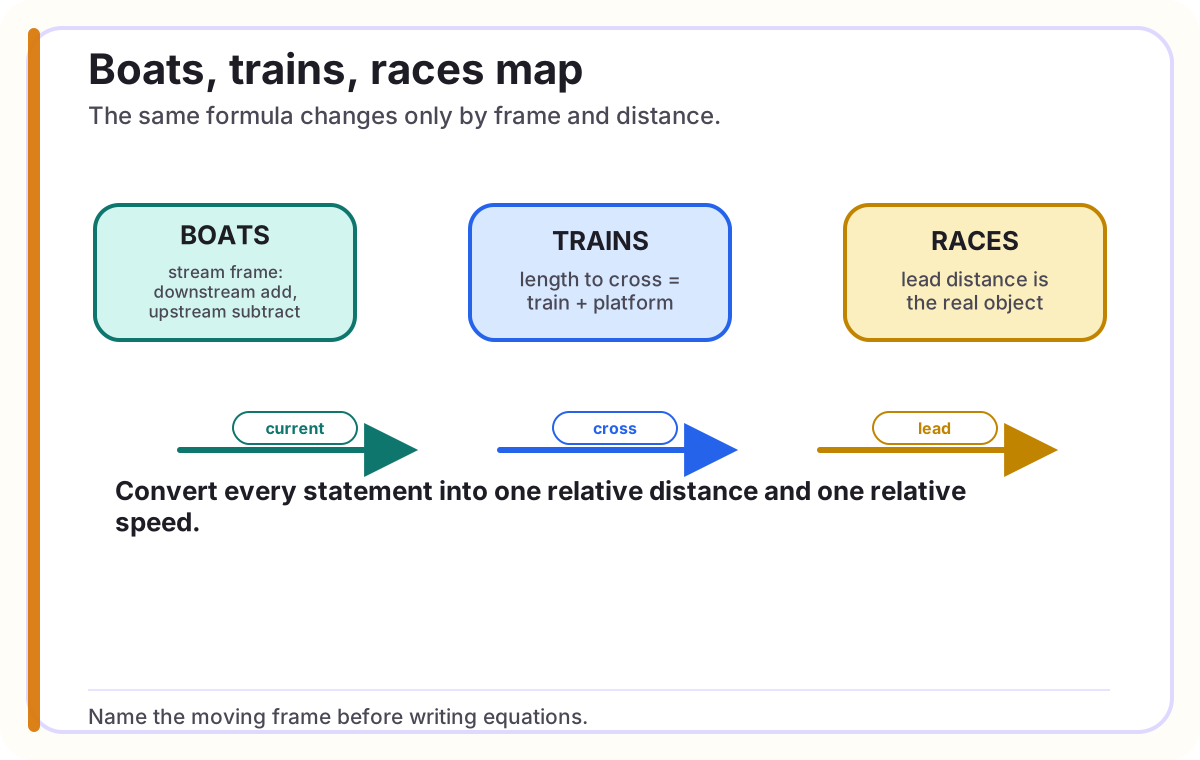
If still-water speed is b and stream speed is s, downstream speed is b+s and upstream speed is b-s. The trap is not the formula; it is losing track of which time belongs to which direction. Keep the direction column visible in your working.
For a 30 km downstream and 30 km upstream trip, do not average speeds. Compute the two times and add them. The average-speed shortcut fails when the time in each direction differs.
Use this section as a classification drill before it becomes a calculation drill. For boats and streams, the first line in the notebook should name the trigger, the operation, and the stop rule. Then attempt the item. This prevents formula hunting and gives the error review a stable label. Past CAT papers and solved-paper repositories are useful for this because they show the variety of language around the same underlying frame [2], [3].
Run the next practice block in sets of 12 to 16 questions. Mark every miss with one tag: wrong classification, missed condition, arithmetic slip, or time loss. The repair session should train the largest tag, not the topic that feels most recent. The aim is to know what to measure in the next block, not only what to read next.
Trains and platforms
A train crossing a pole covers its own length. A train crossing a platform covers train length plus platform length. A train crossing another train uses the sum of both lengths if the opposite train is moving toward it. CAT-style algebra here is usually one equation after the correct distance is named [4], [5].
Write the crossing distance in a separate line. That one line prevents half the errors in train problems.
Use this section as a classification drill before it becomes a calculation drill. For trains and platforms, the first line in the notebook should name the trigger, the operation, and the stop rule. Then attempt the item. This prevents formula hunting and gives the error review a stable label. Past CAT papers and solved-paper repositories are useful for this because they show the variety of language around the same underlying frame [2], [3].
Run the next practice block in sets of 12 to 16 questions. Mark every miss with one tag: wrong classification, missed condition, arithmetic slip, or time loss. The repair session should train the largest tag, not the topic that feels most recent. The aim is to know what to measure in the next block, not only what to read next.
Races and circular motion
In race problems, the finish margin can be converted into a lead distance or lead time. In circular motion, relative speed decides meeting frequency. If runners move in opposite directions on a circle, relative speed adds; if they move in the same direction, it subtracts.
Use a diagram only to name the relative distance. Do not draw decorative tracks that do not change the equation.
Use this section as a classification drill before it becomes a calculation drill. For races and circular motion, the first line in the notebook should name the trigger, the operation, and the stop rule. Then attempt the item. This prevents formula hunting and gives the error review a stable label. Past CAT papers and solved-paper repositories are useful for this because they show the variety of language around the same underlying frame [2], [3].
Run the next practice block in sets of 12 to 16 questions. Mark every miss with one tag: wrong classification, missed condition, arithmetic slip, or time loss. The repair session should train the largest tag, not the topic that feels most recent. The aim is to know what to measure in the next block, not only what to read next.
Three TSD traps
Trap 1 is mixing km/hr and m/s. Trap 2 is averaging speeds when the distances are equal but times differ. Trap 3 is subtracting speeds in opposite-direction movement. Exam-pattern sources tell you the section format, but the topic repair comes from error logs [6], [7].
Make a 3-column error log: unit, distance, direction. If the same column repeats twice, repair that before adding more problems.
Use this section as a classification drill before it becomes a calculation drill. For three tsd traps, the first line in the notebook should name the trigger, the operation, and the stop rule. Then attempt the item. This prevents formula hunting and gives the error review a stable label. Past CAT papers and solved-paper repositories are useful for this because they show the variety of language around the same underlying frame [2], [3].
Run the next practice block in sets of 12 to 16 questions. Mark every miss with one tag: wrong classification, missed condition, arithmetic slip, or time loss. The repair session should train the largest tag, not the topic that feels most recent. The aim is to know what to measure in the next block, not only what to read next.
What to do today
Pick one boats item and one race item. For each, write frame, relative speed, and time equation before solving. The point is to prove that both items use the same skeleton.
Your target is 2 solved problems with no unit rewrite after the first line.
Use this section as a classification drill before it becomes a calculation drill. For what to do today, the first line in the notebook should name the trigger, the operation, and the stop rule. Then attempt the item. This prevents formula hunting and gives the error review a stable label. Past CAT papers and solved-paper repositories are useful for this because they show the variety of language around the same underlying frame [2], [3].
Run the next practice block in sets of 12 to 16 questions. Mark every miss with one tag: wrong classification, missed condition, arithmetic slip, or time loss. The repair session should train the largest tag, not the topic that feels most recent. The aim is to know what to measure in the next block, not only what to read next.
FAQs
What is the core formula for time-speed-distance?
The core relation is distance = speed x time. In CAT problems, the harder step is often choosing the right relative speed before using that relation.
How do I handle boats and streams?
Use still-water speed plus stream speed downstream and still-water speed minus stream speed upstream. Keep the direction attached to each time value.
Are races and circular motion the same topic?
They are linked by relative speed. Races use lead distance; circular motion uses meeting distance on a loop.
How many TSD problems should I practise per week?
Practise 9 to 12 problems per week: 3 boats, 3 trains, 3 races or circular motion, plus review of wrong frames.
What is the common TSD mistake?
The most common mistake is using the right formula with the wrong relative speed.
Conclusion
Use the next practice session to test the method on a small set, then record the exact error type. One clean error category is more useful than 20 unreviewed solutions.
Related reading
References
- Indian Institutes of Management, "Common Admission Test official website," 2025. [Online]. Available: https://iimcat.ac.in/ [2] 2IIM, "CAT previous year question papers," 2025. [Online]. Available: https://online.2iim.com/CAT-question-paper/ [3] Cracku, "CAT previous papers," 2025. [Online]. Available: https://cracku.in/cat-previous-papers [4] IMS India, "CAT syllabus and preparation guide," 2025. [Online]. Available: https://www.imsindia.com/blog/cat/cat-syllabus/ [5] MBAUniverse, "CAT syllabus and exam pattern," 2025. [Online]. Available: https://www.mbauniverse.com/articles/cat-syllabus [6] Career Launcher, "CAT exam pattern," 2025. [Online]. Available: https://www.careerlauncher.com/cat-mba/exam-pattern/ [7] Shiksha, "CAT exam pattern," 2025. [Online]. Available: https://www.shiksha.com/mba/cat-exam-pattern [8] National Council of Educational Research and Training, "NCERT textbook portal," 2025. [Online]. Available: https://ncert.nic.in/textbook.php ↩