Topic Guide
Second-attempt CAT: what changes the second time
The second attempt is not the first attempt with more hours. It is a diagnosis problem. Some students lost marks because the attempt strategy was weak. Others repeated the same review mistakes. Working professionals often had a calendar problem that looked like a discipline problem. The plan should repair the cause, not punish the result.
Diagnose the first attempt
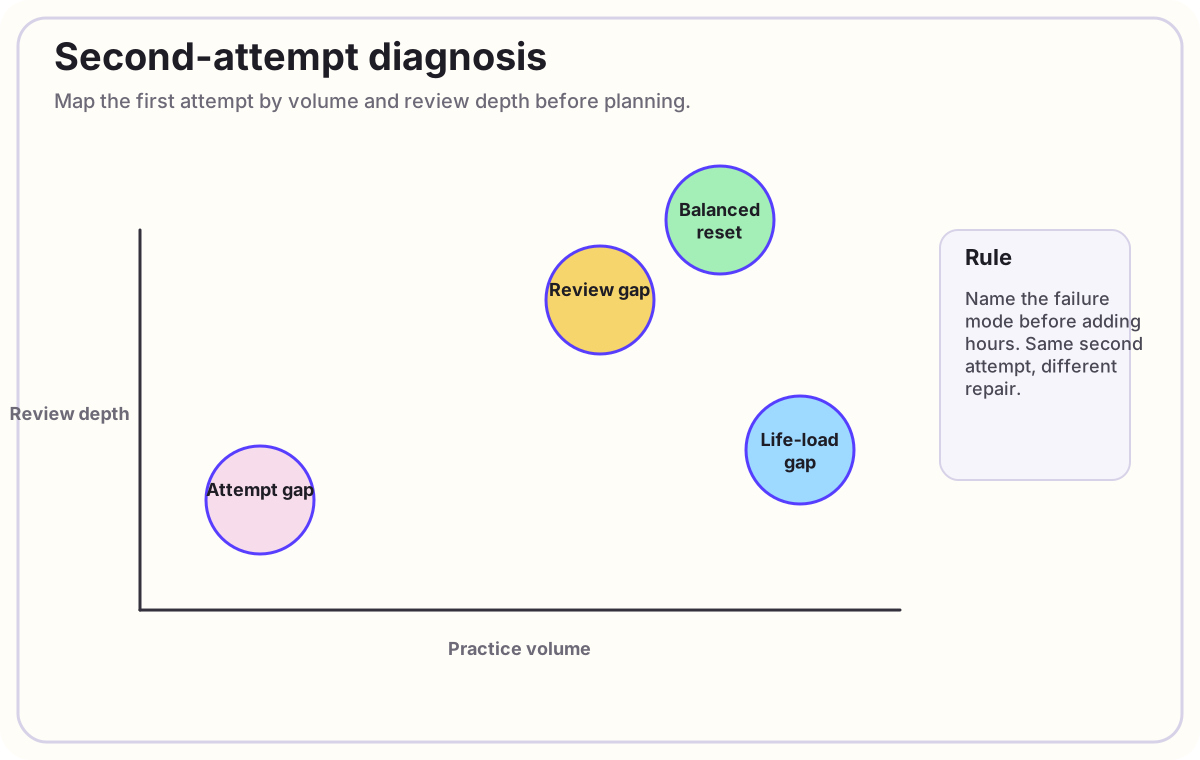
The three common patterns are attempt gap, review gap, and life-load gap. Attempt gap means you knew enough but chose badly under time. Review gap means the same error returned across mocks. Life-load gap means the plan ignored work, commute, or fatigue.
Write the diagnosis in one sentence. If it takes a paragraph, you are still describing the score rather than the cause.
Build a 9-month plan
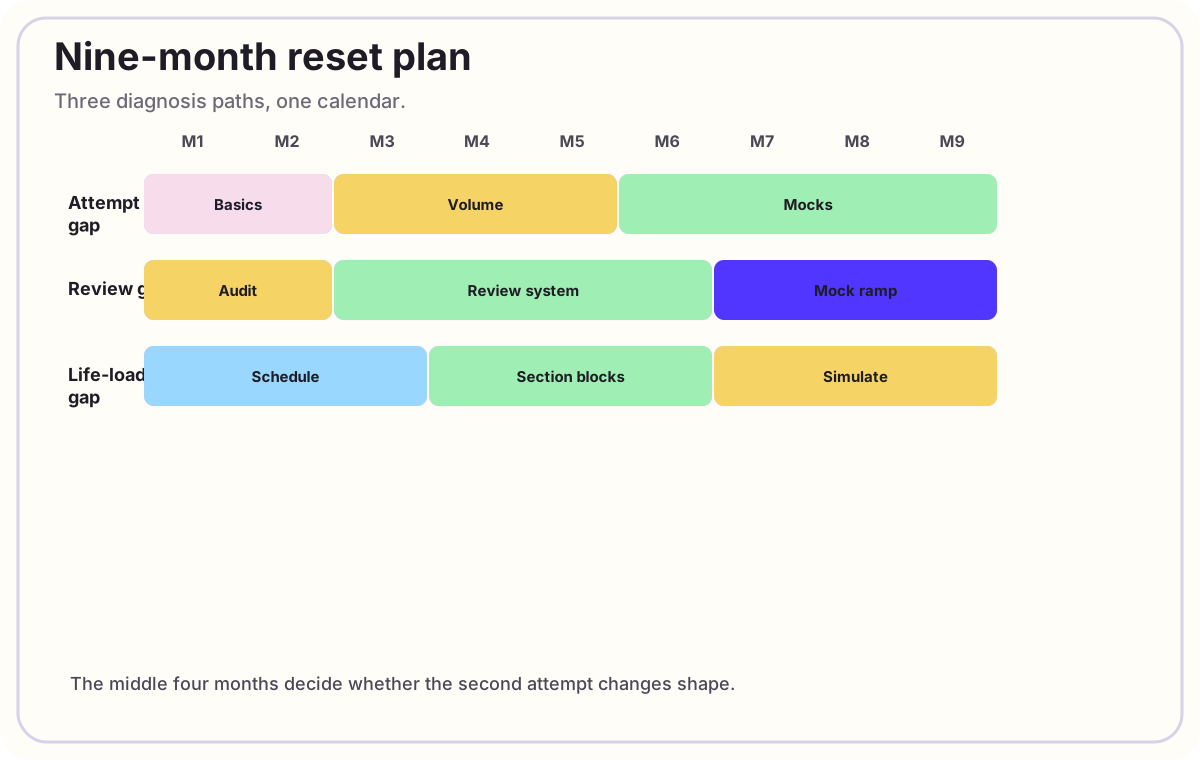
The first 2 months should repair foundations and weak topics. Months 3 and 4 should add section drills. Months 5 and 6 should begin full mocks. Months 7 and 8 should make review the main work. Month 9 should reduce new inputs and stabilise execution.
A second-attempt plan fails when it jumps to full mocks before the old error loop is repaired.
Reset the mock sheet
Do not carry forward a mock sheet that only records marks and percentile. Build a new sheet with error code, section, time loss, and repair action. This lets a mentor or self-review routine see whether the same failure is returning.
After 5 mocks, the sheet should show fewer repeated errors. If it does not, the plan is not repairing the root cause.
Change the calendar, not the personality
If the first attempt broke because of job load, the second plan must move hard work to the hours that survive the job. For many working professionals, this means two weekday focused blocks and one weekend review block, not daily heroic sessions.
Consistency comes from a schedule that respects constraints. Pretending the constraint is absent usually creates another failed month.
Decide whether a mentor is needed
A mentor is useful when the student cannot identify the repeating failure or cannot convert analysis into a new routine. The threshold is not emotion after one mock. It is evidence across 3 to 4 mocks.
Bring the error sheet, not only the percentile. A useful conversation begins with data.
The first-attempt post-mortem
Divide the first attempt into three possible failure modes. The first is content debt: topics were missing. The second is test-decision debt: topics were known, but selection and time allocation failed. The third is review debt: mocks were taken, but errors were not converted into repair drills. Each diagnosis needs a different 9-month plan [6], [7], [8].
The post-mortem should use the last 5 mocks, not memory. Mark each error as concept, calculation, set selection, time, or temperament. If one label dominates, that becomes the first 30-day repair. Without that evidence, the second attempt can become a repeat of the same preparation pattern.
A 9-month reset by diagnosis
For content debt, month 1 should rebuild fundamentals with 4 topic blocks per week. For review debt, month 1 should reduce new material and add a written error log after every practice set. For time-allocation debt, month 1 should add section tests with skip rules and post-test decision review. The calendar is different because the weakness is different.
A repeat candidate has one advantage: evidence. The first attempt leaves score sheets, attempted questions, abandoned sets, and section percentiles. Use that data before buying another resource or adding another mock series. The reset is successful when the first 30 days change the failure pattern, not when they feel busier.
How to protect confidence without pretending
Confidence does not come from ignoring the old score. It comes from seeing one measurable weakness move. Pick one indicator for the next 4 weeks: VARC accuracy, DILR set-selection hit rate, QA arithmetic error rate, or mock-review completion. Track only that indicator until it stabilises.
This is where a mentor or peer reviewer can help. The role is not motivation. The role is to keep the diagnosis specific and to prevent the candidate from changing the plan every time one mock feels bad.
FAQs
What is second attempt CAT?
second attempt CAT is the article's main operating idea. Read it as a decision rule with a number attached, not as a loose definition.
Which source should I trust first?
Use official CAT or institute pages for policy claims, then use coaching analyses for paper-pattern interpretation and academic studies for learning-strategy claims.
How often should this article be refreshed?
Refresh it once every CAT admission cycle, and sooner if an official institute policy page publishes a new PDF.
What is the practical next step?
Write the main number from this article into your mock sheet or shortlist sheet today, then check it after the next mock.
How does this link to Clymber preparation?
It turns a vague CAT-prep question into one measurable decision that can be reviewed by a student or mentor within 7 days.
Conclusion
Use this article as a working sheet, not only as a reading page. Record the main number for your target case, apply it to the next mock or shortlist decision, and review the result within 7 days.
Related reading
- /blog/situational-cat-preparation-guide
- /blog/cat-percentile-explained
- /plans/mentor-pro
- /plans/self-study
- /blog/cat-mock-test-playbook
References
- IIM CAT, "CAT official website." Available: https://iimcat.ac.in. Accessed: 15-Jun-2026. [2] 2IIM, "CAT previous year papers and CAT paper database." Available: https://online.2iim.com/CAT-question-paper/. Accessed: 15-Jun-2026. [3] Cracku, "CAT previous year papers and section-wise analysis." Available: https://cracku.in/cat-previous-papers. Accessed: 15-Jun-2026. [4] J. Dunlosky et al., "Improving students' learning with effective learning techniques." Available: https://journals.sagepub.com/doi/10.1177/1529100612453266. Accessed: 15-Jun-2026. [5] H. L. Roediger III and J. D. Karpicke, "Test-enhanced learning: taking memory tests improves long-term retention." Available: https://doi.org/10.1111/j.1467-9280.2006.01693.x. Accessed: 15-Jun-2026. [6] A. Reddy et al., "Spaced learning and retrieval practice in education." Available: https://pmc.ncbi.nlm.nih.gov/articles/PMC5126970/. Accessed: 15-Jun-2026. [7] IMS India, "CAT syllabus and exam pattern overview." Available: https://www.imsindia.com/blog/cat/cat-syllabus/. Accessed: 15-Jun-2026. [8] MBAUniverse, "CAT exam pattern and syllabus guide." Available: https://www.mbauniverse.com/cat/exam-pattern. Accessed: 15-Jun-2026. ↩