Topic Guide
Set theory in LR: the boundary cases that catch students
Set theory in CAT does not test whether you know the word “union.” It tests whether you see the boundary case. Empty intersections, complements, double-counting, and one-way inclusion create most wrong answers. Classify the boundary first; calculate after.
Set theory tests boundaries, not formula recital
Set theory in CAT LR usually looks small, but the boundary wording is doing the work. MBAUniverse lists Venn diagrams, syllogisms, and set-related logical reasoning under CAT LR coverage 3. The same ideas appear in arrangements, grouping, and selection caselets even when circles are not drawn.
Treat every set problem as a region-identification task first and an arithmetic task second.
The four boundary cases
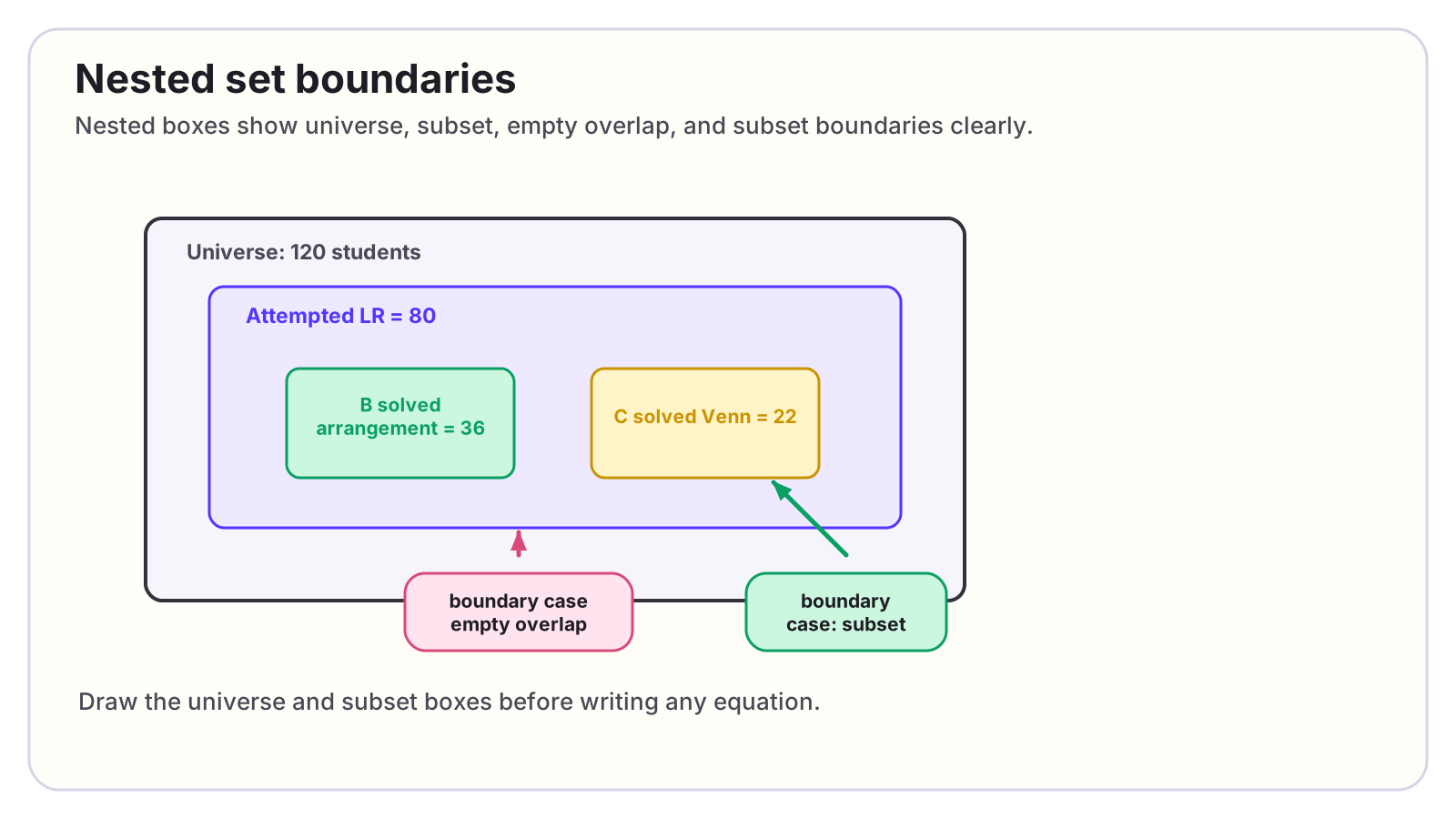
Empty intersection means two sets may not overlap even if the wording sounds related. Double-counting means an item sits in two groups. Complement traps ask outside the named set, not inside it. Asymmetric inclusion means “all A are B” does not imply “all B are A.”
Venn diagrams are useful because they represent all logical regions among sets 6. Use them to make these boundaries visible.
Worked example 1 - empty intersection
If 30 students take QA, 25 take VARC, and the statement says no student takes both, the intersection is 0. Do not create an overlap because the diagram shape has one. A Venn diagram shows possible overlap; the data decides whether the region contains members.
That distinction matters in LR because an empty region often creates a clean conclusion.
Worked example 2 - asymmetric inclusion
“All students who chose geometry also chose algebra” means Geometry is inside Algebra. It does not mean every algebra student chose geometry. If Algebra has 40 and Geometry has 12, the geometry circle sits inside algebra with 28 algebra-only students.
The inclusion-exclusion principle is useful for counts, but subset direction must be solved before the formula is used 7.
The common misread
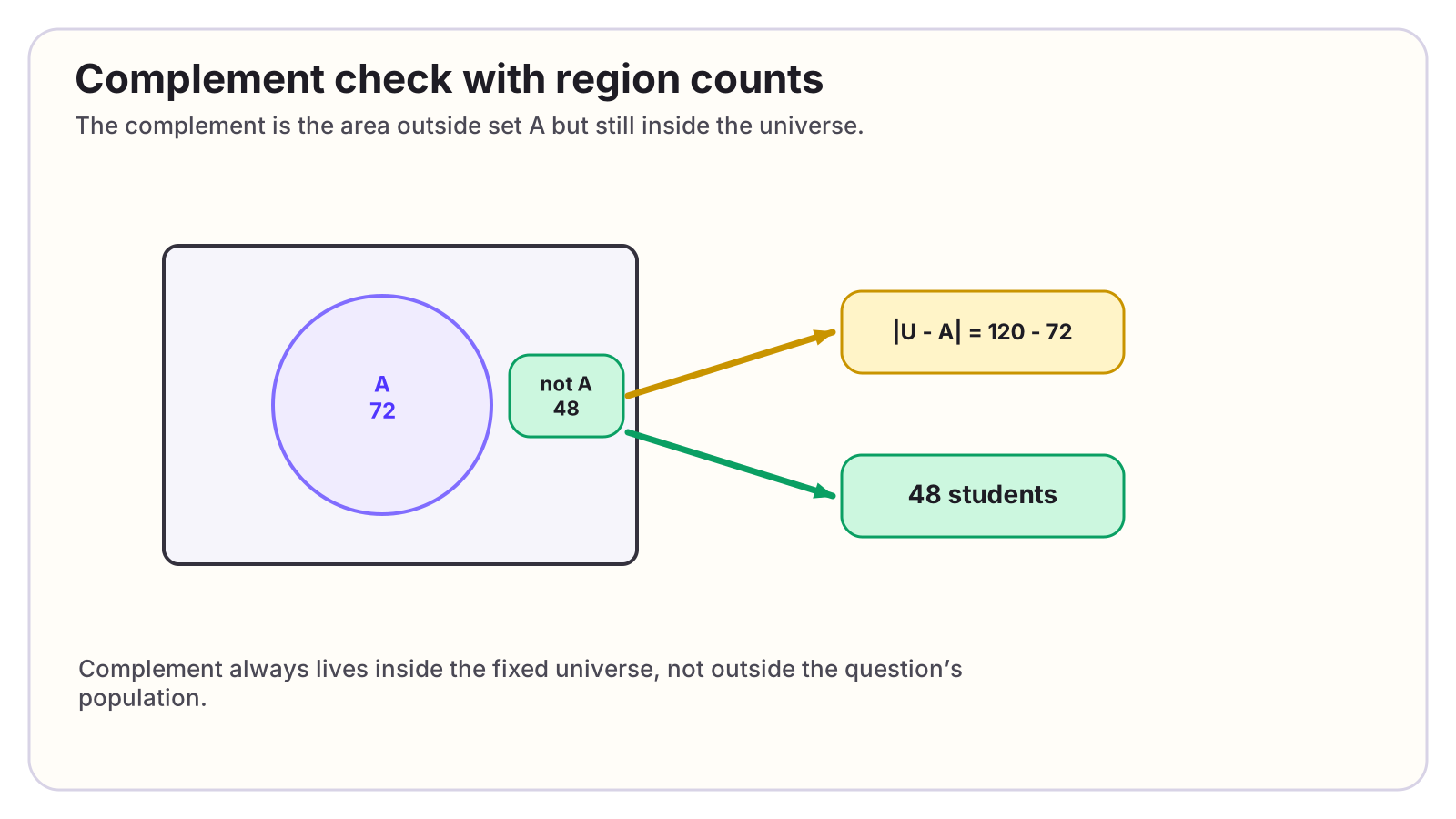
“Not A” means outside A within the stated universe. If the total population is not given, do not compute none. If the universe changes from “students in the class” to “students who attempted at least one section,” the complement changes too.
The official CAT site should be checked annually for format, but set-theory reasoning should be practised from past papers and current preparation analyses 1, 2.
Practice protocol - 4 items, 4 labels
Pull four set-theory items from CAT-style material. For each, write one label: empty, double-count, complement, or asymmetric. Then solve. Practice testing strengthens later retrieval, so do the label before reading any solution 8.
After one week, your target is not only correct answers. It is correct labels before calculation.
FAQs
What are set-theory questions in CAT LR?
They are logical reasoning questions involving groups, overlaps, complements, subsets, and counts.
What is the biggest set-theory trap?
Using complement language without defining the universe. “Not A” depends on what total set is being considered.
How do I handle “all A are B”?
Draw A inside B. Do not reverse the relationship unless the question states it.
Do I need inclusion-exclusion for every set problem?
No. Use inclusion-exclusion for counts. Use diagrams and subset direction for logic.
How should I practise set theory?
Classify each item into one of four boundary cases before solving: empty, double-count, complement, asymmetric.
Conclusion
Pull 4 set-theory items and classify each before solving. Your target is one label per item: empty, double-count, complement, or asymmetric.
Related reading
References
- Indian Institutes of Management, "CAT official website," 2026. [Online]. Available: https://iimcat.ac.in/. Accessed: Jun. 14, 2026. ↩
- 2IIM, "CAT previous year question papers (2017-2025) with solutions," 2026. [Online]. Available: https://online.2iim.com/CAT-question-paper/. Accessed: Jun. 14, 2026. ↩
- MBAUniverse, "CAT 2026 syllabus: section-wise topics and 5-year weightage analysis," 2026. [Online]. Available: https://www.mbauniverse.com/cat/syllabus. Accessed: Jun. 14, 2026. ↩
- Cracku, "CAT exam syllabus 2025," 2026. [Online]. Available: https://cracku.in/cat-exam-syllabus/. Accessed: Jun. 14, 2026. ↩
- IMS India, "CAT syllabus 2026: sections, topics, weightage, and exam pattern," 2026. [Online]. Available: https://www.imsindia.com/blog/cat/cat-syllabus/. Accessed: Jun. 14, 2026. ↩
- Encyclopaedia Britannica, "Venn diagram," 2026. [Online]. Available: https://www.britannica.com/science/Venn-diagram. Accessed: Jun. 14, 2026. ↩
- Encyclopaedia of Mathematics / standard combinatorics reference, "Inclusion-exclusion principle," 2026. [Online]. Available: https://encyclopediaofmath.org/wiki/Inclusion-and-exclusion_principle. Accessed: Jun. 14, 2026. ↩
- H. L. Roediger III and J. D. Karpicke, "Test-enhanced learning: Taking memory tests improves long-term retention," Psychological Science, vol. 17, no. 3, pp. 249-255, 2006. [Online]. Available: https://doi.org/10.1111/j.1467-9280.2006.01693.x. Accessed: Jun. 14, 2026. ↩