Topic Guide
Venn diagrams for CAT: the 3-set discipline
A Venn caselet is solved by order, not by the formula alone. Fill the centre, then pairwise regions, then singles, and only then compute the outside region. If you change that order, the same number gets counted twice. The diagram should make the arithmetic boring.
The 3-set template - 60 seconds to label regions
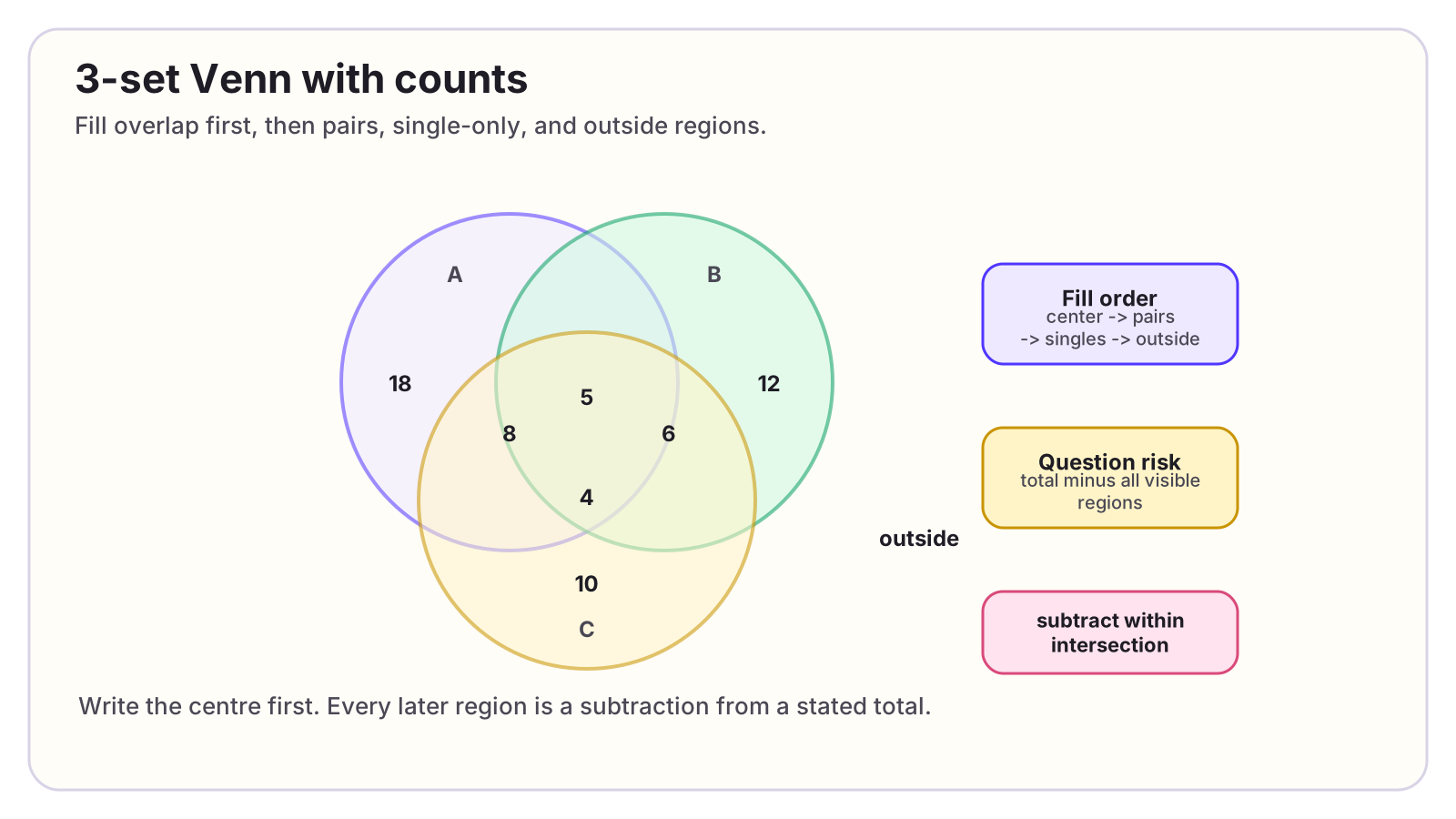
A three-set Venn diagram has 7 internal regions plus the outside region. Draw and label them before reading the full caselet: A only, B only, C only, AB only, AC only, BC only, ABC, and none. Encyclopaedia Britannica describes Venn diagrams as visual tools for relationships among sets 6. In CAT DILR, that visual clarity prevents double-counting.
The first 60 seconds should produce a blank but labelled template.
Fill order - center, pairs, singles
Fill the centre first because triple intersection is included inside every pairwise intersection. Then fill pairwise-only regions by subtracting the centre from pair totals. Then fill singles by removing pairwise-only and centre regions from each set total. Finally, compute none if total population is given.
The inclusion-exclusion principle formalises the correction: add singles, subtract pairs, add the triple intersection 7.
Inclusion-exclusion with a worked example
Suppose 100 students are surveyed. A = 50, B = 45, C = 40, AB = 20, AC = 15, BC = 10, ABC = 5. The union is 50 + 45 + 40 - 20 - 15 - 10 + 5 = 95. Therefore, 5 students are in none. On the diagram, pairwise-only values are 15, 10, and 5 after subtracting the centre.
This worked check catches most arithmetic slips before questions begin.
Common Venn trap patterns
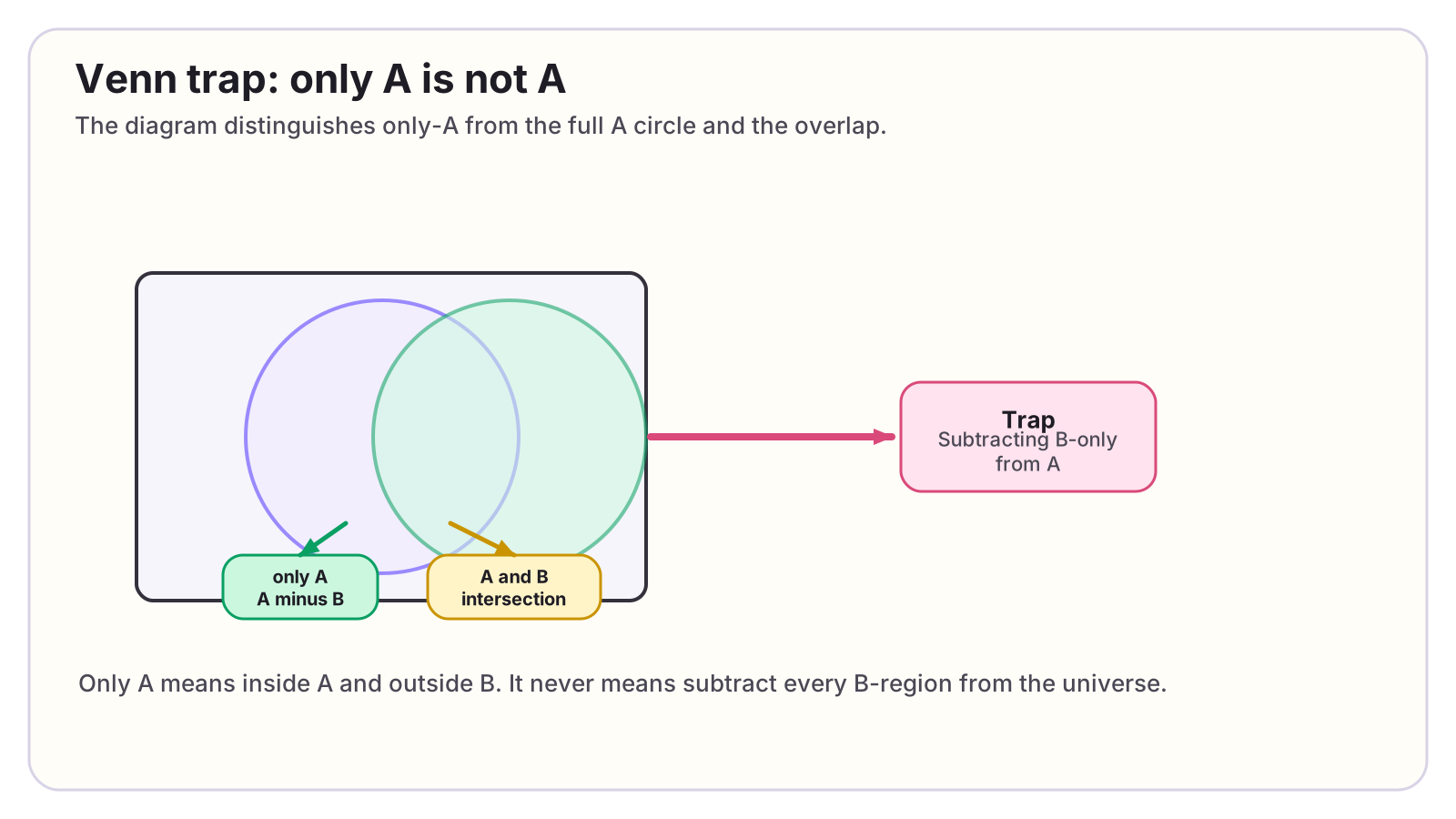
“Only A” means A with no B and no C. “A and B” often includes those also in C unless the question says “only A and B.” “At least one” is the union. “None” is outside all sets. MBAUniverse includes Venn diagrams under logical reasoning topics 3, and IMS notes complex multi-set Venns as a recent DILR trend 5.
Underline the region word before writing numbers.
When the diagram is not enough
If the problem gives relationships rather than direct counts, assign variables to unknown regions. Keep the same fill order, but write equations instead of values. Do not place a value into a region until its scope is resolved.
The official CAT site is still the annual test authority 1, but DILR topic practice should come from solved paper banks and reputable analysis because CAT does not publish a fixed syllabus 2.
Practice routine - 7-minute target
Attempt one 3-set Venn caselet under 7 minutes. Spend the first minute drawing and labelling. Spend the final 30 seconds checking that the region totals sum to the population. Roediger and Karpicke’s work supports attempt-first practice; review should begin after the timed attempt 8.
Your log should record whether the error came from wording or arithmetic.
FAQs
What is the correct order for CAT Venn diagrams?
Fill the centre first, pairwise-only regions second, singles third, and the outside region last.
What is the inclusion-exclusion formula for 3 sets?
Union equals A plus B plus C minus AB minus AC minus BC plus ABC.
What does “only A” mean in a Venn problem?
It means the region inside A but outside B and outside C.
How much time should a 3-set Venn caselet take?
Train toward a 7-minute cap for standard caselets, with a final total check.
Should I memorise formulas or draw diagrams?
Do both. The formula checks the total; the diagram answers region-specific questions.
Conclusion
Solve one 3-set Venn caselet today. Use the centre-pair-single order and finish by checking that all regions sum to the stated population.
Related reading
References
- Indian Institutes of Management, "CAT official website," 2026. [Online]. Available: https://iimcat.ac.in/. Accessed: Jun. 14, 2026. ↩
- 2IIM, "CAT previous year question papers (2017-2025) with solutions," 2026. [Online]. Available: https://online.2iim.com/CAT-question-paper/. Accessed: Jun. 14, 2026. ↩
- MBAUniverse, "CAT 2026 syllabus: section-wise topics and 5-year weightage analysis," 2026. [Online]. Available: https://www.mbauniverse.com/cat/syllabus. Accessed: Jun. 14, 2026. ↩
- Cracku, "CAT exam syllabus 2025," 2026. [Online]. Available: https://cracku.in/cat-exam-syllabus/. Accessed: Jun. 14, 2026. ↩
- IMS India, "CAT syllabus 2026: sections, topics, weightage, and exam pattern," 2026. [Online]. Available: https://www.imsindia.com/blog/cat/cat-syllabus/. Accessed: Jun. 14, 2026. ↩
- Encyclopaedia Britannica, "Venn diagram," 2026. [Online]. Available: https://www.britannica.com/science/Venn-diagram. Accessed: Jun. 14, 2026. ↩
- Encyclopaedia of Mathematics / standard combinatorics reference, "Inclusion-exclusion principle," 2026. [Online]. Available: https://encyclopediaofmath.org/wiki/Inclusion-and-exclusion_principle. Accessed: Jun. 14, 2026. ↩
- H. L. Roediger III and J. D. Karpicke, "Test-enhanced learning: Taking memory tests improves long-term retention," Psychological Science, vol. 17, no. 3, pp. 249-255, 2006. [Online]. Available: https://doi.org/10.1111/j.1467-9280.2006.01693.x. Accessed: Jun. 14, 2026. ↩