Quick Read
Truth-liar puzzles in CAT LR: the 4-statement system
Truth-liar puzzles are not solved by reading the statements again and again. They are contradiction systems. Assume one strong statement, propagate what follows, break impossible branches, and verify the survivor. The 4-statement table keeps that logic visible under time.
Truth-liar puzzles are contradiction systems
Truth-liar puzzles are not solved by rereading the story until it feels clear. They are solved by assuming a statement, propagating consequences, and breaking impossible branches. DILR puzzle types vary by year, so the official CAT site is the annual authority for format while past papers supply practice sets 1, 2.
Your page should show a state table before it shows a final answer.
The 4-statement system
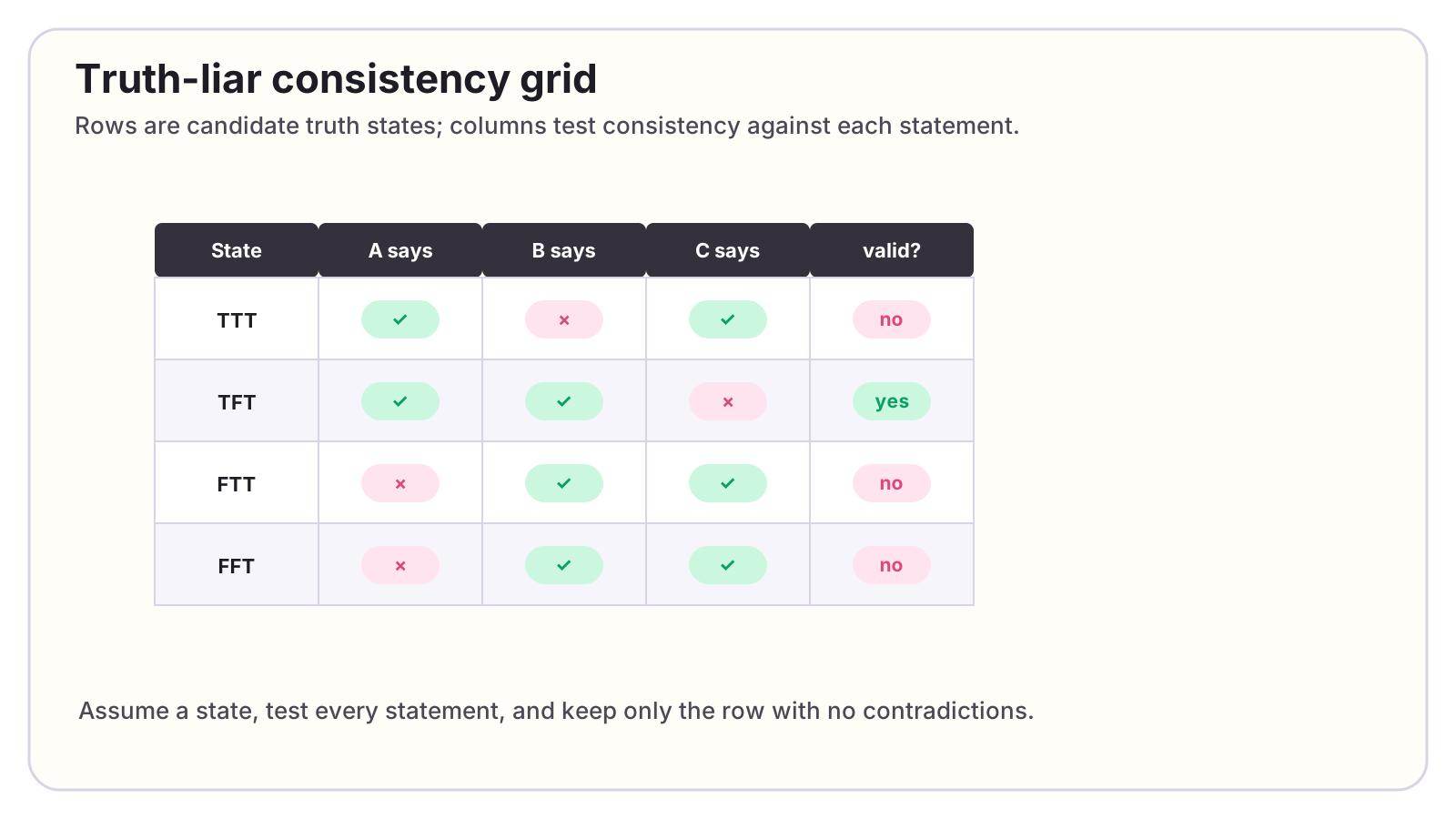
Step 1: choose a statement that names two people or creates a strong condition. Step 2: assume it true and propagate consequences. Step 3: if a contradiction appears, flip it. Step 4: verify every statement under the surviving branch.
This method fits CAT because it stops open-ended speculation. It makes every branch visible.
Worked example - break the assumption
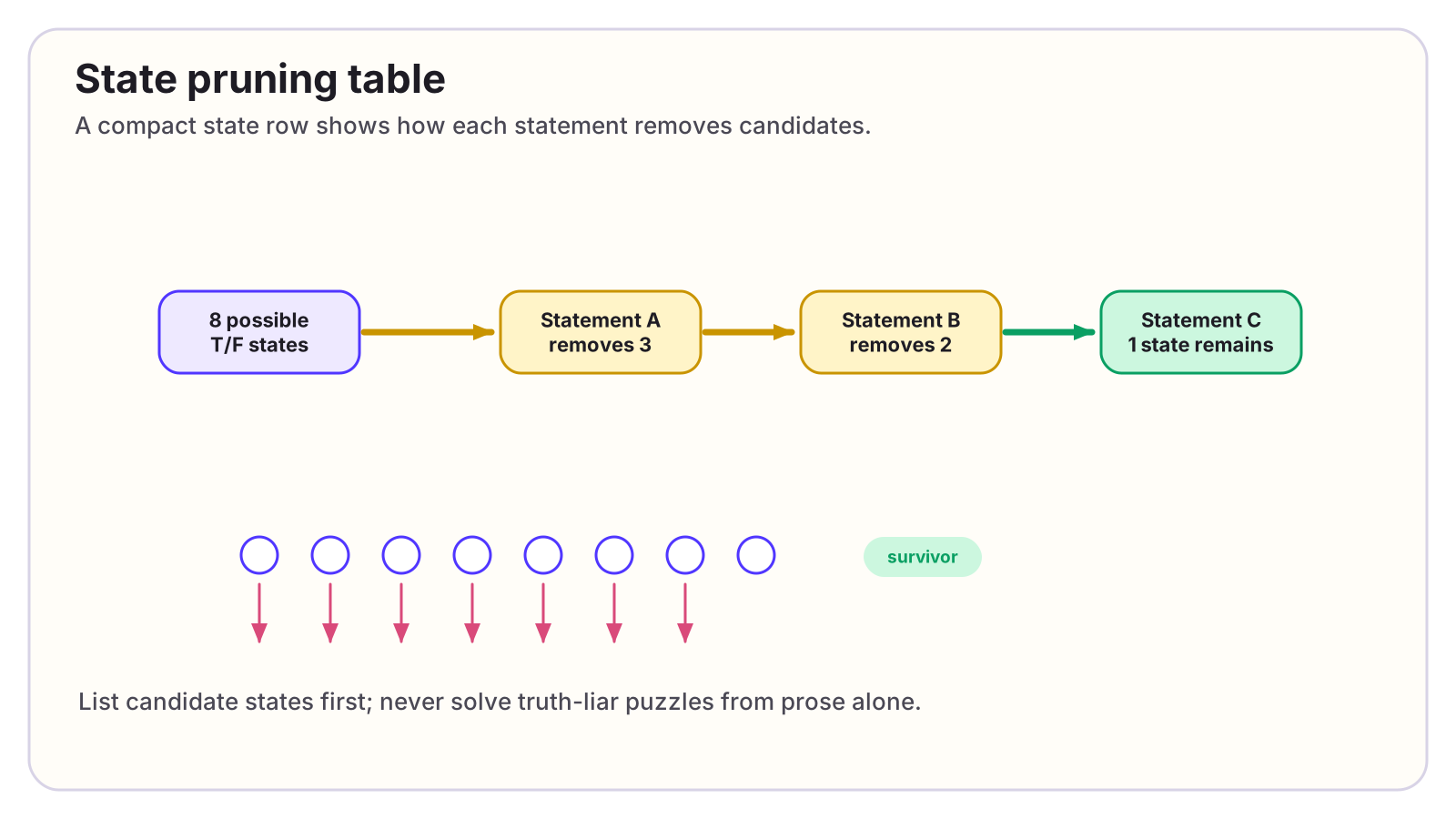
Suppose S1 says A tells truth, S2 says B lies, S3 says A and B have the same status, and S4 says exactly one of S1-S3 is true. Assume S1 true. Then A is truthful, which forces consistency with S3 if A states it. If the branch creates two true statements when S4 allows one, the branch breaks.
Use a table so the contradiction is visible rather than felt.
Where the system fails
The 4-statement system needs an extra row when the question says exactly two liars, at least one truth-teller, or no two adjacent statements have the same truth value. Add a count row at the bottom and update it after every branch.
MBAUniverse and IMS include puzzles and analytical reasoning under DILR preparation coverage 3, 5. Truth-liar items belong to that broader logic family.
Review rule - keep the first wrong assumption
Do not erase failed branches during practice. Circle the first assumption that broke and write why. Roediger and Karpicke’s test-enhanced learning research supports effortful recall and correction 7. A clean final solution without the failed branch teaches less.
For production content, include one failed branch in the worked example so the student sees the method.
Practice routine - 4-minute cap
Attempt one truth-liar item with a 4-minute cap. Spend 45 seconds making the state table, 2 minutes branching, and 75 seconds verifying. Dunlosky et al. support practice testing as a strong learning technique 6, so the attempt should come before explanation.
If you cannot write the table in 45 seconds, drill setup rather than harder puzzles.
FAQs
How do I solve truth-liar puzzles for CAT?
Use a state table. Assume one high-force statement, propagate consequences, break contradictions, then verify all statements.
How much time should a truth-liar item take?
Train with a 4-minute cap: 45 seconds for table setup, 2 minutes for branches, 75 seconds for verification.
What is a high-force statement?
It is a statement that directly fixes a person’s truth status or connects two statuses.
What if the puzzle gives exactly two liars?
Add a count row to the table and update it after each branch.
How should I review these puzzles?
Keep the first failed assumption and write the contradiction that broke it.
Conclusion
Attempt one truth-liar puzzle with a 4-minute cap. Keep the failed branch in your notebook; it is the part that teaches the method.
Related reading
References
- Indian Institutes of Management, "CAT official website," 2026. [Online]. Available: https://iimcat.ac.in/. Accessed: Jun. 14, 2026. ↩
- 2IIM, "CAT previous year question papers (2017-2025) with solutions," 2026. [Online]. Available: https://online.2iim.com/CAT-question-paper/. Accessed: Jun. 14, 2026. ↩
- MBAUniverse, "CAT 2026 syllabus: section-wise topics and 5-year weightage analysis," 2026. [Online]. Available: https://www.mbauniverse.com/cat/syllabus. Accessed: Jun. 14, 2026. ↩
- Cracku, "CAT exam syllabus 2025," 2026. [Online]. Available: https://cracku.in/cat-exam-syllabus/. Accessed: Jun. 14, 2026. ↩
- IMS India, "CAT syllabus 2026: sections, topics, weightage, and exam pattern," 2026. [Online]. Available: https://www.imsindia.com/blog/cat/cat-syllabus/. Accessed: Jun. 14, 2026. ↩
- J. Dunlosky, K. A. Rawson, E. J. Marsh, M. J. Nathan, and D. T. Willingham, "Improving students’ learning with effective learning techniques: Promising directions from cognitive and educational psychology," Psychological Science in the Public Interest, vol. 14, no. 1, pp. 4-58, 2013. [Online]. Available: https://journals.sagepub.com/doi/10.1177/1529100612453266. Accessed: Jun. 14, 2026. ↩
- H. L. Roediger III and J. D. Karpicke, "Test-enhanced learning: Taking memory tests improves long-term retention," Psychological Science, vol. 17, no. 3, pp. 249-255, 2006. [Online]. Available: https://doi.org/10.1111/j.1467-9280.2006.01693.x. Accessed: Jun. 14, 2026. ↩
- Encyclopaedia Britannica, "Venn diagram," 2026. [Online]. Available: https://www.britannica.com/science/Venn-diagram. Accessed: Jun. 14, 2026. ↩