Pillar Guide
CAT exam day strategy
Exam day is not the moment to invent a strategy. It is the moment to run the system you have already tested. The score comes from what you attempt, what you skip, and when you stop spending time on a question that no longer deserves it.
The first task is controlling the clock
A clock plan is more reliable than a confidence plan. 2
Use this checkpoint before adding more unsorted practice or applications.
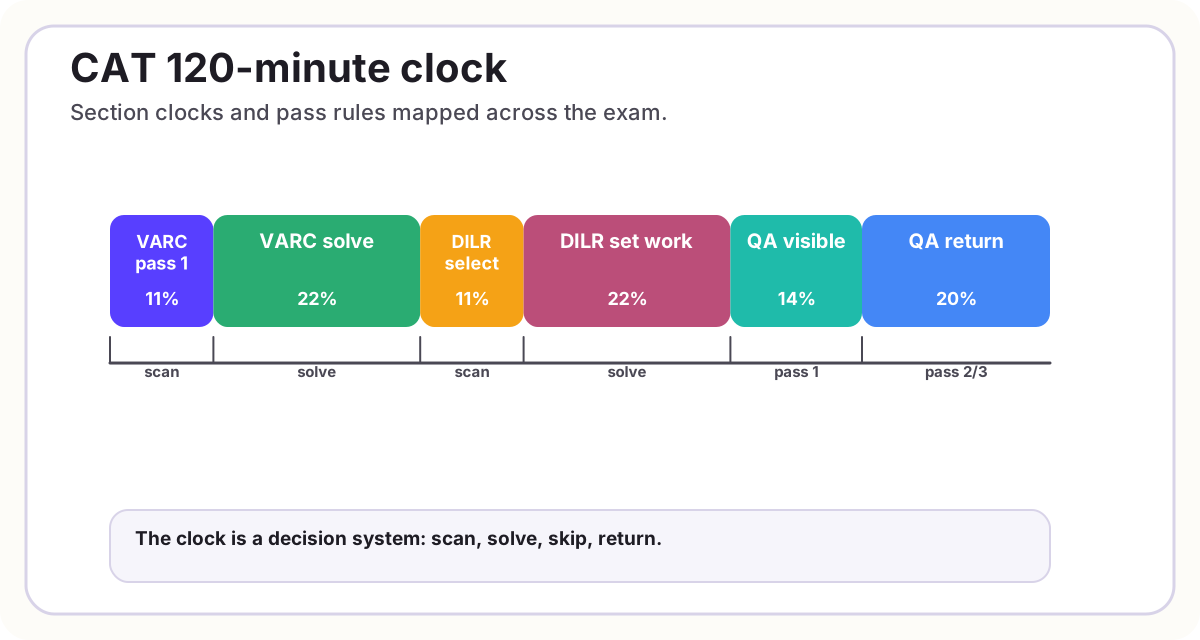
The 3-pass method reduces damage
The system protects time from one sticky question. 3
Use this checkpoint before adding more unsorted practice or applications.
TITA needs a different risk rule
No negative marking does not mean no cost. 4
Use this checkpoint before adding more unsorted practice or applications.
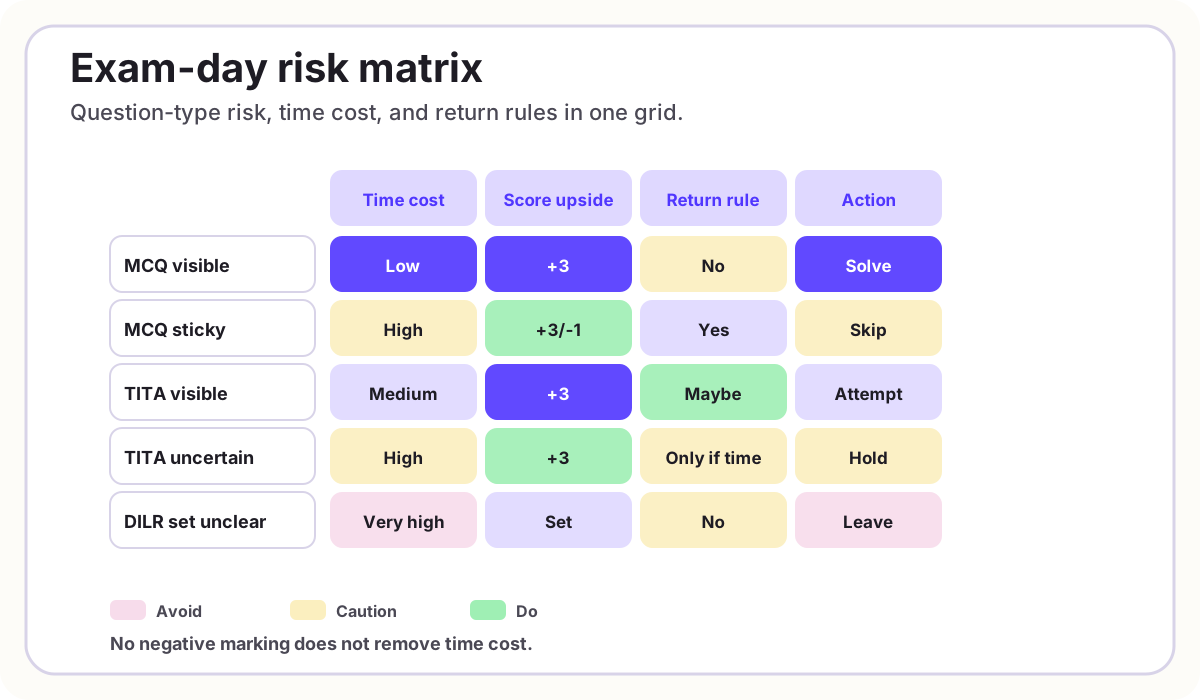
RC and DILR need early abandonment rules
Leaving a bad set is a scored decision. 5
Use this checkpoint before adding more unsorted practice or applications.
Exam-day notes must fit one page
The plan must be short enough to recall. 6
Use this checkpoint before adding more unsorted practice or applications.
Your next action is a full-dress mock
Practice logistics before the actual day. 7
Use this checkpoint before adding more unsorted practice or applications.
FAQs
What is the best CAT exam day strategy?
Use a section-wise clock plan with scan, solve, skip, and return rules.
Should I attempt all TITA questions?
No. TITA has no negative marking cost, but it has time cost.
How many passes should I use in a section?
Use 3 passes: visible, medium, selected return.
When should I leave a DILR set?
Leave if the structure is not visible within your first-read cutoff.
What should I practise before exam day?
Do one full-dress mock with the same slot, food, breaks, and scratchpad routine.
Conclusion
Run CAT exam day with a section-wise clock plan and 3-pass attempt system. Start with the article's numeric anchor today and update it after your next mock or source check.
Related reading
References
- IIM CAT, "Common Admission Test official website," 2025. Available: https://iimcat.ac.in/ ↩
- J. Dunlosky et al., "Improving Students’ Learning With Effective Learning Techniques," Psychological Science in the Public Interest, 2013. Available: https://journals.sagepub.com/doi/10.1177/1529100612453266 ↩
- H. L. Roediger and J. D. Karpicke, "Test-enhanced learning," Psychological Science, 2006. Available: https://doi.org/10.1111/j.1467-9280.2006.01693.x ↩
- IIM Ahmedabad, "Admission - MBA (Indian), PGP 2026-28 selection process," 2025. Available: https://www.iima.ac.in/academics/mba/admissions/indians ↩
- XLRI, "XAT 2026 official website and overview," 2026. Available: https://xatonline.in/ ↩
- Symbiosis International University, "SNAP Test official website," 2025. Available: https://www.snaptest.org/ ↩
- IIM Bangalore, "PGP admission process," 2026. Available: https://www.iimb.ac.in/programmes/post-graduate-programme-management ↩
- IIM Calcutta, "MBA admission policy for domestic candidates," 2026. Available: https://www.iimcal.ac.in/programs/pgp/admission-policy/admission-procedure-for-domestic-candidates ↩