Topic Guide
DI tables and graphs for CAT: read labels before calculating
DI errors often look like arithmetic errors, but the first mistake is label reading. The current CAT pattern is built around three timed sections, and recent public analyses report 68 questions across VARC, DILR, and QA with 40 minutes per section 1[3][4]. Previous-paper databases are the best practice base because they preserve real section phrasing, slot variation, and TITA/MCQ mix [2]. The plan below uses that exam structure plus learning-science evidence on retrieval and spaced review [6][7][8].
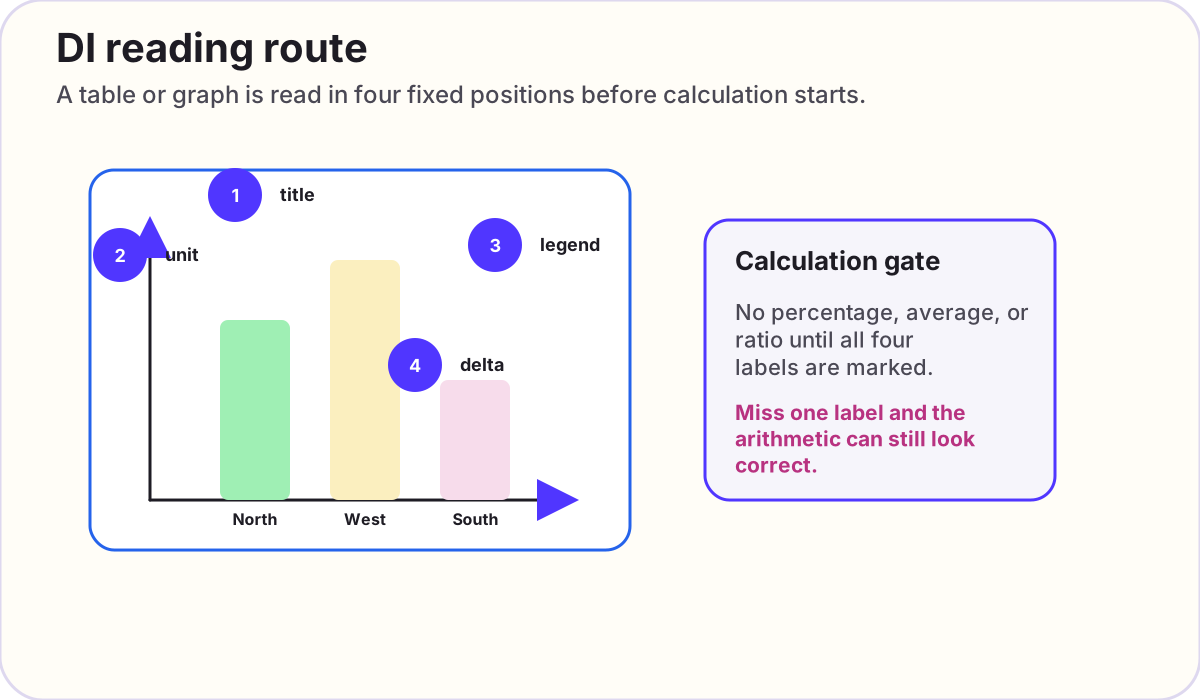
Read title and unit first
The title tells you what the data measures; the unit tells you how to compare. A value of 120 can mean crore, index points, percentage, or number of students. Arithmetic without a unit is a gamble. This links to the section and question-type structure reported by CAT-pattern sources [3][4][5].
Convert to the asked scale
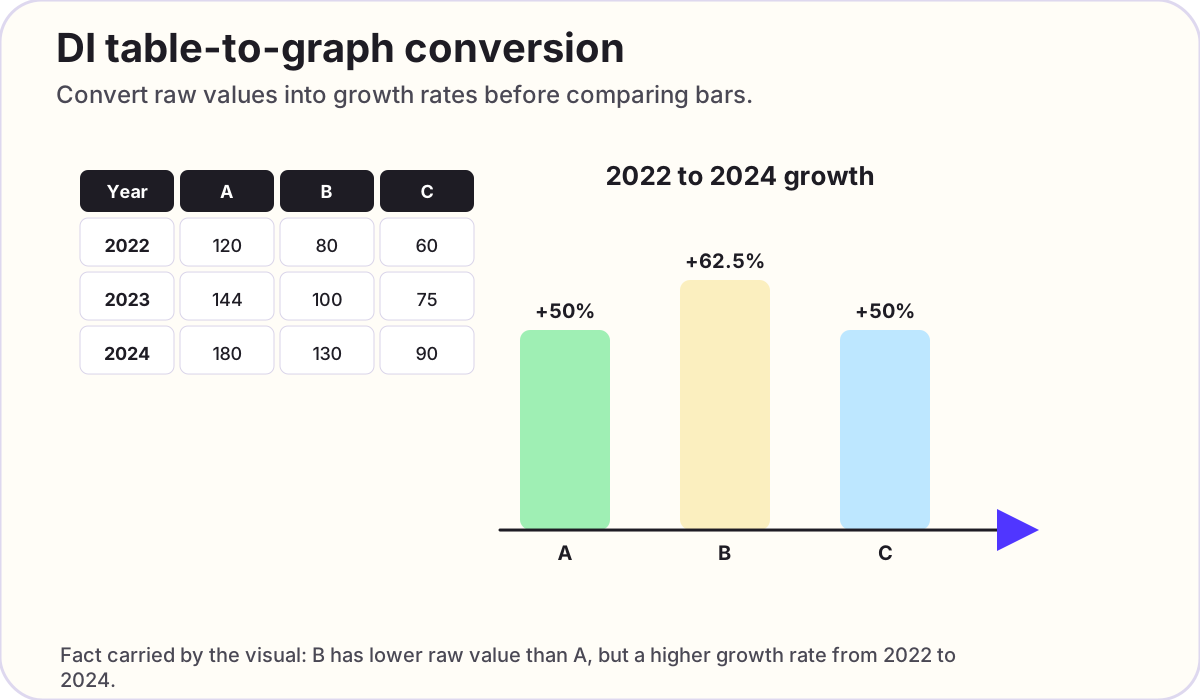
CAT DI commonly asks growth, share, difference, ratio, or weighted average. Convert the table to the scale asked by the question before comparing options. A lower raw value can still have higher growth. Check the rule against previous CAT papers instead of isolated drills [2].
Mark row and column totals
In tables, totals are anchors. In graphs, axes and legends are anchors. Mark them before calculating. This is especially useful when one set combines tables with bars or caselet prose. The official CAT interface and timed-section design make this a practical constraint, not a stylistic preference 1[3].
Use approximation deliberately
Approximation is safe when options are separated. It is unsafe when options differ by less than 2-3 percentage points. Train both exact and approximate paths. The review step is also consistent with evidence that testing and retrieval improve durable learning [6][7].
Build a unit-error ledger
Every DI review should log whether the miss came from unit, base, row, column, or arithmetic. This categorisation converts a vague calculation problem into a repair plan. Spaced review prevents one-session performance from being mistaken for stable skill [8].
FAQs
What should I read first in a DI table?
Read title, unit, row labels, and column labels before doing arithmetic.
How do I avoid DI calculation errors?
Convert values to the asked scale and mark the base before calculating percentages or ratios.
Are graphs harder than tables in CAT DILR?
Not always. Mixed graphs are hard when the unit or base changes.
Should I approximate in DI?
Approximate when options are far apart; calculate exactly when options are close.
What should my DI review log contain?
Track unit errors, base errors, row-column errors, and arithmetic errors separately.
Conclusion
Use the first diagram as your next drill plan, then review the result within 24 hours and repeat the same rule for 3 timed sets.
Related reading
- di caselets cat
- dilr strategy cat 2026
- di calculation shortcuts cat
- cat mock analysis
- dilr set selection cat
References
- IIMCAT, "CAT 2025 official portal." Available: https://iimcat.ac.in/ [2] 2IIM, "CAT previous year question papers, 2017-2025." Available: https://online.2iim.com/CAT-question-paper/ [3] IMS India, "CAT exam pattern 2026: sections, question types, and marks." Available: https://www.imsindia.com/blog/cat/cat-exam-pattern/ [4] MBAUniverse, "CAT exam pattern: sections, questions, duration, and marking scheme." Available: https://www.mbauniverse.com/cat/pattern [5] IMS India, "CAT syllabus 2026: section-wise topics and weightage." Available: https://www.imsindia.com/blog/cat/cat-syllabus/ [6] J. Dunlosky, K. A. Rawson, E. J. Marsh, M. J. Nathan, and D. T. Willingham, "Improving students' learning with effective learning techniques," Psychological Science in the Public Interest, 2013. Available: https://doi.org/10.1177/1529100612453266 [7] H. L. Roediger and J. D. Karpicke, "Test-enhanced learning: taking memory tests improves long-term retention," Psychological Science, 2006. Available: https://doi.org/10.1111/j.1467-9280.2006.01693.x [8] S. Reddy, I. Labutov, S. Banerjee, and T. Joachims, "Unbounded human learning: optimal scheduling for spaced repetition," arXiv, 2016. Available: https://arxiv.org/abs/1602.07032 ↩