Topic Guide
LR grouping and scheduling for CAT: draw positions, not paragraphs
Grouping questions are solved on positions, not in prose. The current CAT pattern is built around three timed sections, and recent public analyses report 68 questions across VARC, DILR, and QA with 40 minutes per section 1[3][4]. Previous-paper databases are the best practice base because they preserve real section phrasing, slot variation, and TITA/MCQ mix [2]. The plan below uses that exam structure plus learning-science evidence on retrieval and spaced review [6][7][8].
Name the dimensions
Before drawing, identify dimensions: people, days, rooms, teams, tasks, or ranks. A scheduling set usually has at least two dimensions; a hybrid set may have three. Missing one dimension creates messy notes. This links to the section and question-type structure reported by CAT-pattern sources [3][4][5].
Draw the empty board first
Create the grid or slots before reading all clues. This gives every clue a place to land. It also shows whether a clue is fixed, relative, negative, or conditional. Check the rule against previous CAT papers instead of isolated drills [2].
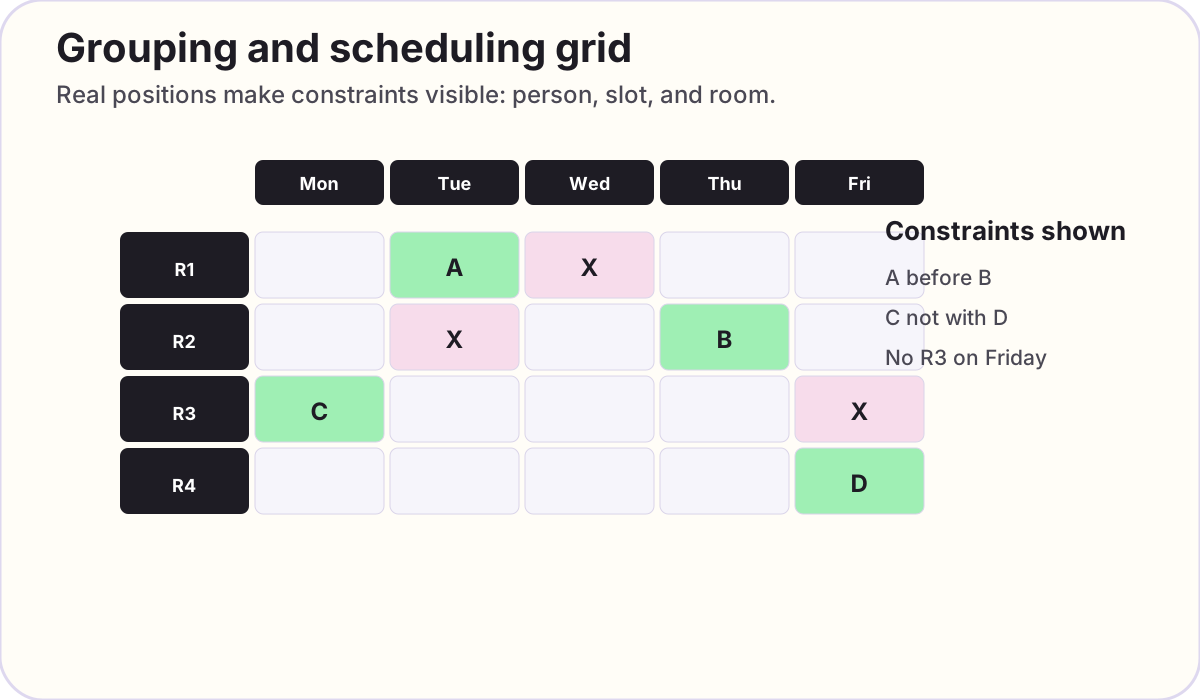
Separate fixed and relative clues
Fixed clues place an entity. Relative clues place a relation. Do not force a relative clue into a fixed cell too early. Mark it as an arrow or bracket until another clue pins it down. The official CAT interface and timed-section design make this a practical constraint, not a stylistic preference 1[3].
Use exclusion marks sparingly
Too many X marks create noise. Mark only exclusions that cut the search space materially: no R3 on Friday, A not with D, or B before C. The review step is also consistent with evidence that testing and retrieval improve durable learning [6][7].
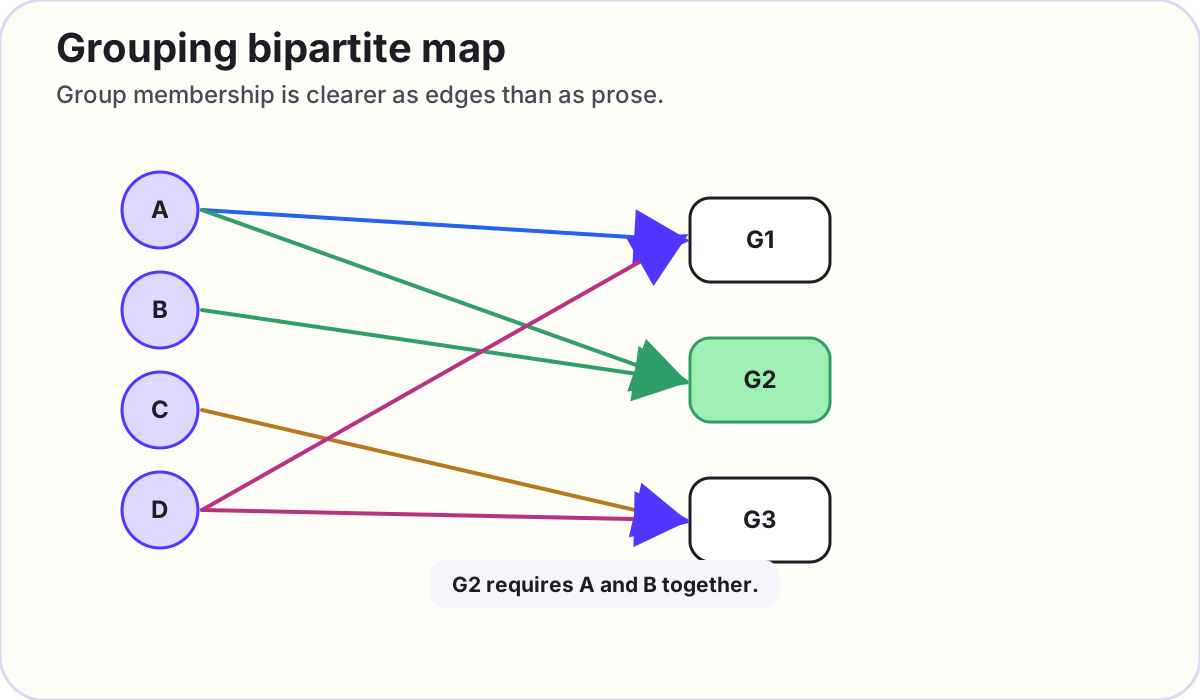
Review the branching point
Most grouping sets have one branch that splits the solution. After practice, identify where you branched and whether there was a cleaner trigger. Spaced review prevents one-session performance from being mistaken for stable skill [8].
FAQs
What is LR grouping in CAT?
It is a logical reasoning set where entities must be assigned to groups, slots, rooms, or schedules under constraints.
Should I use a table or diagram for grouping?
Use a table when dimensions are fixed; use a graph when membership relations matter more than order.
How do I avoid messy LR notes?
Draw the empty board first, then place clues by type.
What is a relative clue?
A clue that says one entity is before, after, with, or apart from another entity.
How should I review grouping sets?
Review the first branch point and the clues that should have reduced it.
Conclusion
Use the first diagram as your next drill plan, then review the result within 24 hours and repeat the same rule for 3 timed sets.
Related reading
- lr arrangements cat
- dilr strategy cat 2026
- games tournaments lr cat
- set theory lr cat
- dilr set selection cat
References
- IIMCAT, "CAT 2025 official portal." Available: https://iimcat.ac.in/ [2] 2IIM, "CAT previous year question papers, 2017-2025." Available: https://online.2iim.com/CAT-question-paper/ [3] IMS India, "CAT exam pattern 2026: sections, question types, and marks." Available: https://www.imsindia.com/blog/cat/cat-exam-pattern/ [4] MBAUniverse, "CAT exam pattern: sections, questions, duration, and marking scheme." Available: https://www.mbauniverse.com/cat/pattern [5] IMS India, "CAT syllabus 2026: section-wise topics and weightage." Available: https://www.imsindia.com/blog/cat/cat-syllabus/ [6] J. Dunlosky, K. A. Rawson, E. J. Marsh, M. J. Nathan, and D. T. Willingham, "Improving students' learning with effective learning techniques," Psychological Science in the Public Interest, 2013. Available: https://doi.org/10.1177/1529100612453266 [7] H. L. Roediger and J. D. Karpicke, "Test-enhanced learning: taking memory tests improves long-term retention," Psychological Science, 2006. Available: https://doi.org/10.1111/j.1467-9280.2006.01693.x [8] S. Reddy, I. Labutov, S. Banerjee, and T. Joachims, "Unbounded human learning: optimal scheduling for spaced repetition," arXiv, 2016. Available: https://arxiv.org/abs/1602.07032 ↩