Topic Guide
Sentence completion for CAT: grammar slot first, meaning second
Sentence completion is not a vocabulary game; it is a slot-fitting task. The current CAT pattern is built around three timed sections, and recent public analyses report 68 questions across VARC, DILR, and QA with 40 minutes per section 1[3][4]. Previous-paper databases are the best practice base because they preserve real section phrasing, slot variation, and TITA/MCQ mix [2]. The plan below uses that exam structure plus learning-science evidence on retrieval and spaced review [6][7][8].
Start with the blank's job
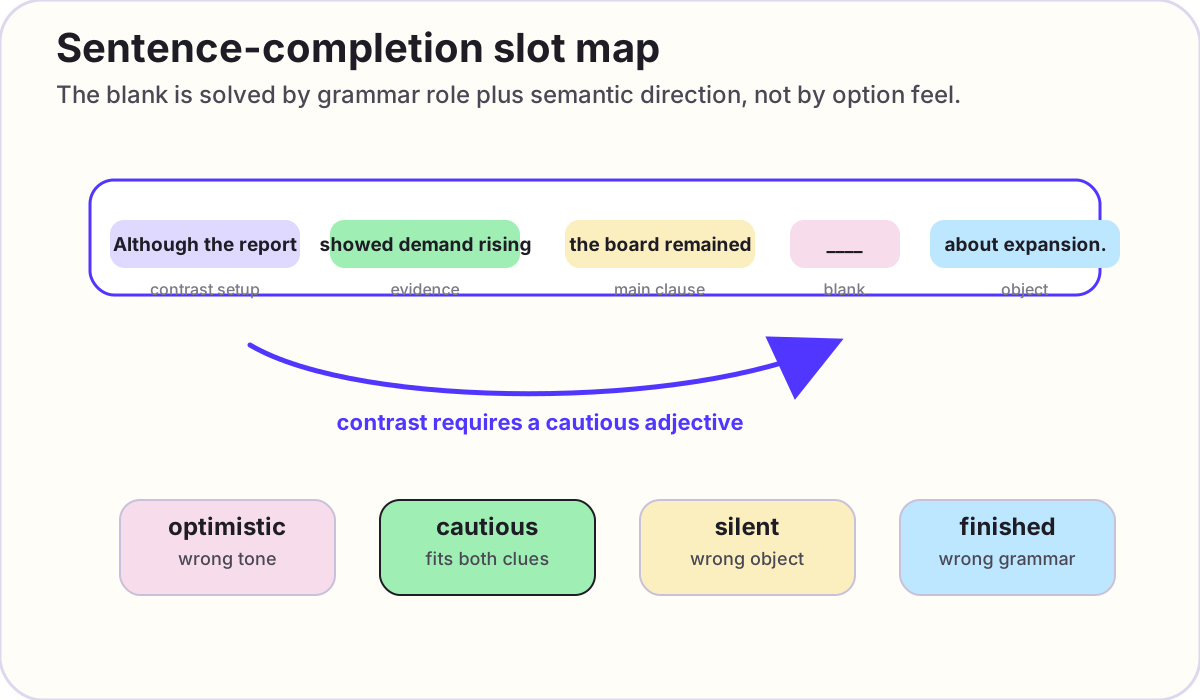
Before looking at options, identify whether the blank needs a noun, verb, adjective, adverb, or clause connector. A grammatically impossible option should die before you debate tone. CAT-style VARC rewards this sequence because the section already includes sentence arrangement and paragraph-completion skills in the verbal ability bucket. This links to the section and question-type structure reported by CAT-pattern sources [3][4][5].
Read the connector on the left
Words such as although, however, therefore, and because tell you whether the blank must preserve contrast, cause, concession, or continuation. Mark the connector before the option set. This avoids the common error of selecting a word that sounds natural in isolation but breaks the sentence direction. Check the rule against previous CAT papers instead of isolated drills [2].
Run a collocation check
A word can be grammatical and still not pair with the object. For example, a board can remain cautious about expansion, but it cannot remain finished about expansion. Collocation is not memorised word lists; it is local phrase behaviour. The official CAT interface and timed-section design make this a practical constraint, not a stylistic preference 1[3].
Use elimination, not preference
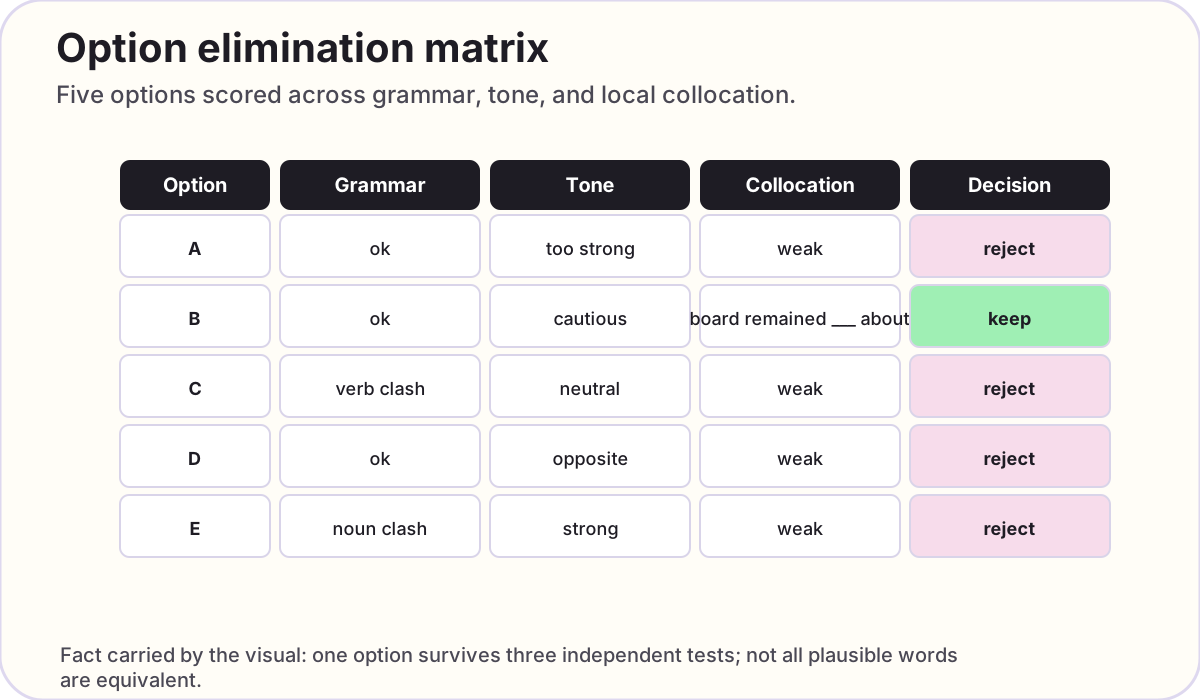
Score every option on grammar, tone, and collocation. Keep the one that passes all three. If two survive, reread the clause after the blank; the right option usually preserves the sentence's scope. The review step is also consistent with evidence that testing and retrieval improve durable learning [6][7].
Build a 20-question drill
Use actual VARC and paragraph-completion questions from previous papers for mixed practice. After each set, log why the wrong options failed. Retrieval and spaced review work better than rereading a word list because they force the slot rule back from memory. Spaced review prevents one-session performance from being mistaken for stable skill [8].
FAQs
Is sentence completion important for CAT VARC?
It is not as large as RC, but it overlaps with para-completion, summary, and odd-sentence skills.
Should I study word lists for sentence completion?
No. Context, grammar role, and local phrase behaviour matter more than memorising isolated meanings.
What is the fastest elimination test?
Reject options that do not match the grammatical role of the blank.
How many sentence-completion drills should I do?
Start with 20 mixed questions, then review every option that failed the grammar, tone, or collocation test.
Can one option be grammatically correct and still wrong?
Yes. It can fail tone, connector direction, or collocation.
Conclusion
Use the first diagram as your next drill plan, then review the result within 24 hours and repeat the same rule for 3 timed sets.
Related reading
References
- IIMCAT, "CAT 2025 official portal." Available: https://iimcat.ac.in/ [2] 2IIM, "CAT previous year question papers, 2017-2025." Available: https://online.2iim.com/CAT-question-paper/ [3] IMS India, "CAT exam pattern 2026: sections, question types, and marks." Available: https://www.imsindia.com/blog/cat/cat-exam-pattern/ [4] MBAUniverse, "CAT exam pattern: sections, questions, duration, and marking scheme." Available: https://www.mbauniverse.com/cat/pattern [5] IMS India, "CAT syllabus 2026: section-wise topics and weightage." Available: https://www.imsindia.com/blog/cat/cat-syllabus/ [6] J. Dunlosky, K. A. Rawson, E. J. Marsh, M. J. Nathan, and D. T. Willingham, "Improving students' learning with effective learning techniques," Psychological Science in the Public Interest, 2013. Available: https://doi.org/10.1177/1529100612453266 [7] H. L. Roediger and J. D. Karpicke, "Test-enhanced learning: taking memory tests improves long-term retention," Psychological Science, 2006. Available: https://doi.org/10.1111/j.1467-9280.2006.01693.x [8] S. Reddy, I. Labutov, S. Banerjee, and T. Joachims, "Unbounded human learning: optimal scheduling for spaced repetition," arXiv, 2016. Available: https://arxiv.org/abs/1602.07032 ↩