Topic Guide
When to start CAT mocks: the readiness rule, not the calendar rule
The right date to start mocks depends on readiness indicators, not the number of months left. The current CAT pattern is built around three timed sections, and recent public analyses report 68 questions across VARC, DILR, and QA with 40 minutes per section 1[3][4]. Previous-paper databases are the best practice base because they preserve real section phrasing, slot variation, and TITA/MCQ mix [2]. The plan below uses that exam structure plus learning-science evidence on retrieval and spaced review [6][7][8].
Check section familiarity first
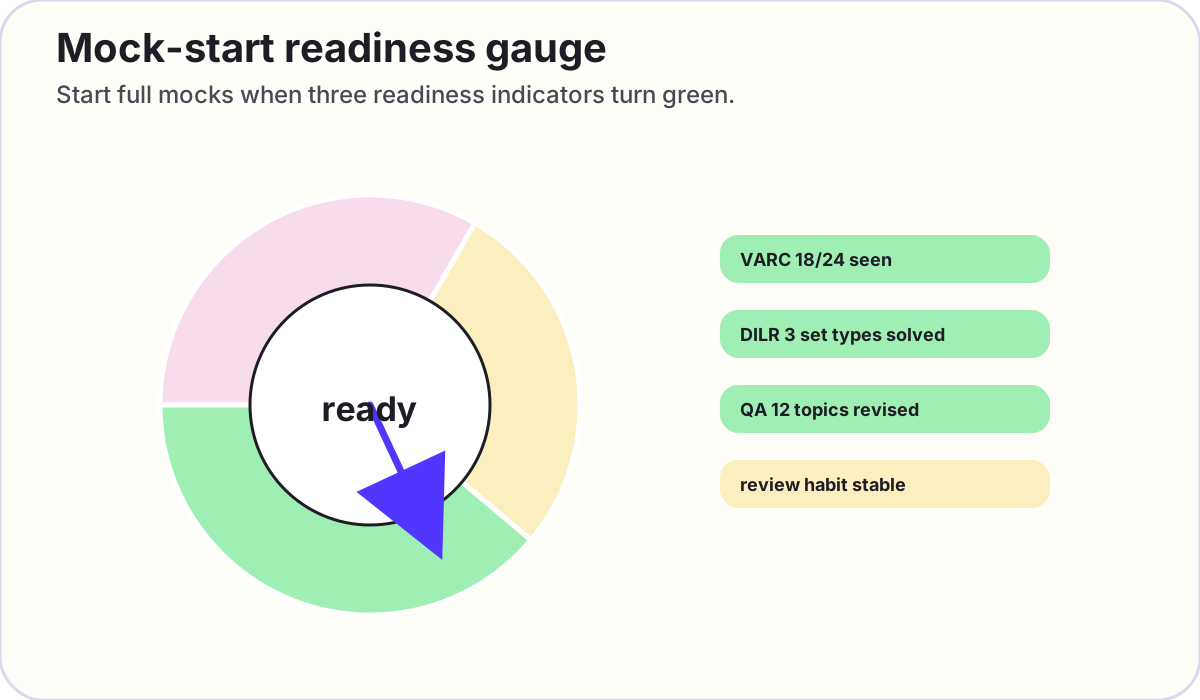
A full mock is useful when you can recognise the section structure: VARC passages and VA, DILR set types, and QA topic families. Without this, the score is noise. This links to the section and question-type structure reported by CAT-pattern sources [3][4][5].
Start sectional tests earlier
Sectional tests train time pressure without the fatigue of a 2-hour paper. Use them before full mocks if your basics are uneven. Check the rule against previous CAT papers instead of isolated drills [2].
Begin full mocks with a review promise
Do not take a full mock unless you have 90-180 minutes to review it. The learning-science evidence for retrieval and testing depends on feedback and repair, not only exposure. The official CAT interface and timed-section design make this a practical constraint, not a stylistic preference 1[3].
Ramp, do not spike
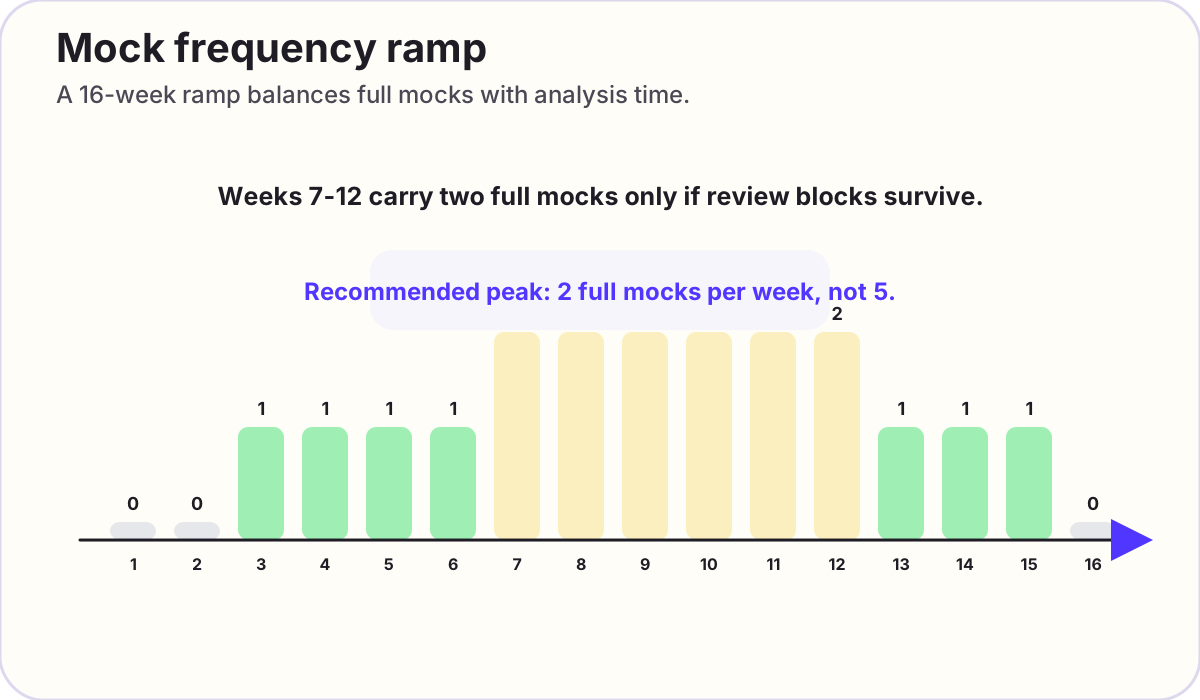
A common ramp is 1 full mock per week, then 2 during peak weeks, then taper. Five mocks a week can crowd out analysis. The review step is also consistent with evidence that testing and retrieval improve durable learning [6][7].
Use stop rules
If three mocks show the same error category, stop adding mocks and repair the pattern. More testing without review repeats the leak. Spaced review prevents one-session performance from being mistaken for stable skill [8].
FAQs
When should I start full CAT mocks?
Start when you know the section structure and can review the paper properly after attempting it.
Should beginners take mocks?
Beginners can take a diagnostic, but regular full mocks should wait until basic familiarity exists.
How many mocks per week are enough?
One per week is enough early; two per week can work during peak preparation if review time remains.
What is the best way to review a mock?
Review wrong, skipped, and correct-but-uncertain questions in separate blocks.
When should I stop taking more mocks?
Pause when the same error repeats across three mocks and repair it before adding another test.
Conclusion
Use the first diagram as your next drill plan, then review the result within 24 hours and repeat the same rule for 3 timed sets.
Related reading
- cat mock test playbook
- how many cat mocks
- sectional vs full length mocks
- cat mock analysis
- mock review template cat
References
- IIMCAT, "CAT 2025 official portal." Available: https://iimcat.ac.in/ [2] 2IIM, "CAT previous year question papers, 2017-2025." Available: https://online.2iim.com/CAT-question-paper/ [3] IMS India, "CAT exam pattern 2026: sections, question types, and marks." Available: https://www.imsindia.com/blog/cat/cat-exam-pattern/ [4] MBAUniverse, "CAT exam pattern: sections, questions, duration, and marking scheme." Available: https://www.mbauniverse.com/cat/pattern [5] IMS India, "CAT syllabus 2026: section-wise topics and weightage." Available: https://www.imsindia.com/blog/cat/cat-syllabus/ [6] J. Dunlosky, K. A. Rawson, E. J. Marsh, M. J. Nathan, and D. T. Willingham, "Improving students' learning with effective learning techniques," Psychological Science in the Public Interest, 2013. Available: https://doi.org/10.1177/1529100612453266 [7] H. L. Roediger and J. D. Karpicke, "Test-enhanced learning: taking memory tests improves long-term retention," Psychological Science, 2006. Available: https://doi.org/10.1111/j.1467-9280.2006.01693.x [8] S. Reddy, I. Labutov, S. Banerjee, and T. Joachims, "Unbounded human learning: optimal scheduling for spaced repetition," arXiv, 2016. Available: https://arxiv.org/abs/1602.07032 ↩